Plan an independent visit to Adachi Museum of Art in Shimane with the main sights, food ideas, access checks, and seasonal notes.
Operational details such as opening hours, admission fees, and train times can change. Prefer official pages and reconfirm before you travel (sources checked on 31 October 2026).
Why visit
- Adachi Museum of Art is a private museum in Yasugi City, Shimane Prefecture, that opened in November 1970 around the collection of Adachi Zenko, an entrepreneur from the city who spent decades buying modern Japanese paintings. The museum now holds around 2,000 works across modern and contemporary Japanese painting, ceramics, lacquerware, wood carvings and pictures for children. The founder’s idea was to show paintings and a garden as one experience, and the building is arranged so that the garden is always seen through a frame rather than walked through.
- The garden is the reason most people come. It covers about 165,000 square meters including the background hills, and the museum states that Sukiya Living Magazine: The Journal of Japanese Gardens has ranked it first in Japan every year since 2003, which the museum counts as 23 consecutive years. The same garden is listed as a three-star site in the Michelin Green Guide Japan. Because the garden is viewed from inside the building, a rainy or overcast day changes the surface of the gravel and the pond rather than ruining the visit.
- The Yokoyama Taikan collection is the strongest single reason for anyone interested in Japanese painting. The museum holds about 120 works spanning his early to late career and describes the group as foremost in both quality and quantity. Famous pieces in the collection include Innocence from 1897 and Autumn Leaves from 1931, and the museum also holds Uemura Shoen’s Daughter Miyuki from 1914 and Woman Waiting for the Moon to Rise from 1944. Works are rotated by season, so the specific painting on the wall depends on when you arrive.
- The museum fits a San’in itinerary without much effort. It sits between Matsue and Yonago, the nearest station is JR Yasugi, and a free shuttle covers the last 20 minutes from the station. The museum suggests at least two hours for the gardens and the galleries together, which makes it a half-day stop that can be paired with Matsue Castle or the Izumo coast on the same trip. It is also open every day of the year, including the New Year holidays, so a fixed arrival date does not need to be planned around a closing day.
- There is a specific pleasure in how the building controls what you see. The museum calls one window a Living Framed Painting and a cut-out wall a Living Hanging Scroll, and the effect is that the garden arrives as a composition rather than as a view. The Kikaku Waterfall in the background was built in 1978 from the design of a Taikan painting held by the museum, so the landscape outside is partly a quotation of a painting inside. Few museums tie the two together this tightly.
Top places and highlights
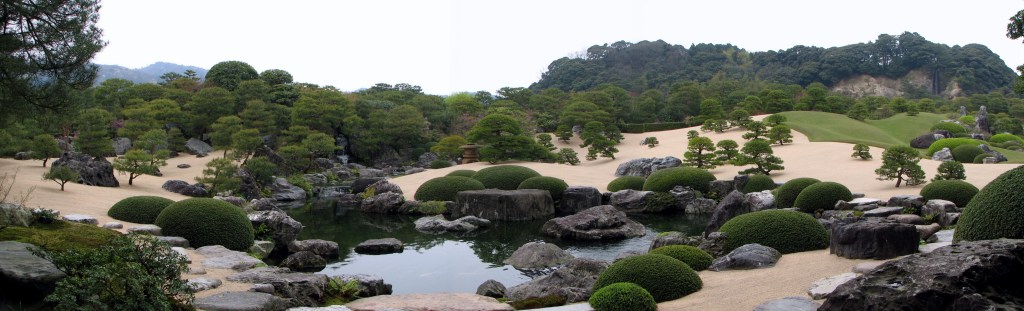
White Gravel and Pine Garden
This is the main garden of the museum and the one most photographs are taken of. The museum says the composition is based on a motif from Yokoyama Taikan’s painting Beautiful Pine Beach, with large and small pines set out on hills of white gravel. The design keeps a deliberate balance with the mountains behind the museum, and the gravel holds the light so that the surface reads differently in the morning, after rain and near closing. Because you view it through a window rather than standing in it, the frame crops the hillside into a single image. Photographs of the garden are permitted here, which is not true of the artworks inside.
Dry Landscape Garden
The Dry Landscape Garden is built in the traditional method where stone and gravel carry the meaning that water would carry in a pond garden. The museum explains that the three upright rocks arranged in the centre stand for steep mountains, and that the water falls from them into the white gravel in front. The intent, as the museum describes it, is a deep sense of nature rather than a literal model of a place. Read it slowly: the gravel is raked to suggest current, and the planting at the edges softens the line where the garden meets the building. It is the most abstract of the four garden areas and rewards a second look from a different window.
Moss Garden
The Moss Garden is the quietest of the four areas and the one most people pass too quickly. Haircap and other mosses are allowed to curve over the ground, which the museum describes as an expression of simple aesthetics. The gardener’s reasoning, as the museum explains it, follows how trees grow on mountain slopes, so the planting leans and settles rather than standing upright. The effect is a green surface with depth rather than a lawn, and it reads best in damp weather, when the moss darkens and the texture becomes visible. Give it a few minutes without moving, since the detail is small and the frame is wide.
Pond Garden
The Pond Garden is the area with water. A waterfall sits at the back of the garden and the stream runs down into the large pond in front, so the composition has a direction and a sound. The museum notes that black pines are arranged on the right side of the pond and red pines on the left, and that the surface reflects light and shadow through the day. At the front stands the tea house Seifu, intended for sen-cha, green tea made from specially prepared leaves. Carp live in the pond and the museum says they swim through the year and remain active even in winter, which makes this the garden area that still moves in the cold season.
Kikaku Waterfall
The waterfall in the background of the garden is not a natural feature. The museum states that the Kikaku Waterfall was created artificially on Mt. Kikaku in 1978, and that the design was based on Yokoyama Taikan’s painting Waterfall in Nachi, which is held by the museum. The falls drop 15 metres onto bare rock, and the museum calls the decision to build Taikan’s painted world into the actual garden a distinctive part of the site. It is the clearest example of how the museum treats the landscape as a work in the collection. Look for it from the upper windows, where it sits behind the pond and the pine groups.
Living Framed Painting and Living Hanging Scroll
Two of the museum’s viewing devices are worth knowing before you arrive. The Living Framed Painting treats a window frame as a picture frame, so the garden becomes a fixed composition that changes only with light and season. The Living Hanging Scroll is a wall with a scroll-shaped opening cut through it, so the garden beyond reads as a sansui-ga landscape painting hung on the wall. The museum points out that this hanging scroll never needs to be replaced, because nature supplies the seasonal change. Both are easy to walk past. Stop at each and let your eyes adjust to the lower light inside the room.
Painting galleries, the Annex and Rosanjin Hall
The collection runs to about 2,000 works and is shown across the main building, the annex and Rosanjin Hall. The main building carries the modern Japanese paintings and the core Taikan group; the annex focuses on contemporary Japanese painting; Rosanjin Hall holds ceramics by Kitaoji Rosanjin. There are also pictures for children, lacquerware and wood carvings. The museum rotates works with the seasons for conservation, and the annex closes periodically, in part or fully, while exhibits are changed. When the annex is shut, the gardens, the main building and Rosanjin Hall stay open, so a closure costs you one section rather than the visit.
Food and drink
- Cafe Taikan is the full-service option inside the museum. The museum describes it as offering light meals including curry made with Shimane Beef and rice wrapped in bamboo leaves, plus beverages and desserts. It is the place to sit down rather than stand at a counter, and on a wet day it fills quickly around midday. The museum states that reservations are not possible, so the practical approach is to eat either before the galleries or after the first garden circuit rather than at the peak of the lunch hour.
- Cafe Midori is the lighter stop, serving beverages and desserts. It works as a break between the main building and the annex rather than as a full meal, and it suits anyone who wants to keep the visit moving. Because both cafes sit inside the museum, the timing of your ticket matters: once you leave, you would need to plan the day around a second entry, which the museum does not describe as a re-entry arrangement on its visitor pages. Build the meal into the visit instead of treating it as a separate stop.
- The tea house Juraku-an serves matcha green tea and is the quietest of the three. The tea house Seifu in the Pond Garden is described by the museum as intended for sen-cha, and Juraku-an is the indoor tea room listed under the museum’s facilities. Neither takes reservations. For anyone who wants the garden with a bowl of tea rather than a full lunch, this is the option that matches the setting, and it takes less time than the cafe, which leaves more of the two-hour visit for the galleries.
- The museum has shops in both the main building and the annex, selling original museum goods, and the museum notes that you can enter a shop without entering the museum itself. That makes gift shopping possible on a tight schedule or after the galleries close their section. For a fuller meal, the sensible plan is to eat around JR Yasugi or in Matsue or Yonago before or after the visit rather than relying on the museum for a large lunch, since the museum describes its own food as light meals, beverages and desserts.
Getting there and around
- The nearest station is JR Yasugi, and the museum runs a free shuttle bus from the station to the museum in about 20 minutes. JR Yasugi is next to JR Yonago, so a base in Yonago connects easily. The shuttle is the default way in for anyone travelling by train, and the museum’s access page lists it as the route from JR users. Because the bus is free and timed to the museum, the constraint on your day is the shuttle timetable rather than the fare, so check the current departure times on the official shuttle page before fixing your train.
- By car, the museum is about 10 minutes from the Yasugi Interchange on the San-in Expressway. The museum’s directions are specific: turn left at the fifth set of traffic lights from the interchange and continue straight for about six kilometres. Parking is free, with space for 400 cars and 30 buses, and there are eight accessible parking spaces for guests with disabilities. Driving gives you the flexibility that the shuttle does not, and it makes the museum easy to combine with Matsue or the Izumo coast on the same day.
- Both Yonago Airport and Izumo Airport are nearby, and the museum states that public transport serves the route from Yonago Airport. For anyone flying into the San’in region, that makes the museum reachable without a car, though the connection involves the airport bus and then the shuttle from JR Yasugi rather than a single through service. Reconfirm the current airport bus times and the shuttle times together, because the two timetables have to fit and the museum does not operate the airport service.
- Intercity expressway buses stop at terminals at JR Yonago Station and JR Matsue Station. From either, the museum’s instruction is to take the train to JR Yasugi and board the free shuttle there, since JR Yasugi is next to JR Yonago. That routing matters if you are arriving from Osaka or Hiroshima by highway bus rather than by rail. Allow time between the bus arrival and the shuttle departure, and treat the shuttle as the fixed point that the rest of the journey has to fit around.
- On baggage, the shuttle has no trunk, and the museum warns that large suitcases may be refused boarding at the driver’s discretion when the bus is crowded; passengers are also asked not to put bags on seats. Coin lockers and a paid baggage storage service are available inside JR Yasugi Station. Inside the museum there are free coin-operated lockers beside the front desk in the main entrance, and staff will store larger items. If you are moving between cities on the same day, leave the luggage at the station rather than on the bus.
Where to stay
- Yonago is the practical base. JR Yonago is next to JR Yasugi, which is where the free shuttle starts, so a hotel near Yonago Station turns the museum into a straightforward half-day without a car. It also puts Yonago Airport within reach for an early departure. The trade-off is that Yonago is a working city rather than a resort, so the appeal is transport convenience and evening restaurants rather than scenery. Book the room separately from the museum ticket; the museum sells admission at the door, not through hotels.
- Matsue is the other sensible base and the better one if you want sightseeing around the museum. Matsue has its own castle and the lake shore, and the museum is a short run east from the city, reachable by train to JR Yasugi and then the shuttle. Intercity buses also terminate at JR Matsue Station. Staying in Matsue means the museum becomes one stop in a fuller day rather than the whole reason for the trip, which suits anyone who wants more than a museum and a garden.
- Staying close to the museum itself is possible but not necessary. The museum is in Yasugi City rather than in a resort area, and the site is designed as a two-hour visit rather than a stay. Guests with pets should note that the museum does not admit pets, though it points to a pet hotel a few kilometres away and states that it is not responsible for problems arising at offsite facilities. For most travellers the useful decision is Yonago for transport or Matsue for sightseeing, not a room beside the gate.
Best time to visit
- The museum is built for all four seasons and says so directly. Each of the four garden areas is described by the museum as having unique features in each season, which is why it recommends the gardens year-round rather than in a single month. The practical consequence is that there is no wrong season for the garden, only a different garden. What changes most is the light: the gravel and the pond surface shift with the angle of the sun, and the framed views are the part of the visit most sensitive to the hour you arrive.
- Exhibitions rotate with the seasons for conservation, and the museum publishes a current exhibition schedule by season for the main building and the annex. The main building runs spring, summer, autumn and winter exhibitions, and the annex runs shorter selections that change several times a year. Because a specific painting may be off view, anyone travelling for one work should check the current exhibition page before booking rather than assuming the best-known pieces are always hanging.
- The annex closes periodically, in part or in full, when exhibits are changed. The museum states that during an annex closure the gardens, the main building and Rosanjin Hall remain accessible. That is the main seasonal risk, and it is a small one if you are going for the garden. Check the exhibitions page for the dates of your trip and, if the annex is the reason for the visit, plan around a period when it is listed as open.
- Autumn and winter each have a distinct look on the museum’s own garden pages. The garden photographs show leaves turning red on the mountain behind the garden after rain, and the Pond Garden photographed after a snowfall with the water still open. The museum notes that carp swim throughout the year and seem comfortable even in winter. Cold weather is therefore not a reason to skip the garden, though the museum closes at 17:00 from October to March instead of 17:30, which shortens the afternoon light.
Practical tips
- Allow at least two hours. The museum recommends that much to appreciate the Japanese gardens and the Japanese paintings together, and it notes that there is no set final admission time for the main building but that the museum closes promptly. A two-hour visit covers the garden windows, the main building and Rosanjin Hall comfortably. Adding the annex, the cafes and the shops pushes it past three hours, so decide before you arrive whether the galleries or the garden is the priority.
- Photography rules are split, and the difference matters. The museum permits photography of the gardens but strictly prohibits photography of the artworks, without exception. Drones are not allowed anywhere on the museum grounds, including remote operation in outside areas and simply carrying one into the building. Tripods are discouraged, though the museum reserves the right to grant permission case by case. Hand-held garden photographs are fine; plan no shoot inside the galleries and no aerial footage at all.
- The gardens are viewed from the building only, and guests are not permitted to enter them. That is not a restriction to work around but the design of the place: the windows and the scroll-shaped openings are the viewing positions, and stepping into the garden would break the composition. Plan the visit as a sequence of windows rather than a walk. This is also why wet weather does not spoil the day, since the whole circuit is indoors and the garden is seen through glass.
- Hours and admission are simple enough to plan around. The museum opens at 9:00 and is open every day of the year, closing at 17:30 from April to September and at 17:00 from October to March. Admission is 2,500 yen for adults, 2,000 yen for university students, 1,000 yen for high school students and 500 yen for elementary and junior high school students, with discounts for groups of 20 or more. Cards including Visa, MasterCard, American Express and Diners are accepted. Reconfirm the current figures on the official page before you travel.
- Use the audio guide and the gallery talks. The museum offers audio devices in Japanese and English, and runs gallery talks on weekends and national holidays. It does not provide personal guided tours, so those two are the available interpretation. Brochures are published in English, French, Simplified Chinese, Traditional Chinese and Korean. For a collection built around one painter, the audio guide is the difference between seeing Taikan’s works and understanding why the garden outside quotes them.
- Accessibility is good but not complete. The main building is fully accessible for wheelchairs and strollers, while the Attached Exhibition Room has only limited accessibility. There are elevators and multi-purpose restrooms with baby-changing tables in both the main building and the annex. Wheelchairs and strollers are available on a first-come, first-served basis and are limited in number, so ask staff on arrival. Free coin lockers sit beside the front desk in the main entrance, and staff will store larger items.
- Service dogs are admitted, but pets are not permitted anywhere at the museum. The museum points to a pet hotel a few kilometres away and states that it is not responsible for problems related to offsite facilities. For a museum whose main attraction is a garden viewed through glass, the pet rule is the one logistical constraint that cannot be solved on site. If you are travelling with an animal, plan the visit around a place to leave it rather than expecting to bring it onto the grounds.
Suggested day-trip outline
- Take the train to JR Yasugi from Yonago or Matsue and board the museum’s free shuttle, which takes about 20 minutes. Check the shuttle timetable first and work backwards, because the bus rather than the train sets your arrival time. If you are driving, the museum is about 10 minutes from the Yasugi Interchange and parking is free.
- Begin with the garden windows before the galleries. The White Gravel and Pine Garden, the Dry Landscape Garden, the Moss Garden and the Pond Garden are all viewed from inside, and the Living Framed Painting and Living Hanging Scroll openings are easy to walk past. Starting here means you see the garden while the rooms are still quiet, and it gives you the context for the Taikan paintings that follow.
- Move into the main building for the modern Japanese paintings and the Taikan group, then Rosanjin Hall for the ceramics. Check the current exhibition list before you go if there is a specific work you want to see, since the collection is rotated by season. If the annex is open, it adds the contemporary Japanese painting section; if it is closed, the rest of the museum still works as a visit.
- Eat at Cafe Taikan for the Shimane beef curry or the rice wrapped in bamboo leaves, or take tea at Juraku-an if you want something lighter and quieter. Neither takes reservations, so go before or after the lunch peak. Finish with the shops in the main building and the annex, which can be entered without the museum if you are short of time.
- Take the shuttle back to JR Yasugi and continue to Matsue for the castle and the lake shore, or west towards Izumo. The museum asks for two hours and delivers a compact, complete stop, so it slots into a San’in day rather than consuming it. Reconfirm the return shuttle time on arrival so the last bus is not the thing you discover at closing time.
Before you go
Timetables, fares, admission fees, and seasonal access rules can change. Check the official tourism and transport sites linked below for the latest information before you travel.
Explore More of Japan
Published guides that pair with this one:
- Izumo Taisha Travel Guide: The Grand Shrine and the Shimane Coast
- Matsue Castle Travel Guide: A National Treasure Keep under Repair
- Tottori Sand Dunes Travel Guide: Coastal Walks in Western Honshu
- Miyajima Travel Guide: Itsukushima Shrine, the Floating Torii, and a Hiroshima Day Trip
Browse every Chugoku guide on this site for the rest of the region.
Sources
- adachi-museum.or.jp — FAQ (checked 2026-10-31)
- adachi-museum.or.jp — Gardens (checked 2026-10-31)
- adachi-museum.or.jp — Access (checked 2026-10-31)
- adachi-museum.or.jp — Floor guide (checked 2026-10-31)
- adachi-museum.or.jp — Shuttle bus (checked 2026-10-31)


Leave a Reply