Plan an independent visit to Aomori Museum of Art in Aomori with the main sights, food ideas, access checks, and seasonal notes.
Operational details such as opening hours, admission fees, and train times can change. Prefer official pages and reconfirm before you travel (sources checked on 31 October 2026).
Why visit
- Aomori Museum of Art opened in 2006 as the prefecture’s main art museum, in a building designed by architect Jun Aoki. The design is not a neutral box: the museum stands beside the Sannai-Maruyama archaeological site, and the architect took the excavated trenches of that Jomon site as the model for the interior. The result is a building where white rooms appear to have been lowered into dug-out ground, and where three of the lower exhibition rooms are finished in bare earth rather than white walls. That makes the architecture itself a reason to visit, not just the collection.
- The Munakata Shiko collection is the core of the museum and the reason it exists in Aomori. Munakata was born in Aomori, and the museum holds a dedicated room for him, the only exhibition space in the building named after an artist. The room has a floor-to-ceiling glass wall on one side, and the museum explains that the design came from a wish not to obstruct the viewing of the works inside. For anyone who knows Munakata’s prints only from reproductions, seeing them in a space built specifically for them is the argument for coming here.
- Yoshitomo Nara’s two permanent works make the museum a destination for a much wider audience. Nara was commissioned to make two pieces integrated into the building rather than placed in it: the Hakkakudo, installed on a floating island on the south side, and the Aomori-ken, an 8.5-metre dog sculpture standing in an outdoor trench. In winter the snow collects on the dog’s head and the museum notes that it looks like a hat, which changes the sculpture’s character completely. In 2008 the museum opened an outdoor passageway so that visitors could approach the dog closely, after visitors asked for it and the artist wanted to meet the request.
- The Aleko Hall is unlike any other exhibition space in Japan that I know of on paper, and the museum’s own description makes the case. It is a four-storey void measuring 21 metres by 21 metres and 19.5 metres tall, with a floor of hard-packed earth, built to hold the backdrops painted for the ballet Aleko. Those backdrops are 15 metres wide and 9 metres tall. The scale is the point: this is an object you cannot see properly in a normal gallery, and the building was shaped around it. Even visitors who skip contemporary art tend to remember this room.
- Aomori is a long way from Tokyo, and the museum is worth planning as a half-day rather than a spare hour. The building also holds a community gallery, two workshops, a roughly 200-seat theatre, a library, a shop and a cafe, and several of these can be entered without buying museum admission. That means the site works as a place to spend a wet or snowy afternoon even if you only want the cafe, the shop and the dog sculpture. It also sits on a bus route that continues to the Sannai-Maruyama site, so the archaeological site and the museum can be paired without a car.
Top places and highlights
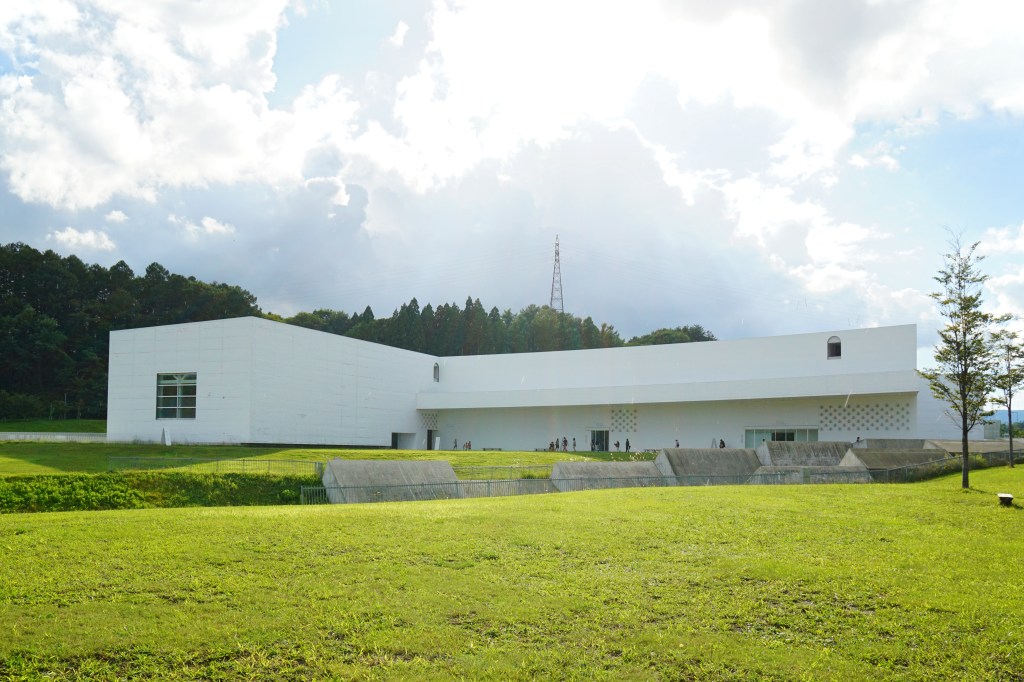
The Aleko Hall
This is the room the building was built around. The museum describes it as a four-storey space 21 metres long, 21 metres wide and 19.5 metres tall, with a floor of hard-packed dirt rather than a finished surface. What fills it are the backdrops painted for the ballet Aleko, 15 metres wide and 9 metres tall, displayed as the collection objects they are. The bare earth floor and the raw scale mean the room reads as an excavation or a stage rather than a gallery. Come here first if you want the building’s logic to make sense before you look at the paintings.
The Munakata Shiko Room
The museum states that this is the only exhibition space in the building named after an artist, which tells you how central Munakata is to the collection. One wall is a single huge pane of glass running from floor to ceiling. The museum explains that the space came from a desire to ensure nothing obstructs the appreciation of the works within, so the room is deliberately stripped back rather than decorated. Munakata was born in Aomori, and the works here are shown as a body of work rather than as highlights. If you see one section of this museum properly, make it this one.
Aomori-ken, the 8.5-metre dog
Yoshitomo Nara’s Aomori-ken stands in an outdoor trench extending away from the permanent exhibition space, and the museum gives its height as 8.5 metres. When the museum opened in 2006 the sculpture could only be seen through a window from inside an exhibition room; visitors asked to see it up close and the artist wanted to meet that wish, so a passageway opened in 2008. The passageway has two staircases and the walk takes 10 to 15 minutes in total, and it is closed in winter once snow begins to accumulate. In snow, the accumulation on the dog’s head reads as a hat, which the museum points out as a deliberate seasonal effect.
Hakkakudo and the floating island
The Hakkakudo is the second of the two works Yoshitomo Nara made for the building rather than for a gallery. It sits on what the museum calls a floating island on the south side, and the cafe at the tip of the east wing is positioned so that you can look at it while you eat. Because it is outside the ticketed area, you can see it without buying admission. The pairing with the Aomori-ken dog is worth noting: one work faces outward into the park and the other is reached through a passageway, so the two together describe how the museum treats sculpture as part of the building rather than as an object on a plinth.
The white cubes and the earth rooms
The lower floors are where the Sannai-Maruyama idea becomes visible. Seven exhibition rooms, labelled A to G, sit on the second basement floor: the museum says four of them are white cubes and three are constructed with bare dirt. A further ten rooms, H to Q, are on the first basement floor. The museum describes the white interiors as spaces that appear to have descended from above, with walls, floors and ceilings all white and filled with light, creating a sense of floating. Room O is a brick space created by using glass to partition off a portion of the outer wall, one of the details that makes the building worth walking slowly.
The steel-plate passageway and the library
A passageway links the east and west sides of the building and also gives access to the library and the community hall. Its walls and ceiling are 4.5-millimetre steel plates painted white, and the museum describes the effect as a tunnel of soft, reflected light. It is the kind of transitional space most museums leave plain, and here it is one of the more memorable stretches of the building. The library holds materials on the artists in the collection as well as Japanese and global art history, journals and DVDs, for on-site use only with no lending, and it closes on days when the museum is closed.
Community Hall, workshops and theatre
The museum is also a working civic building, and several parts of it are free to enter. The community hall is designed so that the interior view is identical from whichever entrance you use, entry is free, and food and drink are allowed inside, which makes it a genuine rest stop rather than a lobby. The community gallery has three rooms for the artistic activity of prefectural residents and its own service entrance, so it can run independently of the museum. Two workshops serve children and professional use respectively, with outdoor trenches plumbed for work involving water, and the theatre seats roughly 200 with a movable back wall that opens onto the Aleko Hall.
Food and drink
- The cafe sits at the tip of the east wing, jutting out into the park, and it has its own entrance so you can walk in from outside without going through the museum. The museum describes an original menu built on local Aomori Prefecture ingredients, and the seating looks out at the Hakkakudo on the floating island. Because it is outside the ticketed area, it works as a break before or after the galleries rather than only in the middle of a visit. The cafe closes on days when the museum is closed, so it is not a separate all-weather option.
- The community hall allows food and beverages and costs nothing to enter, which the museum presents as a space to take a break. That matters in Aomori in winter, when the nearest alternative is a bus ride away. If you are travelling with children or with a group that wants to sit down without another purchase, this is the room to use. Check the museum’s opening hours before relying on it, since the whole building shuts on the days listed in the official calendar.
- The museum shop sells merchandise, art books and exhibition catalogues, and the museum notes that catalogues can also be ordered by mail. It is at the tip of the east wing with its own entrance from the park, and the museum states that the shop may be used without buying museum admission. Hours are given as 9:30 to 17:00, and the shop closes on days when the museum is closed. For anyone who wants a record of a specific exhibition, the catalogue is the practical purchase, since the galleries rotate.
- For a full meal rather than a cafe stop, plan around Aomori city rather than the museum. The site is 20 minutes by bus from JR Aomori Station and 10 minutes by car from JR Shin-Aomori, so eating before you arrive or after you return is straightforward. The museum’s own offering is a cafe menu rather than a restaurant, and the community hall is a place to sit with your own food rather than a place to buy it. Building lunch into the city end of the trip rather than the museum end keeps the day simple.
Getting there and around
- By bus, take the service bound for Sannai Maruyama Iseki from JR Aomori Station; the ride is about 20 minutes and the stop for the museum is Kenritsu-bijutsukan-mae. This is the route the museum itself lists, and it continues to the archaeological site, so the two destinations sit on the same line. Because the bus is a city service rather than a museum shuttle, the timetable is the constraint: check the current departures before fixing your day, and allow for the return trip when you decide how long to stay.
- By car, the museum is about 10 minutes from JR Shin-Aomori Station and about 20 minutes from JR Aomori Station. Shin-Aomori is the Shinkansen station, which makes the museum the easier of the two railheads to use if you are arriving on the bullet train. Note that the parking lot gate is closed nightly, so a car left in the lot after hours is not an option. For a winter visit, the drive is short but the road conditions are the variable, not the distance.
- The museum is wheelchair accessible and wheelchair rentals are available at the information desk on the first floor. Large suitcases and similar baggage can be checked at the same information desk, and coin-operated lockers are provided in the first-floor entrance gallery; the museum notes that the lockers return your coin when the key is returned. Anyone arriving between cities with luggage should use these rather than carrying bags through the galleries, since the exhibition route includes stairs and lifts across several levels.
- The building is organised across several levels, and the main elevator from the first floor down to the second basement is how you reach the Aleko Hall, the temporary exhibition space and the collection exhibition. From that lower level you can also reach the outdoor passageway that leads to the Aomori-ken dog. The passageway has two staircases and takes 10 to 15 minutes to walk in total, and it is closed in winter once snow starts to accumulate, so a winter visit should not plan on it.
- The museum’s own description of getting around is worth reading before you go, because the site is larger than a single gallery. The community gallery, the workshops, the theatre, the library, the shop, the cafe and the community hall are all part of the building, and several can be entered independently. That means you can arrive for the shop or the cafe alone. Allow more time than you would for a comparable museum, since the architecture is spread out and the walk between sections is part of the visit.
Where to stay
- Aomori city is the practical base. The museum is 20 minutes by bus from JR Aomori Station, and the city has the hotels and evening restaurants that the museum area does not. Staying near JR Aomori Station puts the bus stop within walking distance and keeps the day simple. The trade-off is that you travel out to the museum rather than staying beside it, which is normal for a civic museum on the edge of town. Book the room and the museum separately.
- Shin-Aomori is the alternative if you are arriving or leaving by Shinkansen. The museum is about 10 minutes by car from Shin-Aomori, which is faster than from the city centre, but Shin-Aomori itself is a transport hub with limited evening options. It suits a one-night stop where the train times matter more than the restaurants. If you are continuing to Hirosaki or Hakodate the next morning, this is the base that costs you least time.
- For a slower trip, treat the museum as part of an Aomori stay rather than a day trip from elsewhere. The Sannai-Maruyama archaeological site is on the same bus line, and the city’s own sights fill the rest of a day. Staying two nights in Aomori lets you take the museum on a wet day and the site on a dry one without rebooking. The museum’s own calendar determines which days it is open, so check the schedule before you fix the nights.
Best time to visit
- Aomori’s winters are the reason to think about timing. The outdoor passageway to the Aomori-ken dog is closed in winter once snow begins to accumulate, so the close-up view is a three-season option. The snow itself is not a reason to stay away: the museum notes that accumulation on the dog’s head resembles a hat, and the sculpture’s appearance changes with it. If the dog is the reason for your visit, come outside the snow season; if you want the sculpture in snow, accept that you will see it from a distance.
- Opening hours are fixed at 9:30 to 17:00 with final admission 30 minutes before closing, and the museum directs visitors to its schedule and calendar for closed days rather than stating a fixed weekday closure. That means the closing days move, so check the calendar for your dates rather than assuming a Monday closure. In a region where winter travel can be disrupted, confirming the day is open before you set out is worth the two minutes.
- Admission is priced per exhibition, and the museum states that prices for temporary exhibitions vary. The standing figures are 700 yen for adults and 400 yen for college students, with reduced rates of 560 and 320 yen for groups of 20 or more, and high school students and younger need a free ticket collected at the counter before entering. Because the temporary exhibition price changes, the total for a visit depends on what is on. Check the exhibition list for your dates and budget accordingly.
- The building is designed for weather that keeps people indoors, which is the honest argument for a winter visit. The white cubes are filled with light, the steel-plate passageway is enclosed, and the cafe looks onto the Hakkakudo through glass. The museum’s own presentation of the spaces emphasises light and enclosure rather than outdoor views. On a day when the outdoor sites are unappealing, this is a full afternoon that does not depend on the weather beyond the drive or bus ride to the door.
Practical tips
- Budget more time than the collection alone suggests. The building holds two lower-floor gallery levels, the Aleko Hall, the Munakata room, the community gallery, two workshops, a theatre, a library, a shop and a cafe, and the architecture is spread across the site. A focused visit to the collection and the Aleko Hall is roughly two hours; adding the passageway to the dog, the shop and the cafe takes it past three. Check the passageway season first, since it is closed in winter.
- High school students and younger need a free ticket, and the museum is explicit that it must be collected at the ticket counter before entering. This is easy to miss because the admission is free. Adults pay 700 yen and college students 400 yen for the standing admission, with group rates for 20 or more, and temporary exhibition prices are separate and vary. Reconfirm the current prices on the official page before you travel, since the exhibition programme changes what you pay.
- Hours are 9:30 to 17:00 with last admission 30 minutes before closing, and the parking lot gate is closed nightly. The closing days are published in the museum’s calendar rather than fixed to a weekday, so a Monday assumption is not reliable. If you are driving, plan to be out of the lot before it is locked. If you are taking the bus from JR Aomori Station, confirm the return departure when you arrive so the last bus is not a surprise.
- Several parts of the building can be entered without museum admission, including the shop, the cafe, the community hall and the community gallery. That makes the museum usable on a tight schedule or in bad weather even if you are not there for the art. The shop closes on days when the museum is closed, and the cafe does too. Use the free community hall if you need to sit and eat your own food, since the museum allows food and drink there.
- Use the information desk on the first floor for two things: wheelchairs are available for loan, and large suitcases can be checked there. Coin lockers in the first-floor entrance gallery take a coin and return it when you bring the key back. The museum states that it is not responsible for loss or accidents during use of these facilities, so keep valuables with you. The locker is the better option than carrying a bag through several levels of galleries.
- The children’s playroom is a real option for families and has limited hours: Saturdays, Sundays and public holidays from 10:00 to 12:00 and 13:00 to 15:00. It holds picture books and building blocks from the Swiss maker Naef, with coloured pencils for drawing, and the ceiling lighting is an installation by architect Jun Aoki and artist Hiroshi Sugito. There is no childcare, and a child must be accompanied by an adult at all times. Use the first-floor nursing room for nursing and nappy changes.
- The museum sits beside the Sannai-Maruyama archaeological site, and the building’s design came from that excavation. If you have the time, seeing the site before or after the museum makes the white cubes and the earth-floored rooms legible rather than quirky. The bus from JR Aomori Station continues to the site, so the two can be done without a car. For anyone interested in how a museum explains a place to itself, this pairing is the reason to give Aomori a full day.
Suggested day-trip outline
- Start from JR Aomori Station and take the bus bound for Sannai Maruyama Iseki, getting off at Kenritsu-bijutsukan-mae after about 20 minutes. If you are arriving by Shinkansen, come from Shin-Aomori by car instead, about 10 minutes. Buy the ticket at the counter and collect the free ticket for any high school student or younger in the group before entering.
- Begin on the lower levels with the Aleko Hall. The four-storey space with its earth floor and the ballet backdrops explains why the building is shaped the way it is, and seeing it first makes the white cubes and the bare-earth rooms read as a coherent design rather than a series of odd choices. Continue into the collection exhibition and the Munakata Shiko Room while the galleries are still quiet.
- Work back up through the smaller exhibition rooms and the temporary exhibition if it is on. Ten rooms labelled H to Q sit on one lower floor and seven labelled A to G on the other, four of the A to G rooms being white cubes and three bare earth. The brick space that uses glass to partition part of the outer wall is easy to walk past; look for it rather than assuming every room is the same.
- Leave the ticketed area for the outdoor and free sections. If the season allows, take the steel-plate passageway to see the Aomori-ken dog up close; the walk takes 10 to 15 minutes and involves two staircases. Then eat at the cafe, which looks onto the Hakkakudo on the floating island, or sit in the community hall if you brought food. Finish with the shop at the tip of the east wing.
- Return by bus to JR Aomori Station, or continue one stop further to the Sannai-Maruyama archaeological site to see the excavation that the museum building was modelled on. Doing both on the same day is the version of the trip where the architecture stops being decoration. If you are leaving on the Shinkansen, allow for the drive back to Shin-Aomori and check the museum’s closing-day calendar before you fix the date.
Before you go
Timetables, fares, admission fees, and seasonal access rules can change. Check the official tourism and transport sites linked below for the latest information before you travel.
Explore More of Japan
Published guides that pair with this one:
- Hirosaki Travel Guide: Castle Park, Cherry Blossoms, and the Old Town
- Aomori Nebuta Festival Guide: August Floats and Haneto
- Lake Towada Travel Guide: Oirase Stream, Autumn Colour and the Calm Side of Aomori
- Kakunodate Travel Guide: Samurai Streets and Weeping Cherries
Browse every Tohoku guide on this site for the rest of the region.
Sources
- aomori-museum.jp (checked 2026-10-31)
- aomori-museum.jp (checked 2026-10-31)


Leave a Reply