Plan an independent visit to Osaka Aquarium Kaiyukan in Osaka with the main sights, food ideas, access checks, and seasonal notes.
Operational details such as opening hours, admission fees, and train times can change. Prefer official pages and reconfirm before you travel (sources checked on 02 November 2026).
Why visit
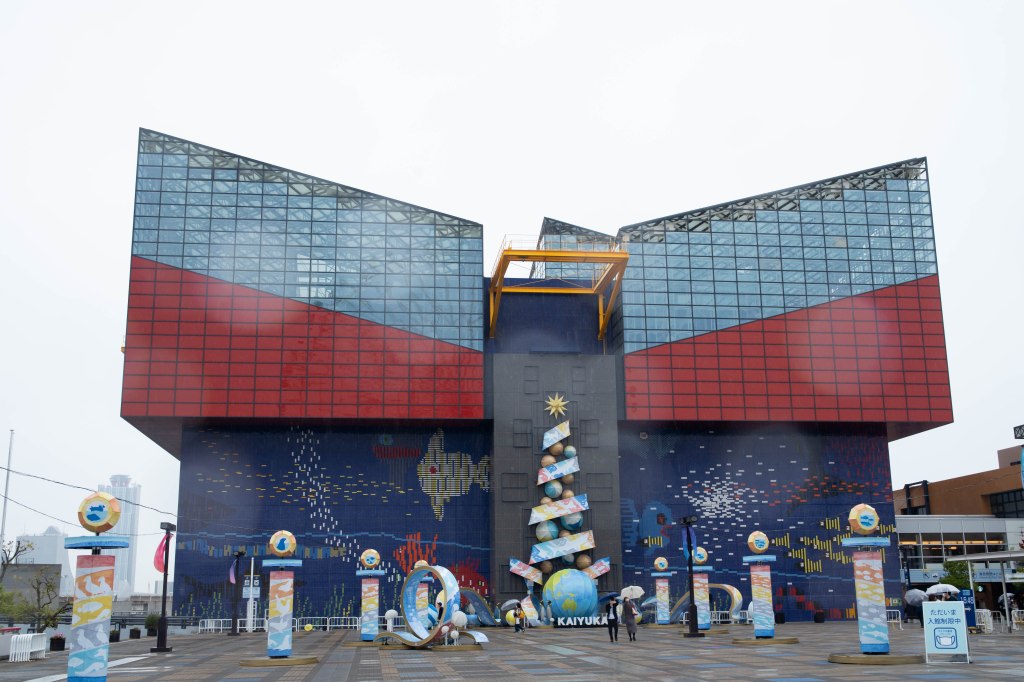
- Kaiyukan is the aquarium on Osaka Bay that most people have seen a photograph of without knowing its name: a dark, cathedral-scale tank with whale sharks drifting past a crowd of silhouettes. It opened in 1990 and was then the largest public aquarium in the world, and it has stayed at the top of the Japanese visitor table ever since, passing 85 million cumulative visitors in 2024. That combination of scale and popularity is the honest starting point. This is not a quiet regional aquarium; it is a major attraction with timed tickets and school groups, and the reason to go anyway is that very few aquariums anywhere let you stand that close to a feeding whale shark.
- The design is what makes it work as a building rather than a hall of tanks. You take an escalator to the eighth floor and then work downward through a spiral of exhibits arranged around the Pacific Ocean tank at the centre, which means the same body of water keeps reappearing at different depths and from different angles as you descend. The staging follows the Ring of Fire, the volcanic rim of the Pacific, so the sequence runs from the Aleutian Islands and Monterey Bay through the Gulf of Panama, Ecuador, Antarctica, the Tasman Sea, the Great Barrier Reef and back into Japanese waters. Twenty-seven tanks across sixteen exhibits hold about 10,941 tons of water. It is a geographical argument, not a random collection.
- The Pacific Ocean tank is the centrepiece and the numbers explain why it reads differently from a normal display. It is 34 metres long and 9 metres deep and holds 5,400 cubic metres of water, with whale sharks, reef manta rays, scalloped hammerhead sharks and schools of Pacific bluefin tuna and Indian mackerel moving through it. Kaiyukan was the second aquarium in the world to keep whale sharks, after Okinawa’s Churaumi, and it housed a manta ray in 1994 when very few institutions had managed it. What that means for a visitor is simple: the tank is not a large fish bowl, it is a piece of open ocean with animals that are used to range, and the scale is the exhibit.
- For a family with children, the building is unusually well organised for a long visit. The route is linear, the tanks are at child height in places, and the New Interactive Area opened in 2013 with three zones where touching is allowed: an Arctic zone with ringed seals, a Falkland Islands zone with southern rockhopper penguins, and a Maldives zone where visitors can touch stingrays and small sharks such as brownbanded bamboo sharks and coral catsharks. The Japan Forest section at the start includes Asian small-clawed otters, Japanese giant salamanders and black-crowned night herons, which connects the Pacific story back to Japanese freshwater life. A two-hour visit is possible; three hours is more realistic with children.
- The location is the other practical argument. Kaiyukan sits at Tempozan Harbor Village in Minato ward, a five-minute walk from Osakako Station on the Chuo subway line, and it is next to the Tempozan Ferris Wheel, the Tempozan Marketplace shopping and dining complex, the Santa Maria sailing ship and LEGOLAND Discovery Center Osaka. That concentration is why it works as a half-day or a full day without a car: you arrive by subway, do the aquarium, eat in the marketplace, and finish with the wheel or the boat. The trade is that this is not a stop on a walk through central Osaka. You come here deliberately, and you should plan the rest of the day around the same bay area.
Top places and highlights
The Pacific Ocean tank
The main tank is 34 metres long, 9 metres deep and holds 5,400 cubic metres of water, and it is the reason the building was designed as a spiral around it. Whale sharks are the draw, but the tank also holds reef manta rays, scalloped hammerhead sharks, Pacific bluefin tuna and schools of smaller fish, and the interaction between them is what you actually watch. Because the route descends around this tank, you see it from the surface, from mid-water, and from a low, close angle where the glass is the only thing between you and an animal the length of a bus. Give it three separate stops rather than one long look.
The eighth-floor start and the Aqua Gate
The visit begins with an escalator ride to the eighth floor, which is an odd and effective piece of staging: you are lifted above the building before you see anything, and then you enter through the Aqua Gate, a tunnel tank of tropical fish, before the Japan Forest. Starting at the top and descending means the aquarium’s geography unrolls downward and the exit is at ground level, so there is no backtracking. It also means the first twenty minutes are crowded on busy days, because everyone enters at once. If you have a timed ticket for the first slot, the escalator queue is the one place you will feel the crowd.
Japan Forest and Japanese freshwater life
Before the Pacific exhibits the route passes through the Japan Forest, a reconstructed Japanese woodland with Asian small-clawed otters, Japanese giant salamanders, black-crowned night herons and other freshwater species. It is the section most visitors hurry through on the way to the whale sharks, which is a mistake if you have children, because the otters are close, active and easy to see, and the giant salamander is an animal most overseas visitors have never encountered. It also sets up the logic of the rest of the building: the Ring of Fire story starts with Japan’s own cold water and forest streams before it moves out into the Pacific.
The Ring of Fire sequence
Sixteen exhibits follow the volcanic rim of the Pacific, and the sequence is deliberately geographical: Aleutian Islands with tufted puffins, Monterey Bay with California sea lions and spotted seals, the Gulf of Panama with coatis and porcupinefish, the Ecuador rainforest with arapaima and capybaras, Antarctica with Adelie, gentoo and king penguins, the Tasman Sea with Pacific white-sided dolphins, the Great Barrier Reef, the Seto Inland Sea, the coast of Chile, Cook Strait and the Japan Deep with Japanese spider crabs. Each is a compressed habitat rather than a species list, and the constant change of temperature and light is part of the experience. If you are travelling with someone who tires of fish, this section gives them birds, mammals and reptiles to break it up.
The New Interactive Area
Opened in 2013, this is the part of the aquarium where touching is part of the programme, and it is divided into three zones. The Arctic zone has ringed seals, the Falkland Islands zone has southern rockhopper penguins, and the Maldives zone lets visitors touch stingrays and small sharks including brownbanded bamboo sharks and coral catsharks. Staff supervise, and there are washing facilities, so it is genuinely hands-on rather than a display behind glass. For children this is often the memory that outlasts the whale sharks, and it is the section worth saving time for at the end rather than rushing past.
The jellyfish gallery
The jellyfish corner holds moon jellyfish, Pacific sea nettles, flower hat jellies, Japanese sea nettles and comb jellies, shown in dark rooms with column tanks. It is the quietest exhibit in the building and the one that most rewards slowing down, because jellyfish movement is only visible if you stop. The lighting is designed for it, and photographers tend to cluster here for the same reason. It also works as a rest stop between the louder mammal and penguin sections, and it is small enough that you can see it properly in ten minutes.
The research record behind the displays
Kaiyukan is accredited as a museum-equivalent facility under the Museum Act and is a member of the Japanese Association of Zoos and Aquariums, and its research on sharks and rays is not decorative. By 2016 it had kept or bred 47 species of sharks, 37 species of rays and one ghost shark, and tagging surveys of its whale sharks have recorded migrations as far as the Philippines and dives to 1,500 metres. It has worked on giant devil rays since 2008 and recorded the world’s first captive conception of the species in 2022. None of that is presented as a headline exhibit, but it is the reason the tanks are stocked and managed the way they are, and it is worth knowing before you decide the place is only spectacle.
Food and drink
- The simplest meal is in the Tempozan Marketplace, the shopping and dining complex attached to the same harbour village, a couple of minutes from the aquarium exit. It has restaurant floors and a food court, which matters because the aquarium’s own eating options are limited and the marketplace is where most visitors end up. Because it is a mall, the offering is broad rather than memorable, and the practical advantage is that it stays open after the aquarium closes and does not require another train ride.
- The more interesting option inside the complex is Naniwa Kuishinbo Yokocho, a recreated retro Osaka food alley with branches of local specialist shops serving takoyaki, okonomiyaki and kushikatsu in a staged Showa-era setting. It is unashamedly aimed at visitors, and the food is better than the theming suggests, because several of the stalls are outposts of established Osaka shops. It is also the easiest place in the bay area to eat several different Osaka dishes in one sitting, which suits a family where nobody agrees.
- Timing is the thing to plan. The aquarium’s busiest period runs through the late morning and early afternoon, and the marketplace restaurants fill at exactly the hour when aquarium visitors come out. Eating at 11:00, before the lunch peak, or after 14:00 gives you a table without a queue, and either slot fits the aquarium’s two-to-three-hour visit. On weekends and school holidays the difference between 12:00 and 14:00 can be twenty minutes of waiting.
- For something more deliberate, the bay area has hotel restaurants and the Tempozan Ferris Wheel building has cafes, and a short subway ride gets you back into central Osaka for a proper dinner in Namba or Umeda. If you are combining the aquarium with the Santa Maria cruise or the ferris wheel at sunset, eat before the sunset slot rather than after, because the restaurants around the wheel are busiest exactly when the light is best.
Getting there and around
- The default route is Osaka Metro’s Chuo Line to Osakako Station, exit 1, from which the aquarium is about a five-minute walk. The exit leads towards Tempozan Marketplace and the large ferris wheel is the landmark to walk towards, so the directions are effectively self-explanatory once you are above ground. From central Osaka this is a single train from Honmachi or Bentencho, and from Umeda or Namba it is one or two changes, which makes it an easy half-day without a car.
- By bus, Osaka City Bus route 88 runs from Osaka Station and route 60 from Namba, both to the Tempozan Harbor Village stop, which is effectively at the door. Nankai Bus also serves the aquarium stop. Buses are slower than the subway but require no changes, which matters if you are carrying luggage or travelling with small children and a stroller.
- From Kansai International Airport there is a limousine bus to the Tempozan area, which drops at the harbour village, and this is the most practical way to connect the aquarium to a flight if you have a long layover or an evening departure. The alternative is the airport train into Osaka and a change to the Chuo Line, which is cheaper but involves more walking with bags.
- There is also a boat. The Captain Line shuttle connects Universal City Port with the Kaiyukan West Pier, which means you can pair the aquarium with Universal Studios Japan without going back through the city centre. It is a short crossing and a genuinely different approach to the building, arriving at the water side rather than the street side, and it is worth checking sailing times before you build a day around it because the service is not frequent.
- By car, the aquarium is immediately off the Tempozan exit of the Hanshin Expressway Bayshore Route, and the Tempozan car park underneath the aquarium and marketplace holds about 1,000 vehicles. The height limit is 2.00 metres and the length limit 5.00 metres, and on the busiest days staff direct cars to overflow lots. Parking is charged with a daily maximum plus a half-hourly rate that is higher at weekends and holidays, so a long combined visit to the aquarium, wheel and marketplace is the expensive version of a car day.
Where to stay
- Namba is the most practical base for most visitors. It is the centre of Osaka’s dining and nightlife, it has direct bus and simple subway connections to Osakako, and it means the aquarium is a half-day trip rather than the anchor of the whole stay. The trade is that Namba is loud at night, which some travellers want and others do not.
- Umeda and Osaka Station suit travellers arriving by shinkansen or flying into Itami, with one change to the Chuo Line and a direct city bus to the harbour village. It is a business district in the evenings rather than an entertainment one, and the aquarium day fits naturally into a stay built around rail travel.
- Staying near Universal City is the option if the aquarium is part of a theme-park trip, because the Captain Line boat connects the two areas directly and the hotels there are built for families. It is a resort district with limited evening choice, so it works for two nights around the parks rather than as a base for seeing the rest of Osaka.
Best time to visit
- Summer is the aquarium’s peak, for an obvious reason: it is air-conditioned, the route is indoors, and Osaka in July and August is punishing outside. The consequence is that the middle of a summer day is also the worst time to arrive, because school groups and families fill the eighth-floor entry. A first-slot timed ticket or an entry after 16:00 gives you the same building with noticeably fewer people.
- The rainy season in June is when the aquarium is at its most useful as a plan B, and it is also when the queue at the entry is least predictable, since rain pushes everyone indoors at once. Buying a timed e-ticket in advance is the difference between walking in and standing outside in the rain, and the ticket is date and time specific rather than a general admission voucher.
- Winter is the quietest season and the best time to see the Pacific tank without a crowd along the glass. The building is warm, the harbour wind is cold, and the walk from Osakako Station is short enough that the weather matters less than it would at a park. January and February weekdays are the calmest periods of the year, apart from the New Year holiday week.
- Golden Week at the end of April and the first week of May, plus the Obon week in mid-August, are the two periods to avoid if you have flexibility, because the aquarium is one of the most popular indoor attractions in the Kansai region and timed tickets sell out. If your dates are fixed, book the earliest slot available and treat the rest of the bay area as the flexible part of the day.
Practical tips
- Buy the timed e-ticket before you travel. Kaiyukan uses demand-based variable pricing, so the adult price changes by date and the calendar on the official site is the only reliable source. A same-day ticket window may not have the entry time you want, and on busy days the aquarium states that visitors may have to wait until their admission time. Booking early also lets you compare the price of your date against the days around it.
- Do not budget from a remembered price. Because pricing varies by date, any figure quoted in a guidebook or an old blog post is a sample rather than the cost. Check the official calendar for your date, and note that children aged two and under enter free while holders of a Japanese disability certificate pay half price, with one caregiver also at half price.
- Allow two and a half to three hours. The route is long, the interactive area slows families down, and the Pacific tank invites repeat stops. A one-hour visit is possible if you walk straight through, but it wastes the ticket. If you are short of time, skip the upper Ring of Fire sections rather than the Pacific tank and the interactive area.
- The building is a one-way descent from the eighth floor, so there is no going back for a second look at an earlier tank. Decide what you care about on the way down and give it the time then. If a particular animal is the reason for the visit, check the feeding schedule published by the aquarium before you arrive, because the tanks are at their most active around feeding times.
- Combine the ticket rather than buying everything separately if you plan to do more than one thing in the harbour village. The aquarium sells set tickets with the Santa Maria sailing ship, with LEGOLAND Discovery Center Osaka, and with the Captain Line shuttle, and the marketplace and ferris wheel are separate. A set ticket only saves money if you were going to do both anyway, so decide the day’s shape before you buy.
- Parking is convenient but not cheap for a long day. The Tempozan car park has a daily maximum that is higher at weekends and holidays, plus a half-hourly rate, and the height limit of 2.00 metres rules out tall vans and some camper conversions. If you are driving a rental car, the subway from central Osaka is usually cheaper than a day of parking plus the expressway tolls.
- Photography inside is allowed but the building is dark and the glass is thick, so phone photos of the Pacific tank mostly record reflections. Turn off the flash, put the lens close to the glass, and expect the best results near the low windows where the light comes from the tank rather than from behind you. Tripods and large camera rigs are impractical in the crowd, and the narrow spiral sections are not the place to stop for a long exposure.
Suggested day-trip outline
- Start with an early timed slot, ideally within the first hour of opening. Ride the escalator to the eighth floor, pass through the Aqua Gate and walk the Japan Forest at a normal pace rather than rushing to the whale sharks. The upper floors are where the crowd is thickest in the first hour, and moving steadily puts you ahead of the school groups.
- Work down through the Ring of Fire exhibits with one proper stop at the Pacific tank from the mid-level windows, then continue through Antarctica and the Tasman Sea. Do not try to see everything closely; choose two or three habitats that interest you and give those the time, because the sequence is long and the later sections are usually quieter.
- Take the interactive area at the point where children start to flag. The Maldives zone touch pool and the penguin and seal zones are the natural break, and it is better to arrive there before the early afternoon than after. Wash your hands at the facilities provided and keep an eye on the published session times if touching is the priority.
- Stop at the Pacific tank a final time from the lowest windows on the way out, which is the angle most people miss because they are already thinking about the exit. From there, leave into the marketplace for a late lunch or an early dinner, timed to avoid the 12:00 to 14:00 rush if it is a weekend.
- Finish the day in the harbour village rather than returning to the city immediately. The Tempozan Ferris Wheel, the Santa Maria sailing ship and the waterfront walk are all within a few minutes, and the sunset slot on the wheel is the reason to keep the evening free. If you are heading to Universal Studios Japan the next day, take the Captain Line boat back towards Universal City rather than riding the subway around the bay.
Before you go
Timetables, fares, admission fees, and seasonal access rules can change. Check the official tourism and transport sites linked below for the latest information before you travel.
Explore More of Japan
Published guides that pair with this one:
- Osaka Travel Guide: Food, Neighborhoods and a Three-Day Plan
- Umeda Sky Building Travel Guide: Kuchu Teien Observatory in Osaka
- Osaka Castle Travel Guide: The Keep, the Park and the Siege That Ended an Era
- Osaka Neighborhoods Food Guide: Street Food Areas and Practical Walking Tips
- Kurama and Kibune Day Trip from Kyoto: Temples, Forest Trails, and Mountain Air
- MIHO MUSEUM Travel Guide: Highlights, Access, and Planning
- Ise-Shima and Toba Guide: Shrine, Pearl Bays and Coastal Food
- Awaji Island Guide: Bridges, Flowers and the Naruto Strait
- Gion Matsuri Guide: Kyoto’s July Festival and Yamaboko Floats
- Ine no Funaya Guide: Kyoto’s Boat-House Village on the Sea
Browse every Kansai guide on this site for the rest of the region.
Sources
- kaiyukan.com — Access (checked 2026-11-02)
- kaiyukan.com (checked 2026-11-02)
- kaiyukan.com (checked 2026-11-02)
- kaiyukan.com (checked 2026-11-02)
- en.wikipedia.org (checked 2026-11-02)


Leave a Reply