Plan an independent visit to Okinawa Prefectural Museum and Art Museum in Okinawa with the main sights, food ideas, access checks, and seasonal notes.
Operational details such as opening hours, admission fees, and train times can change. Prefer official pages and reconfirm before you travel (sources checked on 02 November 2026).
Why visit
- The Okinawa Prefectural Museum and Art Museum is one building with two institutions inside it, and that is the first thing to understand before you plan a visit. The museum and the art museum sit on opposite sides of a shared lobby in Omoromachi, in the Shintoshin district of Naha. You can buy a ticket for the museum only, the art museum only, or both, and the two halves are different enough that the choice matters. The museum is the history and natural history side; the art museum is modern and contemporary work by Okinawan and Asian artists. If you have one afternoon, take the museum.
- For a first trip to Okinawa, this is the most efficient hour-and-a-half you can spend. The permanent exhibition is called Sea and Island Life: Seeking Prosperity, Beauty, and Peace, and it opened on 1 January 2018 with a listed run through 31 March 2030. That long run is the useful detail. Unlike a special exhibition, the core of this museum is not going to be dismantled while you are planning your trip, so the collection you read about is the collection you will see. It covers Okinawa through five fields: nature, archaeology, art and craft, history, and folklore. That breadth is what separates it from a castle or a shrine, where you see one thing well.
- The building itself is worth the walk. It is built largely of local Ryukyu limestone and was designed with the imagery of Okinawa’s gusuku castles in mind, with roughly 24,000 square metres of floor space across four above-ground levels and one basement. That is not a decorative note. Ryukyu limestone is soft, coral-derived stone that weathers into the pitted, grey surfaces you see in castle walls across the island, and using it here ties the museum to the same material history it displays. The grounds continue the argument: the gardens in front hold reproductions of two traditional Okinawan buildings, a thatch-roofed storehouse and a tile-roofed house, along with shisa statues and examples of the island’s pottery.
- The location is the reason this fits into a normal Naha itinerary. The museum stands at 3-1-1 Omoromachi, a ten-minute walk from Omoromachi Station on the Yui Rail monorail, which is 19 minutes and 300 yen from Naha Airport. Omoromachi is two stops from the Makishi and Kokusai Street area, so you can leave a hotel near the nightlife district after breakfast, spend the middle of the day in air-conditioned galleries, and be back for dinner without a car. Parking is free if you are driving, which is unusual for a city museum and useful if you are picking up a rental car at the airport and heading north afterwards.
- The museum has a longer history than the building suggests. The prefectural museum was established in May 1972, immediately after Okinawa’s return to Japanese sovereignty, as a renaming and reorganisation of the Ryukyu Governmental Museum that had existed since 1946. That earlier museum sat in Onaka-cho in Shuri, near Shuri Castle, and closed in 2007 when the collection moved here. The art museum on the new site was Okinawa’s first prefectural art museum. Knowing this changes how you read the displays: this is not a museum built to entertain visitors, it is the institution that inherited the island’s official collection, and the tone is correspondingly serious.
Top places and highlights
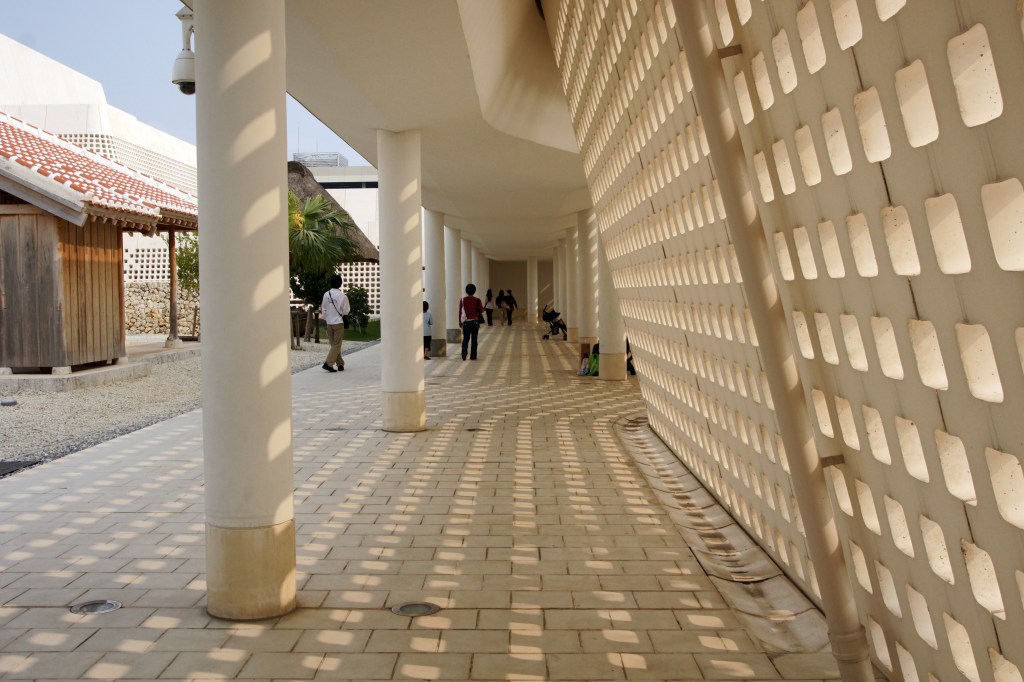
The permanent exhibition, Sea and Island Life
The permanent exhibition is organised around two complementary views of Okinawa, an oceanic aspect and an island aspect, and then divides into five fields: nature, archaeology, art and craft, history and folklore. What that means in practice is that you move from geology and coral reefs into the earliest human settlement of the islands, then into the Ryukyu Kingdom and the trading era, and finally into folk life. The museum’s own description promises the island’s past and present through objects, models and film, and the sequence is what makes it work: each section explains the conditions that produced the next. If you are short of time, the history and folklore fields carry the most weight for a visitor, because they explain things you will see elsewhere on the island for the rest of the trip.
The natural history galleries and Minatogawa man
The natural history section is entered through a glass-floored walkway designed to look as though you are walking over coral towards an island, which is a theatrical device but also a precise description of how these islands formed. A large wrap-around screen shows short films about the geological origins of the Ryukyu chain and about its flora and fauna, and the rooms beyond hold specimens from across the archipelago. The object most visitors remember is the material relating to Minatogawa man, the oldest Homo sapiens specimen found in East Asia, discovered on Okinawa. The galleries also deal directly with the pressure on coral reefs and with endangered species, which is a more honest framing than a simple celebration of tropical nature.
The history section and its floor map
The history galleries are built around a large map of the Ryukyu archipelago projected onto the floor and linked to computer terminals, so you can pull up individual islands with satellite photographs, notes on native plants and animals, and local culture. The rooms around it run from early Jomon-period culture through the Ryukyu Kingdom and its maritime trade to the US Occupation and the return to Japanese sovereignty in 1972. This is the part of the museum that does work no other site on the island can do: Shuri Castle shows you the court, but this shows you the chain of islands the court governed, the trade routes it depended on, and the century that followed the kingdom’s end.
The Bridge of Nations Bell
The museum holds the Bridge of Nations Bell, a nationally designated Important Cultural Property, and it is the single object most associated with the Ryukyu Kingdom’s self-image. The bell’s inscription describes the kingdom as a bridge between nations, positioned between China, Japan and the wider maritime trade, and that phrase has been quoted in Okinawan public life ever since. Seeing it in a case after walking the history galleries is the right order, because the trade networks the earlier rooms describe are what made the bell’s claim possible. Whether it is on display when you visit is worth checking with the museum, since objects of this importance rotate.
The art museum’s collection exhibition
The art museum half of the building shows a collection exhibition drawn from its own holdings: modern and contemporary work, made mainly by artists from Okinawa or connected with it, alongside artists from other Asian countries and beyond. The permanent collection is rotated three to four times a year, so the specific works change even though the character of the display does not. This is where the building earns its double name. The museum explains the island; the art museum shows what artists have made of it since the modern period, including the post-war decades when Okinawan artists were working through the same questions of identity the history galleries describe.
The gardens and the sculpture garden
The grounds are free to walk and are easy to treat as a preamble when you are early for opening. In front of the building the gardens hold reproductions of two traditional Okinawan structures, a thatch-roofed storehouse and a tile-roofed house, plus shisa statues and examples of local ceramics, which gives you a quick primer on the domestic architecture you will see in villages later. Behind the building a sculpture garden holds large contemporary pieces and opens onto Shintoshin Park, a public park that is part of the same redeveloped district. On a hot day this outer circuit is best done in the early morning or after the galleries, not at midday.
The Hands-On Experience Room and the free audio guide
The museum runs a hands-on room, the fureai taiken shitsu, where visitors can handle material relating to Okinawa’s natural environment and folk culture, including traditional clothing, musical instruments such as the sanshin, and puzzles and games. It is the part of the building that works for children and for anyone who learns by touching rather than reading, and it closes at 17:30, earlier than the galleries on Friday and Saturday evenings. Separately, the museum lends audio guides for the permanent exhibits free of charge in five languages: Japanese, English, Chinese, Korean and Spanish. That is a significant detail for overseas visitors, because the label text in the galleries is thinner in English than in Japanese, and the guide closes the gap.
Food and drink
- Eating inside the building means the Camecame Kitchen, the museum cafe, whose name comes from the Okinawan expression kameh, kameh, meaning go ahead and eat. It is open from 10:00 to 18:00, stays open until 20:00 on Fridays and Saturdays to match the late gallery hours, and serves lunch with last orders at 15:00. It closes on Mondays, following the museum, and on the Tuesday after a Monday public holiday. The one thing to plan around is that 15:00 last order: if you start in the galleries at eleven and work through the history section properly, you can easily miss it and end up with only the sweets and drinks side of the menu.
- The menu is built around Okinawan ingredients rather than generic museum food. The museum describes pastas and risottos made with seasonal local vegetables, and a pork egg dog, an adaptation of the pork egg that is a standard Okinawan snack. It also runs limited items tied to whichever exhibition is on. There is a kids’ space, which makes this one of the more comfortable museum cafes for families in Naha, and it is the reason the cafe is worth treating as part of the visit rather than an afterthought. Prices are not published on the English page, so check the board at the entrance rather than budgeting from an old number.
- The museum shop, Yuimui, closes at 18:00 even on nights when the galleries stay open until 20:00, so buy anything you want before the final hour of the visit. It stocks Okinawan craft and museum-related goods, and it is a better place for a small, locally made object than the souvenir shops along Kokusai Street. If you are leaving with a car, the shop is also the last chance to buy before the drive north, where the roadside stations are the next option.
- For a proper meal, Omoromachi itself is a commercial district. The area around the station has shopping and restaurant floors, including the Naha Main Place complex and the DFS Galleria building, both within a few minutes of the museum, and they stay open later than the cafe. The alternative is to ride two stops to Makishi and eat around Kokusai Street, which is where the density of izakaya and Okinawan restaurants is highest. With a 19-minute monorail ride from the airport and a ten-minute walk from the station, both options are easy, and neither requires a car.
Getting there and around
- The simplest route is the Yui Rail monorail from Naha Airport to Omoromachi Station, stop number 11. The ride takes about 19 minutes and costs 300 yen, or 150 yen for children. From the station the museum is a ten-minute walk. That combination, airport to door in under thirty minutes for 300 yen, is why this is one of the easiest major sights in Okinawa to reach without a car, and it works in reverse as a last-day activity if your flight leaves in the evening.
- Driving from Naha Airport takes about 20 minutes, and parking at the museum is free, with a general car park in front of the building, designated spaces for visitors with disability permits, and space for large buses. The museum publishes the map code 33188675 for car navigation, which is more reliable than typing an address into a rental car’s system. Free parking in a city centre is the main reason to drive here, and it also makes the museum a practical first stop after collecting a car at the airport.
- By bus, route 99 from the domestic terminal runs towards Naha Bus Terminal and stops at Omoromachi 3-chome, roughly 30 to 40 minutes and 240 yen, with a ten-minute walk from the stop. Route 120 towards Naha Bus Terminal stops at Uenoya, also about a ten-minute walk. Naha city buses 3, 7 and 10 also serve the area. Bus travel here is slower than the monorail and does not save money for a single traveller, so it mainly makes sense if you are already staying along one of those routes rather than coming from the airport.
- From the Kokusai Street and Makishi area, where many visitors stay, the monorail is two stops and a few minutes, followed by the ten-minute walk from Omoromachi. A taxi is short enough to be cheap if there are two or more of you, though traffic around Omoromachi at commuter times can make the monorail faster. Walking the whole way from Kokusai Street takes around half an hour and passes through the redeveloped Shintoshin district, which is a plain but instructive look at how Naha has been rebuilt since the war.
- One local rule matters if you are travelling between July and September. The museum publishes a typhoon policy: it closes about two hours before buses in Naha stop running, and reopens about two hours after they resume, with a full-day closure if the remaining opening window would be under three hours. Power cuts or building damage can also close it outside those rules. In typhoon season, check the museum’s own notices on the day rather than relying on a schedule you printed at home.
Where to stay
- Omoromachi and the wider Shintoshin district is the most convenient base for this museum, because you can walk to it. The area was redeveloped around the monorail line and is quieter and more open than Kokusai Street, with the large shopping complexes and the park within a few minutes of the hotels. Staying here suits travellers who want an early start at the museum and a straightforward monorail connection to the airport, at the cost of a thinner choice of restaurants in the evening.
- Kokusai Street and Makishi is the opposite trade: the densest concentration of hotels, restaurants and bars in Naha, two monorail stops or a short taxi ride from the museum. If your evenings matter more than your mornings, this is the better base, and the museum is still easy to reach. The street itself is a twenty-minute walk from Omoromachi if you prefer to walk, which also takes you past the pottery district at Tsuboya on the way.
- Naha Airport hotels are the third option and are mostly about early flights. The monorail makes the airport genuinely convenient, so a hotel near the terminal is not the sacrifice it would be in most Japanese cities, and the museum is a 19-minute ride away. This works for a last night before a morning departure, or for a first night if you land late and want to start the next day without moving luggage twice.
Best time to visit
- The rainy season, roughly from May into June, is when an indoor museum earns its place in an itinerary. Okinawa’s rain in this period is heavy rather than constant, and the museum is the best single indoor option in Naha that is not a shopping centre. The galleries are air-conditioned and the displays are dense enough to absorb a wet afternoon, and the monorail connection means you do not have to walk far in the rain.
- Typhoon season runs from around July to September, and the museum’s published closure rule is tied to the bus network rather than to the weather forecast: it closes about two hours before Naha’s buses stop and reopens about two hours after they restart. That is a clear signal to follow, because if the buses have stopped, nothing else in the city is running either. Build a flexible day in this season and keep the museum as the swap-in when a beach day is lost.
- Summer heat is the other reason to come. The galleries are a properly air-conditioned refuge, and on Fridays and Saturdays the museum stays open until 20:00 with last admission at 19:30, which lets you spend the worst of the afternoon elsewhere and arrive in the cooler evening. The cafe also stays open until 20:00 on those days, so an early dinner inside the building is possible before the galleries close.
- Winter is the quietest and most comfortable season for a museum visit, and it is also when the rest of Naha is at its most walkable. The one date to avoid is the New Year period: the museum closes from 29 December to 3 January. It also closes for scheduled maintenance on dates it publishes in advance, and in 2026 that block ran from 30 June to 8 July, so check the closure calendar before building a day around it. Mondays are closed year-round, with the exception that a Monday public holiday or the prefecture’s memorial day keeps it open and shifts the closure to the next weekday.
Practical tips
- Plan around Monday. The museum closes every Monday, but if Monday is a public holiday or the Okinawan memorial day of 23 June, it opens and takes the following weekday as its closure day instead. New Year’s holiday is a separate closure from 29 December to 3 January. The maintenance closures announced for each year can be a week long, so a quick check of the calendar before you fix your Naha days is worth more than any other preparation here.
- Decide which half you are visiting before you reach the ticket desk. The museum’s permanent exhibition and the art museum’s collection exhibition are priced separately, and there is a combined one-day passport that the museum sells for limited periods, listed at 750 yen for adults and 400 yen for high school and university students during its autumn 2026 window. Those combination prices are period-limited, so treat the published figure as a check-at-the-desk number rather than a fixed cost.
- Base prices for the museum’s permanent exhibition are 530 yen for adults, 270 yen for high school and university students, and 150 yen for elementary and junior high students from outside the prefecture, with group rates for parties of twenty or more. The art museum collection exhibition is 400 yen for adults, 220 yen and 100 yen respectively. Entry is free for children of preschool age, for visitors aged 70 and over with identification, and for holders of a disability certificate plus one accompanying person. Students at three named Okinawan institutions also enter free with a student card.
- Last admission is 30 minutes before closing, which matters more than it sounds on Fridays and Saturdays, when the building stays open to 20:00 but the hands-on room shuts at 17:30 and the shop at 18:00. If the hands-on room is the reason for your visit, treat 17:30 as the real closing time. The same applies to the information centre and library, which keep their own hours.
- Photography rules differ by exhibition, and the museum asks visitors to follow the notices in each room rather than a single building-wide rule. Tripods and selfie sticks are not allowed. If a particular object matters to you, ask at the desk before you start, because the answer changes with the show and the museum does not publish a room-by-room list.
- Bags go in coin lockers before you enter the galleries. The museum asks visitors with suitcases or large backpacks to use the lockers, and staff will help if a bag does not fit. Note-taking is pencil only, because pen ink and mechanical pencil lead can damage objects, and pencils are available on request. Smoking, including e-cigarettes, is banned across the whole site, and there are no ashtrays or smoking areas.
- Take the free audio guide in English. It covers the permanent exhibits in five languages and removes the main frustration of the museum for overseas visitors, which is that the Japanese label text is fuller than the English. Allow about two and a half to three hours if you are doing both the museum and the art museum, or ninety minutes for the museum’s permanent galleries alone. The grounds and gardens are free and can be tacked on either end without a ticket.
Suggested day-trip outline
- Arrive at opening, 09:00, and start in the museum rather than the art museum. The permanent exhibition begins with the natural history galleries and the coral walkway, and the building is quietest in the first hour, which is when the wrap-around screen film and the floor map terminals are usable without waiting.
- Work in the exhibition’s own order: nature, then archaeology, then history, then art and craft, then folklore. The history section is the one to give the most time, both for the floor map and for the sequence from the Ryukyu Kingdom to 1972. If you have an hour and a half in total, take nature briefly and spend the rest here.
- Break for lunch at the Camecame Kitchen before 15:00 last orders. Aim to sit down around 12:30 to 13:00, order the pork egg dog or one of the local vegetable pastas, and use the kids’ space if you are travelling with children. Buy anything you want from the Yuimui shop at the same time rather than leaving it until the end.
- Spend the afternoon in the art museum’s collection exhibition. The holdings rotate three to four times a year, so what is on view will differ from any account you read, including this one. If the day is hot, this is also the coolest part of the building to sit through slowly, and the galleries are usually quieter than the museum side.
- Finish outside. Walk the front gardens with the reconstructed thatch storehouse, tile-roofed house and shisa, then the sculpture garden behind the building and out into Shintoshin Park. From there it is a ten-minute walk back to Omoromachi Station. If you want dinner on Kokusai Street, ride two stops to Makishi rather than walking, and if you are flying out the same evening, the airport is 19 minutes in the other direction.
Before you go
Timetables, fares, admission fees, and seasonal access rules can change. Check the official tourism and transport sites linked below for the latest information before you travel.
Explore More of Japan
Published guides that pair with this one:
- Shuri Castle Guide: The Heart of the Ryukyu Kingdom
- Naha and Kokusai Street Guide: Markets, Food and the Old Capital
- Okinawa Peace Memorial Park Guide: Mabuni and the Battle Sites
- Churaumi Aquarium Travel Guide: Whale Sharks, Mantas and the Okinawa Coast
- Sefa Utaki Travel Guide: The Ryukyu Sacred Grove in Nanjo
- Tokashiki Island Guide: A Kerama Day Trip from Naha
- Katsuren Castle Ruins Travel Guide: A Gusuku above the East Coast
- Yambaru National Park Travel Guide: Okinawa’s Northern Forest
- Bise Fukugi Tree Road Travel Guide: Walking Okinawa’s Green Village Tunnel
- Cape Manzamo Travel Guide: Elephant Rock, Sunset and the Onna Coast
Browse every Okinawa guide on this site for the rest of the region.
Sources
- okimu.jp — Visitor information (checked 2026-11-02)
- okimu.jp — Access (checked 2026-11-02)
- okimu.jp (checked 2026-11-02)
- okimu.jp (checked 2026-11-02)
- okimu.jp (checked 2026-11-02)
- okimu.jp — Visitor information (checked 2026-11-02)
- en.wikipedia.org (checked 2026-11-02)


Leave a Reply