A practical English guide to Kitsuki in Oita: the samurai districts, the castle, the views and access from Beppu.
Operational details such as opening hours, admission fees, and train times can change. Prefer official pages and reconfirm before you travel (sources checked on 05 November 2026).
Why visit
- Kitsuki is a small castle town on the coast of Oita, and its old samurai districts still sit on the two hills that flank the valley in the middle. The streets between them are narrow, walled with stone, and stepped, so that walking from one house to the next is a climb; the result is one of the most legible old towns in Kyushu.
- The castle is said to be the smallest in Japan, a three-storey keep on a low hill above the valley, and it is a reconstruction, but the position is original and the view from the top takes in the roofs, the hills and the sea beyond. Below it, the two districts of samurai houses are laid out on either side of a stream, connected by a sloping street that is the town’s signature view.
- Kitsuki is not a museum town. People live in the old houses, the shops sell to locals, and the preservation has been done by repairing rather than rebuilding. That gives it a quieter, more convincing atmosphere than the heavily restored districts elsewhere, and it is why a walk here feels like a visit to a place rather than a set.
- It is also easy to reach and easy to combine. The station is on the Nippo line between Kokura and Beppu, the town is close to the Kunisaki peninsula and to the hot springs of Beppu and Yufuin, and a half-day here fits naturally into a trip around Oita.
Top places and highlights
The two samurai districts
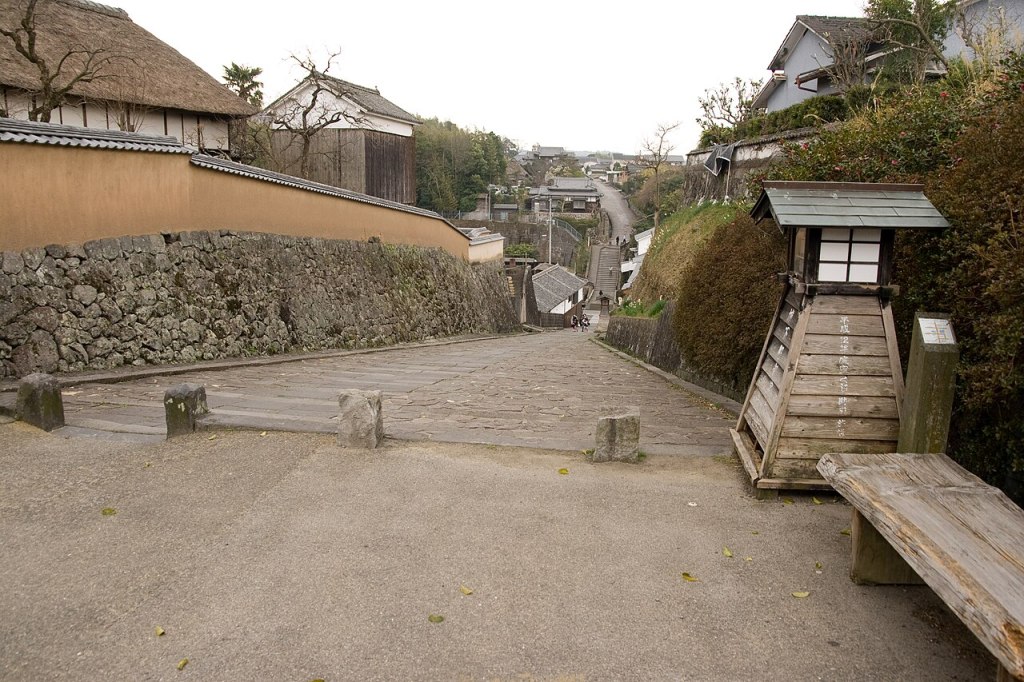
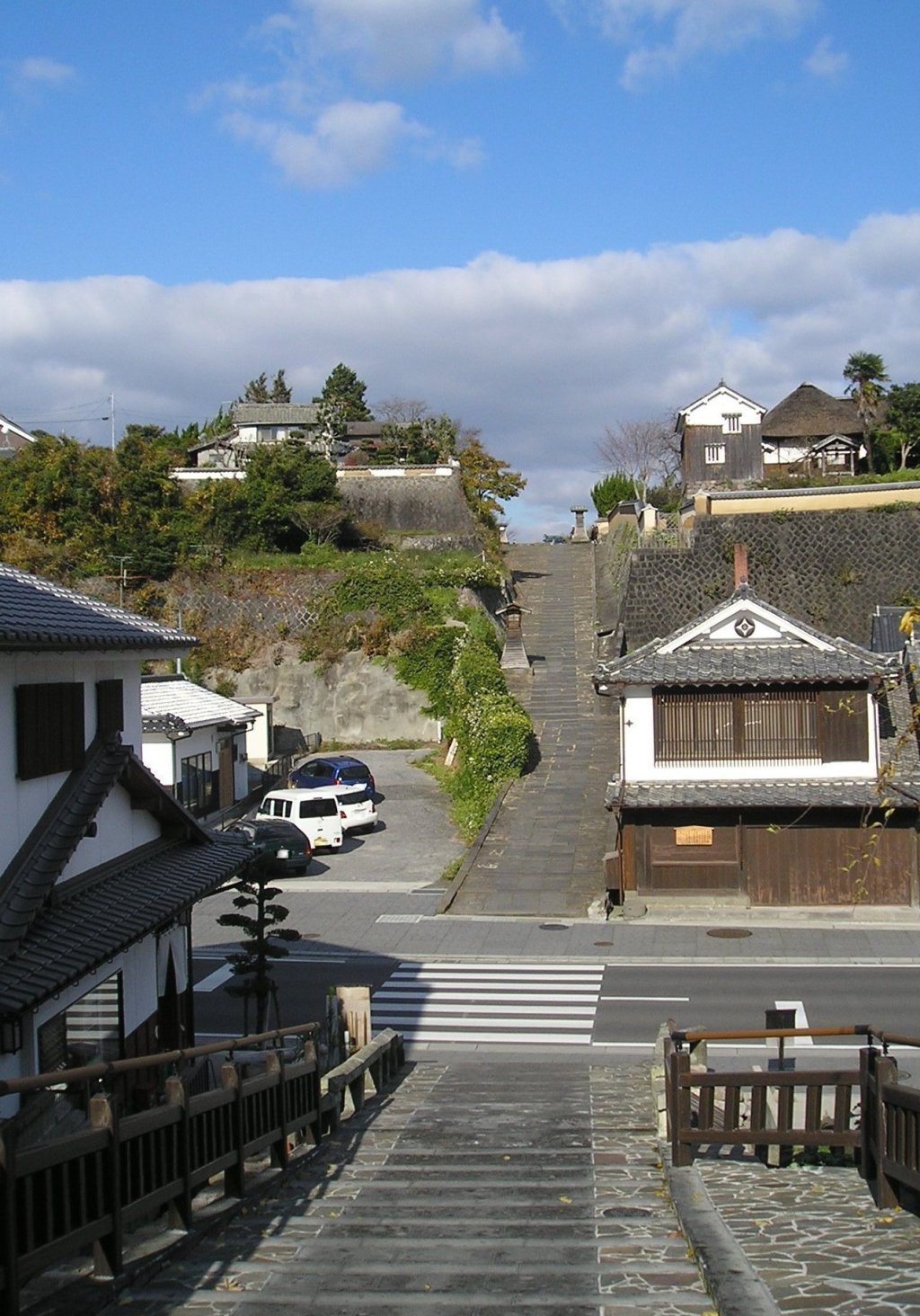
The old town is split between two hills, with the merchant quarter and the castle in the valley between them. On each hill the streets are lined with the walls of samurai houses, gates, and the narrow lanes that served as fire breaks, and a few houses are open to visitors. The lanes are steep and the walls are high, so the walk is as much about the space between the buildings as about any single sight. Start on one hill and cross the valley slowly.
The sloping street
The street that runs down from one district to the other, with stone walls on both sides and the roofs of the town below, is the image most people associate with Kitsuki. It is short, perhaps a hundred metres, but the perspective is perfect: the walls converge, the steps fall away, and the valley opens at the bottom. Stand at the top in the late afternoon, when the light rakes across the stone, and you have the whole town in one view.
Kitsuki castle
The keep is small, rebuilt in the twentieth century on the original stone base, and it holds a modest museum of the domain and its lords. The climb to it is short and the view from the top floor is the reason to go: the two hills of the old town, the valley between them, and the sea and the mountains in the distance. Because the castle is small, it is easy to see how the town was designed around it, which is harder in a great fortress.
The samurai houses that are open
Several former samurai residences keep their gates open, with tatami rooms, small gardens and the household objects of the period on display. They are modest rather than grand, which is the point: these were the houses of retainers, not lords, and the scale shows how the middle rank of the domain lived. One house usually includes a tea room, and the gardens are small and carefully made.
The view over the town
From the upper lanes and from the castle, Kitsuki reads as a single composition: two ridges of roofs, a valley with the merchants’ street, and the sea in the distance. It is a rare thing in Japan to see a castle town so clearly, and the small size of the place means you can hold it in your head after a single walk. Photographers should come in the morning or the late afternoon rather than at midday.
Oita food
The region’s cooking is robust: toriten, the marinated chicken tempura, kabosu citrus, and the fish of the Bungo channel, including the mackerel and fugu of the ports nearby. Kitsuki has a handful of restaurants serving set meals and noodles, and they are inexpensive and local. The nearby hot spring towns add kaiseki and ryokan dining if you want a more formal meal.
The Kunisaki peninsula
South of Kitsuki, the Kunisaki peninsula is a rural area of old temples, stone Buddhas and mountain paths, with a culture shaped by a mixture of Buddhism and Shinto that is unlike anywhere else in Japan. It needs a car to explore properly, but the northern edge is close enough to combine with Kitsuki in a day. If you have an interest in the history of Japanese religion, this is the reason to stay another night.
Food and drink
- Toriten, Oita’s marinated chicken tempura, is served with a citrus dipping sauce and is on most local menus.
- Kabosu, the green citrus of Oita, flavours dressings, drinks and desserts throughout the region.
- The ports nearby land mackerel, sea bream and fugu, and the restaurants in Kitsuki serve them simply.
- Set meals of local fish and rice are the reliable lunch in the town centre, and they are cheap and quick.
- The hot spring towns of Beppu and Yufuin, within an hour, have the region’s most ambitious cooking and its famous sweets.
Getting there and around
- Kitsuki station is on the JR Nippo main line, about twenty minutes from Beppu and an hour and a half from Kokura.
- The station is a few kilometres from the old town, so take a local bus or a taxi for the last stretch.
- From Oita airport, a bus and a train reach Kitsuki in about half an hour, which makes it an easy first or last stop.
- By car, the Oita expressway and the coastal roads connect Kitsuki with Beppu, Oita city and the Kunisaki peninsula.
- Once in the old town, everything is on foot, but the lanes are steep and stepped, so allow time.
Where to stay
- Kitsuki has a few small inns and guesthouses in and around the old town, some in restored buildings.
- Beppu and Yufuin, within an hour, offer the full range of hot spring accommodation, from cheap inns to luxury ryokan.
- Oita city has business hotels near the station, convenient for the airport and the train.
- Staying in the old town is the way to see the lanes in the early morning and the evening, when the day visitors have gone.
Best time to visit
- Spring is mild and the hills around the town are green, with the castle park at its best.
- Summer is hot and humid, and the stone lanes hold the heat, so walk early or late.
- Autumn is the best season, with clear air, comfortable walking and the view from the castle at its sharpest.
- Winter is cold and quiet, with few visitors and the old houses at their most atmospheric.
Practical tips
- Wear shoes with grip; the lanes are stepped and the stone is polished by centuries of use.
- Check which samurai houses are open before you go, since they keep limited days and hours.
- Start at the castle, then walk one district, cross the valley and finish on the other hill.
- The town is small, so a half-day is enough, but allow more if you want to sit in a cafe and look at the roofs.
- If you are driving, park below the old town and walk up; the lanes are too narrow for cars.
- Combine the visit with Beppu or the Kunisaki peninsula rather than making a long trip for Kitsuki alone.
Suggested day-trip outline
- Morning: train to Kitsuki station, bus to the old town and the castle.
- Late morning: the first samurai district, with one or two houses open to visitors.
- Lunch: a set meal of local fish in the town centre.
- Afternoon: cross the sloping street to the second district, then the view from the upper lane.
- Late afternoon: coffee or a sweet before the bus back to the station.
- Evening: onsen and dinner in Beppu or Yufuin, an hour away by train.
Before you go
Timetables, fares, admission fees, and seasonal access rules can change. Check the official tourism and transport sites linked below for the latest information before you travel.
Explore More of Japan
Published guides that pair with this one:
- Suizenji Garden Travel Guide: Kumamotos Miniature Landscape
- Gunkanjima Travel Guide: Hashima Island and the Coal City
- Aoshima Travel Guide: The Island Shrine and the Devil Washboard
- Karatsu Travel Guide: Pottery, a Castle, and the Saga Coast
- Fukuoka Travel Guide: Hakata Ramen, Yatai Stalls and a Compact Coastal City
Browse every Kyushu guide on this site for the rest of the region.
Sources
- city.kitsuki.lg.jp (checked 2026-11-05)
- visit-oita.jp (checked 2026-11-05)


Leave a Reply