Ise Jingu is the most important Shinto shrine in Japan, and it does not behave like a tourist attraction. There is no ticket gate, no queue for a viewpoint and almost nothing to photograph at the moment that matters. The two main shrines, Naiku and Geku, are places of worship for Amaterasu-Omikami and Toyouke-no-Omikami, set in forest and rebuilt from scratch every twenty years. Visitors come by the million, but the experience is deliberately quiet.
That makes Ise both rewarding and easy to get wrong. People arrive late, go to Naiku first, take photographs at the prayer area, and leave thinking they have seen two wooden buildings. The traditional order, the early hour and a little preparation turn the same visit into one of the strongest days in Japan.
This guide covers what the two shrines are, why you visit Geku before Naiku, the Shikinen Sengu rebuilding cycle, the Okage Yokocho food streets, shrine etiquette, access from Nagoya and Kyoto, and how to combine Ise with the coast.
Why visit
Because Ise is the source. Amaterasu-Omikami, the ancestral deity of the imperial family, has been worshipped here for about two thousand years, and the shrine is the head of a network of 125 shrines. More than 1,500 rituals are held each year, and the whole complex covers an area the shrine compares to the centre of Paris. This is not a sight added to an itinerary; it is the reason many Japanese travellers make the trip at all.
The setting does the rest. Naiku is reached over a bridge across the Isuzu River and then along a gravel path through tall cedars, with the river audible below and almost no buildings visible until you arrive. Geku is smaller and closer to the station, a calm introduction rather than a lesser shrine. Together they make a day that is as much a walk in old forest as a lesson in religion.
The practical case is decent too: both shrines are free, open from early morning, and reachable by train from Nagoya, Osaka and Kyoto. Ise is a realistic day trip from Nagoya and a comfortable overnight from Kyoto or Osaka.
What Ise Jingu is
Ise Jingu, officially called Jingu, is not one shrine but a group of 125 shrines centred on two: Kotaijingu, known as Naiku, and Toyouke-daijingu, known as Geku. Naiku is dedicated to Amaterasu-Omikami, the sun deity and ancestress of the imperial family. Geku is dedicated to Toyouke-no-Omikami, the deity who provides food, clothing and shelter, and who is understood to serve Amaterasu.
Amaterasu was originally worshipped in the imperial palace. According to the shrine’s account, the sacred mirror that represents her was moved out during the reign of Emperor Sujin, and Princess Yamatohime-no-mikoto was then ordered to find a permanent home for it. She searched across the country and was told in a revelation to enshrine the deity at Ise, roughly two thousand years ago. Toyouke-no-Omikami was brought to Ise about 1,500 years ago.
The sacred mirror is kept inside the innermost sanctuary at Naiku, within four rows of wooden fences. Visitors worship from in front of the third fence and cannot enter the courtyard, which is why the building itself is half hidden and why the atmosphere is so restrained.
Reading the shrine
Shinto has no founder, no scripture and no single image of the deity, which is why Ise can feel empty if you arrive expecting a cathedral. The kami are understood to be present in the place itself: the mountain, the forest, the river, the rock. A shrine is a house built to receive and honour that presence, and the fence around it marks the boundary between the ordinary and the sacred.
That explains the details. The gravel path is swept, the trees are left old, and the buildings are simple and unpainted, because the point is not decoration but clarity. Offerings of food, cloth and sake are made daily, and the rituals are tied to the rice-growing year. When you bow twice, clap twice and bow once, you are announcing yourself and then greeting the deity, not performing a ceremony for an audience.
It also explains why photography is restricted at the prayer area. The moment of greeting is not a photo opportunity, and the shrine protects it for the people who have come to pray.
Geku first, then Naiku
The shrine asks visitors to visit Geku first and then Naiku, and this is not a formality. Geku is the outer shrine, five minutes on foot from Ise-shi Station, and it serves as the place to greet Toyouke-no-Omikami before meeting Amaterasu at Naiku. It also happens to be the easier start: smaller, quieter, and a gentle introduction to the scale of the site.
Geku’s architecture mirrors Naiku’s, with one addition: the Mikeden, a hall where offerings of food are made to the deities every day. The grounds are compact, with a gravel path, old trees and a few subsidiary shrines, and 20 to 30 minutes is enough unless you stop to pray at each one.
From Geku, take the loop bus (route 51 or 55) to Naiku. The ride is short, and the bus is the standard way to connect the two shrines; taxis are available but expensive for the distance.
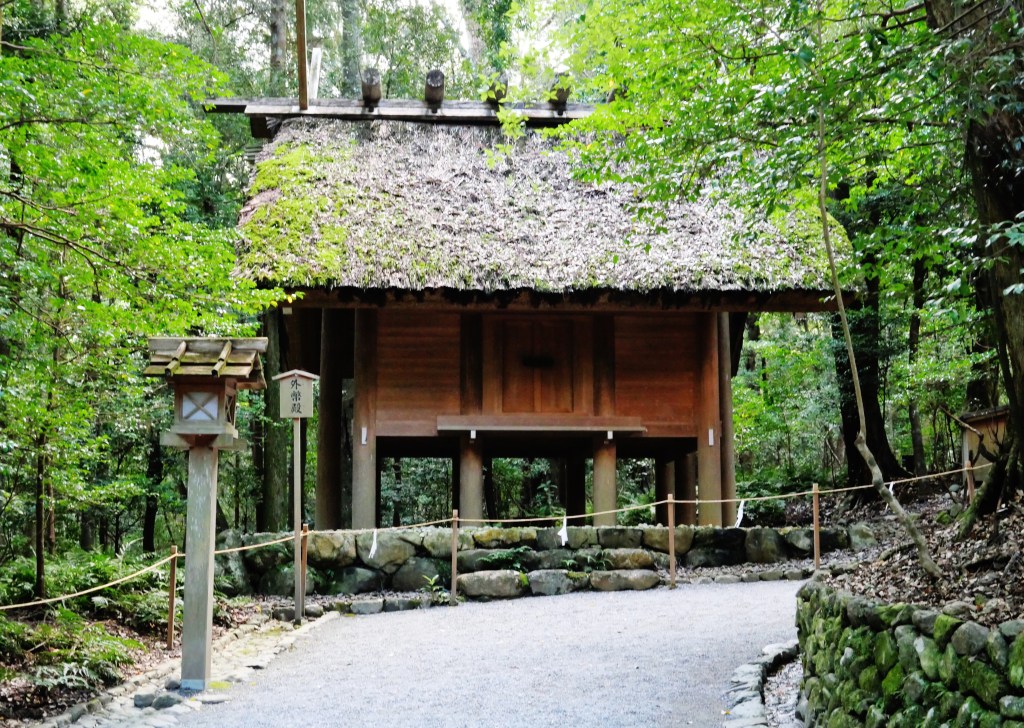
Naiku and the sacred forest
Naiku begins at the Ujibashi bridge, more than 100 metres long, which crosses the Isuzu River and is traditionally understood to separate the sacred realm from the everyday world. Cross it slowly. The river below is clear, the forest on the far bank is dense, and the temperature drops as soon as you are under the trees.
The approach is a wide gravel path through cedars, with the river on your right and stone lanterns along the way. There is a purification basin before the main precinct, and then the steps up to the sanctuary. The main hall is behind four fences, and even from the worship area you see only the roof and the tops of the walls; that partial view is the point. The mirror inside is never shown.
To the side of the main sanctuary are the Kaguraden, where visitors can commission sacred music and dance for a personal prayer, and the Kodenchi, the empty site where the previous divine palace stood and where the next one will be built. The Kodenchi is a small, fenced rectangle of gravel with a few stones, and it explains the whole logic of the shrine better than any sign: the building is temporary, the site is eternal.
Allow an hour at Naiku, more if you walk the side paths and stop at the smaller shrines. The forest is the attraction as much as the buildings, and the sound of the river follows you the whole way.
The twenty-year rebuild
Every twenty years, the divine palace at Naiku is rebuilt on the adjacent site, along with its sacred treasures, textiles and furnishings, and the deity is moved into the new building. This is Shikinen Sengu, and it has been carried out since 690. The most recent, the 62nd, was completed in 2013; the next is due in 2033.
The cycle takes about eight years of rituals, beginning with the cutting of the first trees, and it is repeated at Geku and the other shrines of Ise. The wood comes from the shrine’s own forests, and the old building is dismantled and its materials reused elsewhere in Japan. Nothing about the design changes: the point is exact repetition, which is why the shrine looks ancient even though the building is new.
For visitors, the practical effect is that part of the site may be closed or screened while preparations are under way. If you are visiting close to 2033, check the official site for notices before you travel.
Okage Yokocho and Oharai-machi
The street from the Naiku bus stop to the Ujibashi bridge is Oharai-machi, lined with souvenir shops, restaurants and stalls. In the middle of it, five minutes’ walk from the bridge, is Okage Yokocho, a recreated Edo-period lane with a large street lamp at the entrance. It is unashamedly commercial, and it is also the most convenient place to eat.
Look for Ise udon, thick and soft noodles in a dark soy broth; tekone sushi, bonito marinated in soy and served over rice; and akafuku, the red bean mochi sold since 1707, best eaten with tea at the shop near the bridge. The lane also has skewers, croquettes, sake and sweets, and the crowd is part of the experience. Most shops open from mid-morning and close in the late afternoon, with hours posted month by month, so do not leave lunch too late.
Prices are reasonable for a major sight, and cash is still useful at the smaller stalls. If you want a quieter meal, the side streets of Oharai-machi have restaurants away from the main flow.
Etiquette
Ise is an active place of worship and its rules are simple but taken seriously. At the temizu basin, take the dipper in your right hand, pour water over your left hand, then switch hands and rinse your right. Pour water into your cupped left hand to rinse your mouth, without touching the dipper to your lips, then rinse your left hand again and let the remaining water run down the handle to clean it.
At the sanctuary, bow twice deeply, clap your hands twice, and bow once more. Do not take photographs at the prayer area, and do not eat, drink or smoke anywhere in the precinct except in designated areas. Keep your voice down, do not block the path, and do not enter fenced areas. The shrine does not prohibit photography everywhere, but the prayer area is off limits and the signs are clear.
Dress sensibly rather than formally. The path is gravel and the steps are stone, so shoes you can walk in matter more than a collared shirt.
When to go
Opening hours follow the season: 5:00 to 17:00 in October, November and December; 5:00 to 18:00 from January to April and in September; and 5:00 to 19:00 from May to August. The shrines are free and open every day. Check the official site before an early start, because the times are set by the shrine and can change.
Early morning is the best time. At 6:00 the Naiku path is nearly empty, the light comes through the cedars, and the river is loud enough to cover the sound of other visitors. By 10:00 the buses arrive and the approach fills; by midday Okage Yokocho is shoulder to shoulder.
Spring and autumn are the most comfortable seasons. Summer is hot and humid, and the forest traps the heat; start at opening and carry water. Winter is quiet and cold, with bare trees and clear views across the river. New Year is the busiest period of the year, and the mid-October Kanname-sai, when the first rice of the harvest is offered, is the most important ritual of the shrine’s year.
Getting there
The gateway is Ise-shi Station, served by Kintetsu and JR. Geku is about five minutes on foot from the station, and the loop bus to Naiku (route 51 or 55) leaves from nearby. Naiku is a short bus ride from Geku, and 15 to 20 minutes from the station area.
From Nagoya, the Kintetsu limited express takes around 90 minutes. From Osaka, allow about two hours; from Kyoto, a little over two hours with a change at Yamada-Kamiguchi or Iseshi. The JR route via Nagoya is slower but covered by some rail passes, which matters if you are travelling on a national pass.
By car, Ise is about 90 minutes from Nagoya on the Higashi-Meihan and Ise expressways. Parking near Naiku fills early on weekends and holidays, and the shrine asks visitors not to park in the residential streets. Public transport is the better choice.
Suggested itineraries
Classic day trip from Nagoya
Take an early limited express and reach Ise-shi by 8:30. Walk to Geku, pray, then take the loop bus to Naiku and walk the forest approach before the crowds. Have lunch in Oharai-machi, visit Okage Yokocho, and return to Nagoya in the late afternoon.
Overnight in Ise
Stay near Ise-shi Station, visit Geku at opening, then Naiku, then spend the afternoon on the coast at Futami and Meoto Iwa. Dinner in the city, and an early train out the next morning.
With the coast
After Naiku, take the train to Futaminoura for Meoto Iwa, the pair of rocks in the sea joined by a rope, then continue to Toba for the aquarium or a boat trip in Ise-Shima. This turns a shrine visit into a full day on the peninsula.
Rainy day
The forest paths drain well and the shrine is atmospheric in rain, but the gravel and stone steps get slippery. Skip the coast, spend longer at Geku and Naiku, and use Okage Yokocho for shelter and lunch. The shrine does not close for weather.
Food and where to stay
Ise is a food stop as much as a shrine stop. Beyond Ise udon, tekone sushi and akafuku, the city is known for spiny lobster in season, oysters from the bay, and sake from the surrounding breweries. The restaurants along Oharai-machi cover the basics; for a slower meal, look in the streets behind the station.
Most visitors stay in Ise-shi, within walking distance of Geku and the station, where business hotels and small ryokan are plentiful. Toba, 20 minutes away, has onsen hotels facing the bay and works well if you want the coast as well. Book ahead for weekends in spring and autumn, and much further ahead for New Year.
Nearby
Meoto Iwa, the wedded rocks, are a short train ride to Futaminoura and then a bus or 20-minute walk, best seen at low tide when the rope between them is fully visible. The two rocks are understood to represent the deities Izanagi and Izanami, and the nearby Okitama Shrine is a small stop on the coastal road. Toba has the aquarium, pearl-cultivation history and boat trips among the islands of Ise-Shima. Further afield, the Kumano Kodo pilgrimage routes begin in the mountains to the south, and Nagoya is close enough for a same-day return.
If you are building a longer trip, Ise pairs naturally with Nagoya, Kyoto and the Kumano region rather than with Tokyo.
Practical tips
- Visit Geku first, then Naiku; that is the shrine’s own recommendation.
- Arrive at opening. The difference between 6:00 and 10:00 at Naiku is enormous.
- Both shrines are free, and there is no ticket or reservation.
- Carry cash for small stalls and coin lockers.
- Wear shoes for gravel and stone steps.
- Do not photograph the prayer area, and keep quiet near the sanctuaries.
- Check the seasonal opening hours and any Sengu-related closures on the official site.
- Allow a full day for Geku, Naiku and Oharai-machi; half a day is rushed.
- If you continue to the coast, check tide times for Meoto Iwa before you go.
Before you go
Confirm the opening hours for your dates and check whether any part of Naiku is restricted ahead of the 2033 Sengu. Decide whether you are visiting as a day trip or staying overnight, because the early-morning visit is the whole point and a day trip from Kyoto makes that difficult. Bring cash, wear walking shoes, and read the etiquette once before you arrive so you are not working it out at the temizu basin. Above all, leave time to stand still: Ise rewards patience more than it rewards a checklist, and the quiet minutes on the Naiku path are what people remember.
Sources
- Ise Jingu: about the shrine, Naiku and Geku (checked 2026-10-26)
- Ise Jingu: opening hours, temizu and etiquette (checked 2026-10-26)
- Ise Jingu: annual rituals and Shikinen Sengu (checked 2026-10-26)
- Ise Jingu: access and loop bus (checked 2026-10-26)
- Okage Yokocho: shops and monthly opening hours (checked 2026-10-26)
Explore More of Japan
- Nagoya Travel Guide — the practical base for Ise
- Kyoto Higashiyama Travel Guide — temples and lanes in Kyoto
- Kumano Hongu Travel Guide — the pilgrimage routes south of Ise
- Koyasan Travel Guide — temple stays in the mountains


Leave a Reply