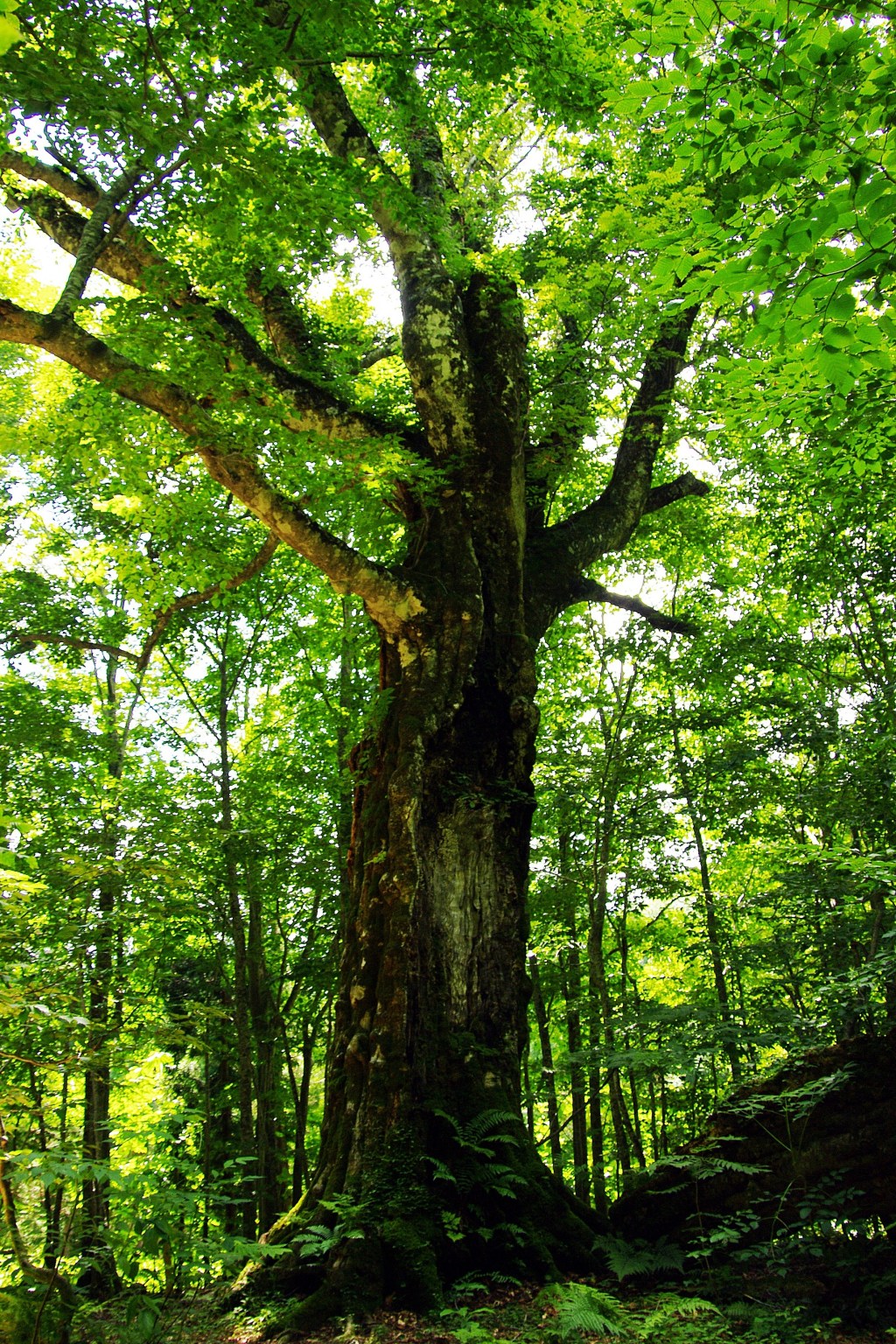
Shirakami-Sanchi is a mountain range covered by a forest that has never been logged. Not replanted, not managed, not cleared: an unbroken beech wood that has been growing and dying and regrowing since the last ice age, across the border of Akita and Aomori in northern Tohoku. In 1993 it became one of Japan’s first natural World Heritage sites.
The name means the range of the white god, and the forest does feel like a place with its own rules. Beech trees hold the water, the undergrowth is open and green, and the light comes down in a way that broadleaf forest does not usually allow. It is also wet, quiet and full of bears, which is why the walking is more regulated than the maps suggest.
This guide covers the three gateways (Juniko, Anmon and Fujisato), the 2026 state of the trails, which are actually open, how to reach them by train and bus, and what to do when the weather or a closure changes the plan.
Why Shirakami
Because this is the largest remaining virgin beech forest in East Asia, and you can walk into it without a permit on several short trails. The core area is about 17,000 hectares, with a buffer of similar size, and the forest inside it has been left alone for so long that the soil, the fungi and the insects are as much the point as the trees.
Because the water is extraordinary. Beech forest holds rain like a sponge and releases it slowly, which is why the streams here run clear and cold all summer. Aoike, the blue pond at Juniko, is the famous example, but every river on the Aomori side has the same green-blue colour.
Because it is easy to combine with the rest of northern Tohoku. The Gono line along the Sea of Japan, Hirosaki’s castle park, the Oirase gorge and Lake Towada are all within a few hours, and the forest makes a good two-night stop between them rather than a separate expedition.
What the forest is
The dominant tree is the Japanese beech, Fagus crenata, a tall, smooth-barked deciduous tree that grows in cool, snowy mountains. Beech forest once covered much of northern Japan; almost all of it was cut for charcoal, timber and farmland during the Edo and Meiji periods. Shirakami survived because the terrain was too steep and the snow too deep to make logging pay, and because local opposition defeated a dam project on the Akaishi river in the 1960s.
The forest was inscribed by UNESCO in December 1993, together with Yakushima, as Japan’s first natural World Heritage properties. The listed core is 16,971 hectares, with a buffer zone of about 14,500. Inside it there is no logging, no road building and no motor traffic; outside it, the valleys are farmed and fished as they have been for centuries.
Wildlife is the reason the forest is protected rather than just admired. Black bears live here at one of the highest densities in Japan, along with Japanese serow, Japanese macaques, martens and the black woodpecker, kumagera, which is the symbol of the region. Golden eagles nest on the cliffs. None of this is guaranteed on a day walk, but the bear signs are everywhere: claw marks on beeches, stripped bark, and scat on the trail.
The three gateways
Shirakami is not one destination. It has three separate approaches, and choosing the right one matters more than any itinerary.
Juniko, on the Aomori side near the Sea of Japan, is the most popular and the easiest for a first visit. It is a cluster of 33 small lakes and ponds in the foothills, with a short walking circuit, the blue Aoike at its centre, and a railway station 15 minutes away. It is forest edge rather than deep forest, but it is beautiful and accessible.
Anmon, in Nishimeya south of Hirosaki, is the deep-valley approach: a gorge with three waterfalls, a beech forest walk, and a visitor base at Aqua Green Village ANMON. It is the classic Aomori side, and in 2026 it is the one with the most closures.
Fujisato, on the Akita side, is the quietest and the most serious. The World Heritage Centre Fujisato-kan explains the ecology, the trailheads for Shirakami-dake and the western ridges start nearby, and the village has a handful of inns. Few foreign visitors come here, and that is part of the appeal.
Getting there
From Tokyo, take the Akita Shinkansen to Akita (about 3 hours 50 minutes), then the Ou line north to Futatsui (about an hour). Fujisato is a 20-minute taxi ride from Futatsui, or a shared taxi booked at least an hour in advance. The village’s shared rides are limited: one service runs only on Saturdays, and none on Sundays and holidays, so a car or a taxi is the realistic option for the Akita side.
For Juniko, take the Ou line to Higashi-Noshiro and change to the Gono line, or come from Akita along the coast. Juniko Station is a small stop on the Gono line with a view of the sea; from the station, the Konan bus runs to Aone Shirakami Juniko in about 5 minutes for 250 yen, and on to the Oku-Juniko car park in about 15 minutes for 700 yen. In 2026 the bus runs from 16 April to 30 November, with departures from Juniko Station at 9:30, 10:30, 11:35 and 13:10, and returns from Oku-Juniko at 11:15, 12:50, 15:00 and 15:40.
For Anmon, take the Shinkansen to Shin-Aomori and the Ou line to Hirosaki (about 35 minutes), then a bus from Hirosaki Bus Terminal. The direct Anmon-Shirakami-go bus in 2026 runs only on Saturdays, Sundays and holidays between 19 September and 31 October, taking about 90 minutes. On weekdays there is no direct bus, and a taxi or rental car from Hirosaki (about 50 minutes) is the alternative.
By car, the Tohoku Expressway serves both sides: Fujisato is about 50 minutes from Odate-Minami or 15 minutes from Futatsui-Shirakami, and Nishimeya is about an hour from Hirosaki or Owani. Juniko is reached from the Noshiro-minami or Fukaura exits, then the Juniko Park road.
Getting around
A car is close to essential for the Akita side and for linking Juniko with Anmon. Roads are good but narrow, and the mountain road between Anmon and Tsurugidake is gravel in parts. The Shirakami Line is open from Sakose to Anmon and on to Tsurugidake, but the section beyond Tsurugidake toward Fukaura is closed indefinitely after typhoon damage, so you cannot drive through from Aomori to the coast.
On the Aomori side, the 2026 road situation is worth checking the day before you travel. The Tsugaru-Shirakami line to Anmon reopened in April, the section to Tsurugidake reopened in late May, and the Futatsui line between Nishimeya and Akita reopened on 19 October for the first time in four years. The Akaishi ravine road is still closed, with guided walks the only way in.
Snow closes the high roads from November to April, and the Juniko area closes to unguided visitors from December to March. In winter the forest is accessible only with a guide, on snowshoes.
Juniko and Aoike
Juniko means twelve lakes, but there are 33, and the name comes from the twelve that can be seen from the ridge above. They were formed when a slope collapsed in an earthquake in 1704 and dammed the valleys. The circuit from the Oku-Juniko car park takes about 90 minutes at a slow pace, past small ponds, a giant Japanese cedar and the two famous ones: Aoike and Konagoshi.
Aoike is the reason people come. It is about 9 metres deep, fed by springs, and the water absorbs red light so completely that it looks artificially blue, with fallen beech trunks visible on the bottom through the clarity. The colour is strongest in the morning, when the sun is high enough to reach the water but the pond is still in shade. It is a five-minute walk from the car park and there is a railing and a viewing platform; expect company.
The rest of the circuit is quieter. The Juniko visitor centre and the Shirakami Juniko Eco Museum, near the station and the lakes respectively, explain the geology and the forest. The eco museum is open 9:00 to 16:30 and closed on Mondays and Tuesdays; the visitor centre is open 9:00 to 16:00 from April to November and closed in winter.
Parking at Oku-Juniko is paid, and the car park fills by mid-morning in autumn. The bus is the better choice if you are coming by train, and it drops you at the same place.
The Anmon falls
Anmon is a gorge in the Shirakami foothills with three waterfalls, and in a normal year it is the most accessible deep-forest walk on the Aomori side: a path along the river, a steep wooden staircase, and the three falls in sequence.
In 2026 it has been a difficult year. Heavy rain closed the gorge repeatedly through the summer, and as of late October the second and first falls remain closed, the third fall was closed again on 19 October after more rain, and a partial reopening on 23 October allowed walkers to reach about 2 kilometres in, near the Futamata junction, until 8 November. That section requires a written route notification at the trailhead and a helmet, which can be rented for 100 yen. The situation changes with every storm; check the visitor centre’s notice board the same morning.
The forest walk itself is still worth it. The path follows the Anmon river through beech and maple, with the water running green over the rocks, and the autumn colour in late October is the best of the year. If the falls are closed, walk as far as the barrier and enjoy the river; do not duck the tape.
Shirakami-dake
The highest point of the range is Shirakami-dake, 1,235 metres, a broad beech-covered summit with a view over the whole forest to the sea. It is a real mountain walk, not a stroll: three to four hours up from the Fujisato side, with no water on the trail and a long ridge section exposed to the weather.
The shorter approach starts near Fujisato and climbs through beech forest to the ridge, then follows it to the summit. The longer Juniko course starts from the lakes and traverses several peaks; it is for fit walkers, has more up and down than the distance suggests, and the prefecture advises carrying plenty of water. Both routes are open in 2026, with the usual warnings about bears and sudden fog.
If you want the view without the climb, the drive up the Shirakami Line to Tsurugidake, and the short walk to the Mother Tree, gives a high-altitude taste of the forest. The Mother Tree, a giant beech estimated at 400 years old, died in 2024 and the path now stops short of it for safety, but the surrounding stand of old trees is still impressive.
The World Heritage Path
Near Anmon, the World Heritage Path is a short, well-made trail through beech forest with interpretive signs, a small loop and a longer circuit. The short loop reopened in May 2026 after storm damage, and the long loop followed in late August. It is the easiest place to feel the forest without committing to a mountain, and it is where guided walks start.
The Fujisato side has its own version: the Shirakami Sanchi World Heritage Centre, a free museum with exhibits on the beech forest, its water cycle and its wildlife, open 9:00 to 17:00 from March to November, closed on Tuesdays. The staff keep a current trail map and will tell you honestly which paths are passable. Behind the centre, the trails into the forest start within walking distance.
Where to stay
Juniko has the best accommodation for a first visit. Aone Shirakami Juniko, five minutes from the station, has Finnish-style cottages, a restaurant and a shop, and runs guided walks; it is the base for the lakes. There are also small pensions and minshuku in the villages along the Gono line, and the seaside onsen inns at WeSpa Tsubakiyama and Furofushi Onsen are 20 to 40 minutes away by bus.
Anmon has Aqua Green Village ANMON, a cluster of cottages and a restaurant at the trailhead, with free parking for cars and a direct bus from Hirosaki in season. It is the most convenient place to stay if the falls are your priority.
Fujisato has a handful of small inns and guesthouses, plus the World Heritage Centre; it is quiet, cheap and close to the Shirakami-dake trailhead, but you need a car or a taxi. Hirosaki and Noshiro are the fallback for business hotels, restaurants and late arrivals, at the cost of an hour’s drive each way.
Book ahead in autumn and on the October weekends when the Anmon bus runs. Winter accommodation is limited, and some places close entirely from November to April.
Food and drink
This is mountain food, not destination dining. Soba, wild vegetables, grilled river fish, local pork and rice are the staples, and the restaurants at Aone, ANMON and the roadside stations do them well. Juniko’s Kyororo shop sells local vegetables, beech-themed sweets and coffee, and the Gono line stations have small stands selling squid and soft ice cream.
Akita sake and Aomori cider are both worth trying; the Fujisato area has small breweries, and the Aomori side is cider country. In Hirosaki, the apple-based sweets and cider are the local speciality, and the city has the best restaurant choice within an hour.
Do not expect dinner after 19:00 outside the hotels. If you are self-catering, buy food in Noshiro, Hirosaki or Fukaura before you head up, because the villages have one shop at most.
Seasons
The forest is open from late April to early November for most visitors. Spring arrives late: the beeches leaf out in mid-May, and the fresh green lasts about three weeks. Summer is cool and wet, with rain most weeks and mosquitoes in the valleys, but the forest is at its densest and the rivers are full.
Autumn is the peak. The beeches turn yellow and copper from mid-October, the maples add red, and the Juniko ponds reflect the colour. It is also the busiest few weeks, especially at Aoike, and the Anmon bus only runs at weekends until the end of October. Winter is for guided snowshoe trips only: the Juniko area closes, the roads are snowbound, and the forest is silent under two metres of snow.
Whatever the season, the weather changes fast. Fog, rain and sudden temperature drops are normal, and the mountain sections can be cold even in August. Carry a rain shell and a warm layer on every walk.
Two days in Shirakami
Day 1: Juniko
Take the early train to Juniko Station, drop your bag, and take the bus to Oku-Juniko. Walk the lake circuit in the morning, spend time at Aoike before the crowds, then visit the eco museum. In the afternoon, walk back to Aone or take the bus, and stay the night near the lakes.
Day 2: Anmon or the mountain
With a car, drive to Anmon in the morning for the gorge walk and the World Heritage Path, then return via Hirosaki. Without a car, take the Gono line back to Higashi-Noshiro and the Ou line to Hirosaki, then the Anmon bus if it is running. If you want the summit instead, base in Fujisato and climb Shirakami-dake, allowing six to seven hours for the round trip.
With three days, add the Fujisato centre and a drive up the Shirakami Line to Tsurugidake, or continue north to Lake Towada and the Oirase gorge.
Budget
Shirakami is cheap once you are there. The Juniko bus is 250 to 700 yen, parking at Oku-Juniko is a few hundred yen, the museums are free or nearly so, and the trails cost nothing. Accommodation is the main expense: cottages at Aone or ANMON run about 12,000 to 20,000 yen per person with two meals, and small minshuku are cheaper.
The big cost is access. A rental car for two days is 10,000 to 14,000 yen plus fuel, and the Shinkansen from Tokyo is the largest single item. A two-night trip from Tokyo, with a car, is realistically 60,000 to 80,000 yen per person.
Practical tips
- Check the trail and road status the same morning. Closures here change weekly after rain.
- Carry a bear bell and walk in company. Bear sightings are common, attacks are rare, and noise is the best prevention.
- Do not leave food in your car or pack within reach; bears here are not habituated but they are numerous.
- Wear boots with grip. The Anmon path and the Juniko circuit are wet and slippery even in dry weather.
- Take water. The Shirakami-dake trails have no water source, and the huts are unmanned.
- Fill in the route notification at the Anmon trailhead and wear the helmet when the gorge is partly open.
- Do not fly drones. The World Heritage area bans them, and the rangers enforce it.
- Stay on the boardwalk at Aoike; the banks are fragile and the pond is small.
- Book the Anmon bus and any guided walk in advance; the weekend service fills in October.
- Bring cash. The villages have few ATMs and some places do not take cards.
- Expect no phone signal in the valleys; download maps before you leave.
- Do not count on the Shirakami Line as a through road to the coast; the western section is closed.
Before you go
Choose your gateway before you book anything. Juniko is the easy introduction, Anmon is the gorge, Fujisato is the mountain. Trying to do all three in two days without a car is a mistake, and even with a car it is a lot of driving for a forest that rewards sitting still.
Then check the two things that change every week: the road and trail closures, and the weather. Shirakami is a rainforest in all but name, and a plan that ignores the forecast will spend a lot of time in a car park. The best days here are grey and damp, when the beeches darken and the water turns bright, so do not cancel a walk because of drizzle; do cancel it for a typhoon or a closure notice.
Finally, accept the scale. The core forest is enormous and almost entirely roadless, and the trails only touch its edges. That is the point. You are not going to see Shirakami; you are going to stand inside a piece of it for a few hours, which is more than most people manage.
Sources
- Shirakami-Sanchi Visitor Center: 2026 road, trail and closure notices (checked 2026-10-26)
- Shirakami-Sanchi World Heritage Centre Fujisato: access and hours (checked 2026-10-26)
- Aqua Green Village ANMON: 2026 Anmon-Shirakami-go bus dates (checked 2026-10-26)
- Konan Bus: 2026 Juniko line timetable and fares (checked 2026-10-26)
- Juniko Eco Museum: bear advice and facility hours (checked 2026-10-26)
- Aomori Prefecture: Shirakami-dake Juniko trail maintenance (checked 2026-10-26)
- Lake Towada Travel Guide — the caldera lake to the east
- Oirase Gorge Travel Guide — the stream walk nearby
- Hirosaki Park Travel Guide — castle and cherry blossom
- Hachinohe and Tanesashi — the Pacific coast
- Nyuto Onsen Travel Guide — hidden hot springs
- Kakunodate Travel Guide — samurai streets


Leave a Reply