Plan a visit to Zakimi Castle in Yomitan, Okinawa, a World Heritage gusuku with a restored arch gate and views over the coast.
Operational details such as opening hours, admission fees, and train times can change. Prefer official pages and reconfirm before you travel (sources checked on 03 November 2026).
Why visit
- Zakimi Castle is a small gusuku on a 120-metre hill in Yomitan, and its walls are the most beautiful in Okinawa. They are built in Ryukyu limestone, laid in gentle curves rather than straight lines, and the curves are structural: the plan of the ramparts resembles the arch of a modern dam, which is what allowed the walls to stand on soft ground and what made them strong enough to survive five centuries. The result is a fortress that looks like sculpture, and it is the reason the castle is included in the World Heritage listing of the Gusuku Sites and Related Properties of the Kingdom of Ryukyu.
- The castle was built in the early fifteenth century by Gosamaru, the lord of Yomitan, who is remembered as the great castle builder of the Ryukyu Kingdom and who is said to have built Zakimi as his masterpiece. He had been based at Yamada Castle about four kilometres to the north-east, joined Shō Hashi’s campaign against Nakijin Castle in 1416, and then moved here for the position. The story matters because it places the castle in the moment when Okinawa was being unified, and because Gosamaru’s later fate, ordered to take his own life at Nakagusuku, gives the place a shadow that the sunny walls do not suggest.
- The site is free and open all the time, which is rare for a World Heritage property in Japan. There is no gate, no ticket office and no closing hour, and the walls can be climbed, with a few areas roped off. That freedom changes the visit: you can come for the sunrise, for the late afternoon light on the stone, or on a rainy day when the limestone turns dark and the curves read more clearly.
- The view is the other reason. From the highest part of the walls you can see almost the whole of Yomitan, the cane fields and the villages and the sea on the west coast, and on a clear day the horizon is the East China Sea. The hill was chosen for exactly that, and standing on the rampart is the fastest way to understand why the castle is where it is.
- The museum next to the car park is the part that turns a pretty ruin into a history. The Yuntanza Museum reopened in 2018 at twice its former size, with a ground floor on the castle and the natural and cultural heritage of Yomitan, and an upper floor on archaeology, folk life, nature and the Battle of Okinawa, including dioramas of the caves and the turtle-back tombs. It is cheap, it is air-conditioned, and it explains what you are looking at.
- The practical case is strong. Zakimi is 10 to 15 minutes on foot from a bus stop on the main Naha to Yomitan line, five minutes by car from the Route 58 Kina intersection, and free to park. It combines with Cape Zanpa, the Yomitan pottery village and the beaches of the west coast, and it takes an hour or two rather than a day.
Top places and highlights
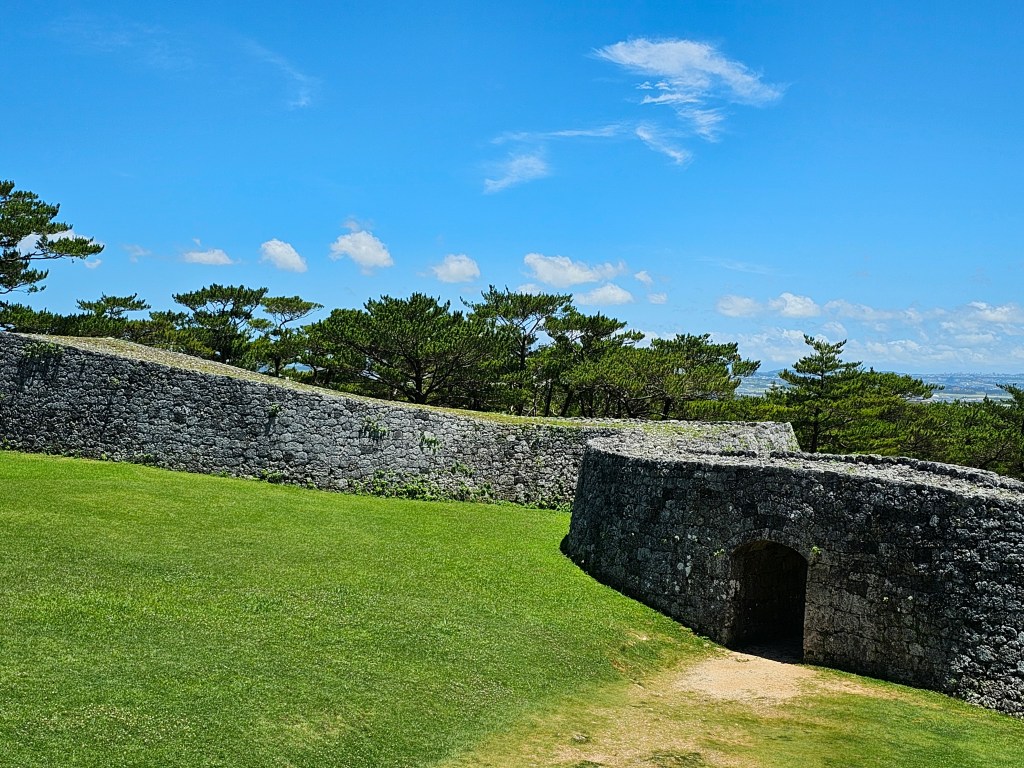
The curved ramparts
The walls are the reason to come. They are laid in Ryukyu limestone in broad curves, with the plan of each section acting like an arch to spread the load on soft ground, and the joins between the curves are placed where defenders could watch the approaches. Most of the wall is in the nozura-zumi and uchia-ishi styles, with some of the more formal work, so the main techniques of Okinawan castle building are visible in one small site.
The two enclosures and the stone gate
The castle has two main enclosures, an outer wall running 365 metres around an area of 7,385 square metres, and an arched stone gate that is the image most people carry away. It is a medium-sized castle for the early fifteenth century rather than a vast one, which is why an hour is enough to walk it properly and why the detail matters more than the scale.
The view from the rampart
The hill is about 120 metres high and the top of the wall gives a 360-degree view over almost all of Yomitan, with the cane fields, the villages, the west coast and the sea. The wall can be climbed and there are no railings, which is why the castle asks visitors to be careful, particularly at New Year when people come for the first sunrise and the walls are crowded. It is the best free viewpoint in the village.
The Yuntanza Museum
The museum beside the car park reopened in 2018 with twice the floor area of the old village history museum, and it covers the castle, the nature and crafts of Yomitan, and the archaeology and folk life of the island, with a section on the Battle of Okinawa and dioramas of the caves and tombs. It is open 9:00 to 18:00 with last entry at 17:30, closed on Wednesdays and over New Year, and admission for visitors from outside the village is 500 yen for adults and 300 for school students.
The New Year’s sunrise
On 1 January the castle fills before dawn with people coming to see the first sunrise of the year from the walls, and the museum is closed but the castle is open as usual. It is the one time the site is crowded, and the village asks visitors not to enter the roped-off areas or climb the walls in the crush, since there are no barriers at the top. It is a local tradition rather than a tourist event.
Gosamaru’s story
Gosamaru built Zakimi after the fall of Nakijin and later moved to Nakagusuku Castle for the king, where he was accused of rebellion and ordered to die. The story is told at the museum and it gives the castle a human scale: the walls were built by a man whose career ended badly, and the fortress he left is the thing that survived him. It is the thread that connects Zakimi to Nakagusuku and Katsuren, the other two castles of his career.
Yomitan pottery
The village is one of the centres of Okinawan ceramics, and the Yachimun no Sato kiln village in Yomitan, a short drive from the castle, has workshops and a shop where the local ware is made and sold. It is the best thing to combine with the castle, since the colours and the clay are the same limestone landscape the walls are built from. Check opening days before you go, as the workshops keep their own hours.
Food and drink
- Yomitan is not a food destination, but the village has the Okinawan staples done well: soba with pork and bonito broth, taco rice, and the sweet potato pastries of the island. The cafes along the west coast are the pleasant option, with sea views and long opening hours.
- The village is known for its vegetables and its herbs, and the farmers’ markets sell the bitter melon, the sea grapes and the shikuwasa citrus that define Okinawan cooking. The local markets are the place to buy them rather than the souvenir shops.
- The west coast around Cape Zanpa has restaurants overlooking the water, and the seafood and the Okinawan pork dishes are the things to order. The area is quiet outside the Japanese holiday periods.
- The pottery village has a cafe, and combining a visit to the kilns with lunch there is the natural pairing. The Okinawan sweets and the coffee of the island are the local specialities, and the brown sugar and the salt of the outer islands are the take-home items.
Getting there and around
- By bus, take the Naha Bus Terminal routes 29 or 62 on the Yomitan line via Kina and get off at the Zakimi stop, from which the castle is about 10 to 15 minutes on foot. The route 28 via Sokabe stops at Takashio Iriguchi, about 20 minutes away, and the route 20 or 120 from Nago stops at Kina, about 30 minutes away.
- By car, the castle is about five minutes from the Kina intersection on Route 58, and about an hour and ten minutes from Naha Airport. There are free car parks, with a new south car park opened in April 2024, and the one nearest the main entrance is small and fills quickly, so it is worth driving on to the larger one behind the castle.
- There is no railway in Okinawa outside the Naha monorail, so the castle is reached by bus, car or taxi. A taxi from Naha is expensive, and the bus is slow but direct, and the walk from the stop is flat until the last slope.
- The castle is always open and free, and the museum beside it is open 9:00 to 18:00 with last entry at 17:30, closed on Wednesdays and from 28 December to 4 January. If the museum is closed, the castle is still worth the trip.
Where to stay
- Yomitan has guesthouses, small hotels and a few resort hotels on the west coast, and staying in the village means the castle can be visited at sunrise or in the evening when it is empty. It is a quieter base than Naha or Chatan.
- Chatan and Okinawa City are 20 to 30 minutes away and have the largest concentration of hotels, restaurants and shops, and the American military presence that shapes the food and the nightlife. It is the practical base for the central west coast.
- Naha, an hour away, is the transport hub and the place with the most accommodation. Staying there makes Zakimi a day trip combined with Cape Zanpa and the pottery village, which is how most visitors do it.
Best time to visit
- Spring is the best season, with warm but not oppressive weather, the cane fields green and the sea clear, and the castle at its most comfortable. The Okinawan cherry blossoms, the kanhizakura, open in January and February, earlier than on the mainland.
- Summer is hot and humid, with strong sun on the exposed walls, and the visit is best done early in the morning or in the late afternoon. The sea is at its best and the west coast beaches are the reason many people come.
- Autumn is warm and relatively dry, with the typhoon season tapering off in September, and the light on the limestone is at its best. October and November are the most reliable months for a visit that includes both the castle and the coast.
- Winter is mild by mainland standards, with the castle quiet and the New Year sunrise the one crowded day, and the whale watching season off the Kerama and Zamami islands beginning in January. It is a good season for the museum and for walking without heat.
Practical tips
- Go early or late, not at midday. The walls are exposed, there is no shade on the ramparts, and the light is at its best in the first and last hours. The castle is open all night, which makes a sunset visit easy.
- Wear shoes with grip. The paths inside the castle are grass and limestone, and the steps up to the wall are uneven, and the rampart has no railing at the top. It is not a difficult walk, but sandals are a bad idea.
- Park at the south car park. The spaces nearest the entrance are few and fill quickly, and the larger car park behind the castle was added in 2024. Both are free, and the walk from the back is short and passes the walls.
- Visit the museum first if it is your first gusuku. It explains the castle, the techniques and the history in air-conditioned comfort for 500 yen, and the walls make much more sense afterwards. It is closed on Wednesdays, which is worth checking.
- Combine the castle with Cape Zanpa and the pottery village. They are within 15 minutes of each other by car, and the combination makes a full half day rather than a 40-minute stop. The cape has the lighthouse and the cliffs, the kilns have the local ceramics.
- Do not climb the walls on New Year’s Day if you are not comfortable in a crowd. The first sunrise draws a large crowd, there are no barriers on top and the village asks people not to enter the roped-off areas or push up the walls. It is a local tradition, and it is not managed like an event.
- Respect that this is a historic site and not a park. There are no bins and no facilities beyond the museum, the grass is not a picnic lawn in the way a city park is, and the roped-off areas protect the masonry. The freedom of access is a privilege rather than a licence.
Suggested day-trip outline
- Take the route 29 or 62 bus from Naha Bus Terminal to the Zakimi stop, about an hour, and walk 10 to 15 minutes up to the castle, or drive from Route 58 at the Kina intersection in five minutes and park at the south car park.
- Walk the two enclosures and climb the rampart for the view over Yomitan and the sea, then sit on the grass inside the walls for a few minutes. The castle is small enough that the visit is about the stone rather than the distance, and an hour is enough without the museum.
- Visit the Yuntanza Museum for the castle’s history, the techniques of the walls, and the folk life and wartime history of the village. It takes about 45 minutes and it is the part that explains what Gosamaru built and why.
- Drive to Cape Zanpa for the lighthouse and the cliffs, about 15 minutes away, and eat lunch on the west coast. Then go to the Yachimun no Sato pottery village to see the kilns and buy a piece made in the village.
- Return to Naha in the evening, or stay on the west coast for the sunset. If you have a second day, the castle is worth a second visit at sunrise, when the light comes up over the hills behind it and the walls are empty.
Before you go
Timetables, fares, admission fees, and seasonal access rules can change. Check the official tourism and transport sites linked below for the latest information before you travel.
Explore More of Japan
Published guides that pair with this one:
- Katsuren Castle Ruins Travel Guide: A Gusuku above the East Coast
- Nakagusuku Castle Ruins Travel Guide: A Gusuku without a Keep
- Nakijin Castle Ruins Travel Guide: A World Heritage Gusuku
- Shuri Castle Guide: The Heart of the Ryukyu Kingdom
- Okinawa Travel Guide: Discover Japan’s Tropical Paradise
- Shikinaen Garden Travel Guide: Naha’s Ryukyu Royal Garden
- Kouri Island Travel Guide: The Heart Rock and a Bridge over Emerald Water
- Okinawa Prefectural Museum and Art Museum Travel Guide: Highlights, Access, and Planning
- Okinawa Peace Memorial Park Guide: Mabuni and the Battle Sites
- Tokashiki Island Guide: A Kerama Day Trip from Naha
Browse every Okinawa guide on this site for the rest of the region.
Sources
- vill.yomitan.okinawa.jp (checked 2026-11-03)
- okinawastory.jp (checked 2026-11-03)


Leave a Reply