Plan a visit to Shikinaen, the Ryukyu royal garden in Naha, with opening hours, admission, access, and what to see.
Operational details such as opening hours, admission fees, and train times can change. Prefer official pages and reconfirm before you travel (sources checked on 03 November 2026).
Why visit
- Shikinaen is the largest of the Ryukyu royal family’s villas and the only one of its gardens that survives, built in 1799 as a retreat for the royal household and a place to receive foreign envoys. It is in Naha, twenty minutes from the city centre by bus, and it is a World Heritage site as part of the Gusuku sites of the Ryukyu Kingdom. For anyone trying to understand what the Ryukyu court actually was, rather than only what its castles looked like, this is the most legible place in the city.
- The garden is a strolling garden of the kind Japanese lords competed to build in the early modern period, but it is not a copy of a Japanese garden. The centre is a pond shaped like the character for heart, with a Chinese-style hexagonal pavilion on an island, stone arches, and walls of Ryukyu limestone around the water. The result is a garden that reads as Japanese in structure and Ryukyuan in detail, which is exactly what the kingdom was: a maritime trading state that sat between China and Japan and borrowed from both.
- The history is unusually well documented. The garden was built in 1799 and received the Chinese investiture envoys Zhao Wenkai and Li Dingyuan in 1800, when they came for the investiture of King Sho On. The royal family had already built an earlier villa in 1677 at Sakiyama in Shuri, which was called the East Garden because it lay east of Shuri Castle; Shikinaen, south of the castle, was called the South Garden. That pairing is the clearest evidence that these gardens were part of a courtly landscape arranged around the castle.
- The site is also a record of loss and reconstruction. It was designated a national Place of Scenic Beauty in 1941, then destroyed in April 1945 during the Battle of Okinawa, and rebuilt between 1975 and 1996 at a cost of 780 million yen. It was redesignated in 1976, made a Special Place of Scenic Beauty in March 2000, and inscribed as World Heritage in December 2000. The garden you walk through is therefore a careful modern reconstruction of a pre-war landscape, and knowing that changes how you look at the stonework.
- The practical case is simple: it costs 400 yen, it takes an hour to an hour and a half, it is reachable by city bus without a car, and it is quieter than Shuri Castle. It is also a garden rather than a museum, which makes it a good counterweight to the castle and the war sites that fill most Naha itineraries. The downside is the Wednesday closure, which catches visitors out more than any other detail here.
Top places and highlights
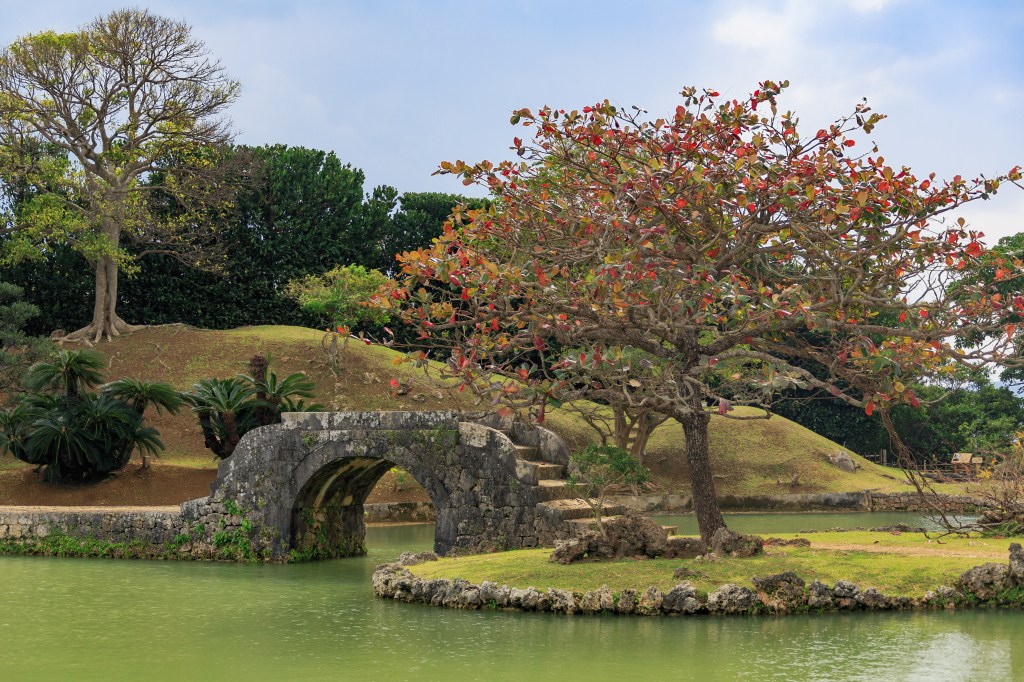
The heart-shaped pond and the hexagonal pavilion
The centre of the garden is a pond shaped after the character for heart, with an island in it, and on the island a Chinese-style hexagonal pavilion called the Rokkakudo. Stone arches and bridges are arranged around the water, and the path circles it so that the composition changes with every few steps. This is the image most people carry away from Shikinaen, and it is the part where the Chinese influence on Ryukyu garden design is most obvious.
The Ryukyu limestone walls
The walls around the pond are built of Ryukyu limestone, stacked rather than cut into regular blocks, and the texture is completely different from the formal stonework of a Japanese castle garden. It is the detail that tells you where you are. Look at the wall as carefully as the pavilion, because the rough, fossil-rich stone is the material the Ryukyu islands are actually built from, and it appears all over the garden in paths, steps and edging.
The Udun and the court architecture
The garden contains an Udun, the reception building of the villa, built in the Ryukyuan style with the low, wide proportions and the red tile roof associated with the court. The buildings occupy about 643 square metres of the 41,997 square metre site, so they are small in proportion to the grounds, which is the point: this is a landscape with buildings in it rather than a house with a garden attached. It is the closest thing in Naha to seeing how the royal family lived outside the castle.
The seasonal planting
The garden was designed so that a place known for eternal summer would still show the seasons: plum in the eastern grove whose scent carried across the water, wisteria near the island and the spring in summer, and balloon flower by the pond in autumn. The planting today follows that intention rather than reproducing it exactly, and it means the garden is not a single-season sight. Late winter and early spring, when the plum is out, is the period the original design was most obviously built around.
The view from the upper path
The strolling route rises onto higher ground behind the pond, and from there the whole composition is visible at once: water, island, pavilion, the curve of the limestone wall and the trees closing the view. Most visitors walk the lower path and leave; the upper circuit is what makes the garden a strolling garden rather than a pond, and it is where the design reveals itself as a sequence of deliberately framed views rather than a single picture.
The quiet
Shikinaen is in a residential district rather than a tourist zone, and even in a busy season it is far calmer than Shuri Castle or the Peace Park. That quiet is not incidental: the villa was built as a retreat, and the garden still functions that way. For anyone assembling a Naha itinerary of castles and war memorials, an hour here is the pause that makes the rest of the day work.
Food and drink
- There is no restaurant inside the garden, and eating and drinking are prohibited on the grounds, so this is not a lunch stop. The nearest food is in the surrounding residential streets and back towards the city, which are ordinary neighbourhood territory rather than a dining district.
- The practical arrangement is to eat before or after, in central Naha, where the choice runs from Okinawa soba to the izakaya streets around Makishi. The bus into Shikinaen passes through the city, so a meal before the visit costs nothing in detours.
- Okinawa soba is the local dish worth making time for, and the standard version is a pork-bone broth with wheat noodles and braised pork belly, served with pickled ginger. It is a lunch dish rather than a dinner one, and most shops close in the late afternoon.
- If you are combining Shikinaen with Shuri Castle, the area around Shuri has more options than the area around the garden, including the Makishi and Shuri shopping streets. Doing the castle first and eating there before coming south to Shikinaen is the more efficient order.
Getting there and around
- By bus, Naha Bus routes 2, 3, 4, 5 and 14 all stop at Shikinaen-mae, which is the stop for the garden, and the ride from the city centre takes around twenty minutes depending on traffic. Route 2 is the Shikina-Kainan line, 3 the Matsukawa-Shintoshin line, 4 the Shinkawa-Omoromachi line, 5 the Shikina-Makishi line and 14 the Makishi-Kainan loop.
- The garden has a free car park, which is unusual for a World Heritage site in a city, and it makes the garden one of the easier sites in Naha to reach by car. The trade is that the car park is small and first-come, so it fills quickly on holidays and in the plum season.
- There is no monorail station at the garden, and the Yui Rail does not serve this part of the city, so the bus or a car is the only practical way in. By car from Naha Airport the drive is around 45 minutes, which is longer than the distance suggests because of city traffic.
- The garden is in the Maja district south-east of the city centre, and it pairs naturally with Shuri Castle to the north rather than with the Naha waterfront. A taxi between the two is short enough to be worth considering if you are short of time and do not want to route through the bus terminal.
Where to stay
- Staying in central Naha around Kokusai Street or the bus terminal is the practical choice, with the garden a short bus ride away and everything else in the city walkable. This is where most visitors stay and it makes Shikinaen an easy half-day.
- The Shuri area, near the castle, suits anyone whose priority is the Ryukyu heritage sites, and it puts Shikinaen and Shuri Castle on the same day without crossing the city. It is quieter in the evening, with fewer restaurants.
- The Naha waterfront and the area around the Miebashi monorail station is the alternative for anyone who wants the port, the fish market and the nightlife in walking distance. The garden is then a bus ride south, which is a small cost for a better evening.
Best time to visit
- The plum season in late winter and early spring is the period the garden was designed around, when the grove to the east of the pond comes into flower and the scent carries across the water, as the original account describes. It is the best reason to choose a date, and it is also when the garden is at its busiest.
- Spring brings the wisteria near the island and the spring, and the garden’s planting is at its most varied. Okinawa’s spring arrives early, so the window is February to April rather than the Japanese main-island calendar, and it is one of the best times to be outside in Naha at all.
- Summer is hot and bright, and the garden is at its greenest, but the stone paths and the open water offer little shade and the humidity is severe. If you visit in summer, go at opening time, which is 9:00, rather than in the afternoon.
- Autumn brings the balloon flower by the pond, which the original design specifically mentions, and the heat finally breaks in November. Winter is mild and dry, the garden is quiet, and the plum begins again in the new year, which is why the period from January to March is the strongest window overall.
Practical tips
- Do not come on a Wednesday. The garden closes every Wednesday, and when Wednesday is a national holiday or 23 June, Okinawa’s memorial day, it closes the following day instead. This single rule catches out more visitors than anything else here, and the city also posts temporary closures for maintenance that override the schedule.
- Check the opening hours by season. From 1 April to 30 September it is open 9:00 to 18:00 with last entry at 17:30, and from 1 October to 31 March it is 9:00 to 17:30 with last entry at 17:00. The garden is small enough that an hour is enough, but an hour and a half is better and the last entry time is strict.
- Wear shoes with grip. The garden’s own notice warns that the stone paving and the steps are slippery and uneven, and that they become worse when wet. Sandals and smooth soles are a bad choice here, and the paths are not suitable for anyone unsteady on their feet without assistance.
- Admission is cheap but the rules are firm. Adults pay 400 yen, children of junior high age and under 200 yen, groups of 20 or more pay 320 and 160 yen, preschool children with a parent are free, and holders of a disability certificate enter free with one carer. Naha residents aged 65 and over pay half price on the day ticket.
- Bring nothing to eat. Food, drink and smoking are all prohibited inside the garden, and there is no cafe on the site. Water is not sold there either, so drink before you arrive or plan on leaving for the nearest shop.
- Park for free but arrive early. The car park is free, which is rare for a site of this importance, but it is small. In the plum season and on holidays it fills, and the bus is then the simpler option even if you have a car.
- Combine it with Shuri rather than with the waterfront. The garden and the castle are the two halves of the Ryukyu court landscape, and seeing them on the same day makes both clearer: the castle as the seat of power, Shikinaen as the place the court went to be at ease and to receive its Chinese envoys.
Suggested day-trip outline
- Take Naha Bus route 2, 3, 4, 5 or 14 from the city centre to Shikinaen-mae, about twenty minutes, and arrive at opening time at 9:00. The garden is small enough that an early start leaves the rest of the day free, and the light on the pond is softest in the morning.
- Walk the lower path around the heart-shaped pond first, past the hexagonal pavilion and the stone arches, and then take the upper circuit behind the water for the view over the whole composition. Give the limestone walls and the Udun a few minutes each, because they are what distinguish this garden from a Japanese one.
- Leave by mid-morning and continue north to Shuri Castle, or return to the city for lunch. The two sites together are the clearest introduction to the Ryukyu Kingdom available in Naha, and doing them in this order moves from the court at leisure to the court in power.
- If you are in Naha in February or March, come back for the plum, which is the season the garden was designed around. If you are visiting in summer, do the garden first thing and plan to be indoors by midday, because the stone paths hold the heat.
- Finish with Okinawa soba somewhere in the city rather than near the garden, since there is nothing to eat on site, and use the bus route back through town rather than retracing the same streets on foot. The garden is a quiet hour rather than a day, and it works best as the opening of one.
Before you go
Timetables, fares, admission fees, and seasonal access rules can change. Check the official tourism and transport sites linked below for the latest information before you travel.
Explore More of Japan
Published guides that pair with this one:
- Shuri Castle Guide: The Heart of the Ryukyu Kingdom
- Okinawa Travel Guide: Discover Japan’s Tropical Paradise
- Naha and Kokusai Street Guide: Markets, Food and the Old Capital
- Sefa Utaki Travel Guide: The Ryukyu Sacred Grove in Nanjo
- Okinawa Prefectural Museum and Art Museum Travel Guide: Highlights, Access, and Planning
- Kouri Island Travel Guide: The Heart Rock and a Bridge over Emerald Water
- Okinawa Peace Memorial Park Guide: Mabuni and the Battle Sites
- Tokashiki Island Guide: A Kerama Day Trip from Naha
- Katsuren Castle Ruins Travel Guide: A Gusuku above the East Coast
- Yambaru National Park Travel Guide: Okinawa’s Northern Forest
Browse every Okinawa guide on this site for the rest of the region.
Sources
- information.okinawa (checked 2026-11-03)
- naha-navi.or.jp (checked 2026-11-03)
- okitour.co.jp (checked 2026-11-03)


Leave a Reply