Visiting the Usuki Stone Buddhas in Oita? This English guide covers the carvings, admission, access and the seasons.
Operational details such as opening hours, admission fees, and train times can change. Prefer official pages and reconfirm before you travel (sources checked on 04 November 2026).
Why visit
- The Usuki Stone Buddhas are the most important group of cliff carvings in Japan, and in June 1995 they became the first magaibutsu to be designated a National Treasure, and the first National Treasure in Kyushu. The designation covers 61 figures in four clusters, not a single image, which is the measure of how unusual the site is.
- The carvings were cut into the soft rock of a hillside between the late Heian period and the Kamakura period, roughly the twelfth to fourteenth centuries. The stone is welded Aso tuff, hardened pyroclastic flow from Mount Aso about 90,000 years ago, and it is soft enough to carve with the techniques of wooden sculpture. That is the technical explanation for why these figures are finer than most stone Buddhas in Japan.
- Nobody knows exactly who commissioned them or why. There is no record, only the prevailing theory that the Oga clan, which ruled the area from the end of the twelfth century, had them carved for its prosperity, and the local legend of a rich man or a charcoal burner who paid for them as a prayer for his daughter. The mystery is part of the site.
- What makes them worth a detour is the condition and the scale. The figures range from about one metre to about 2.8 metres, they are carved in relief into the living rock, and the four clusters are protected by shelters and roofs that let you look closely. The Dainichi Nyorai of the Furuzono cluster is the image the site is known by, and it is a genuinely great piece of Buddhist sculpture rather than a curiosity.
- The site is quiet and rural, on the edge of a small town in Oita, and it takes an effort to reach. That is part of the experience: the carvings are in the hillside where they were made, with moss and weathering and the marks of the tools still visible on the stone.
- Usuki itself is a pleasant small castle town with a reconstructed castle, a preserved merchant street and a reputation for fugu, and the stone Buddhas combine naturally with a half day in the town. It is a place to slow down rather than tick off.
- The site is also easy to use. It is open every day, the admission is modest, there is free parking and a free multilingual audio guide, and the volunteer guides are free with a booking. For a National Treasure in a rural setting, it is unusually accessible.
Top places and highlights
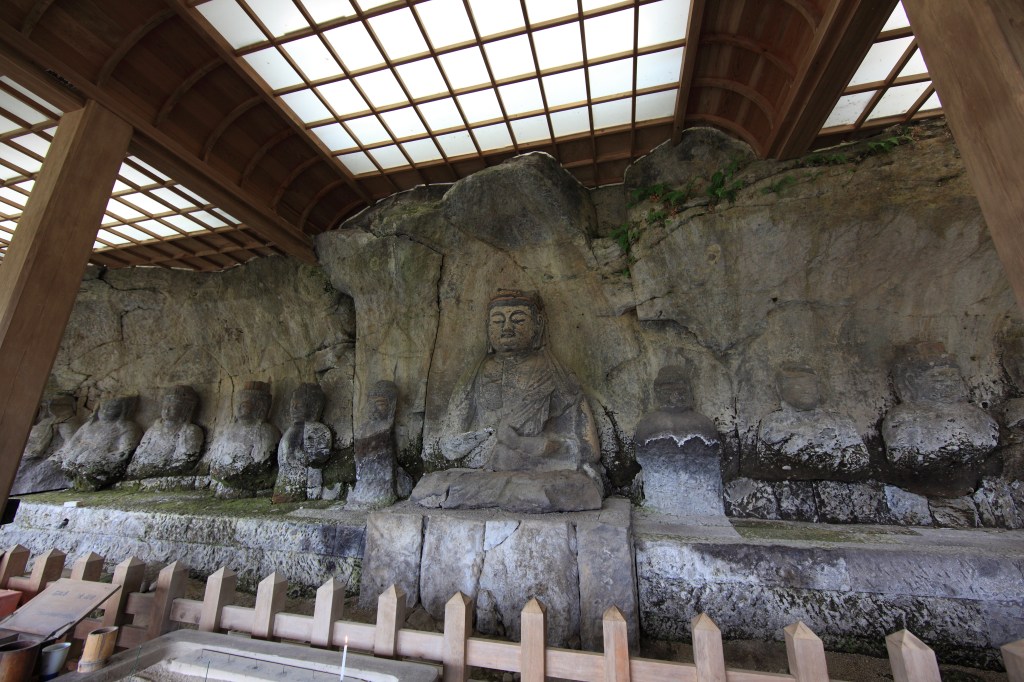
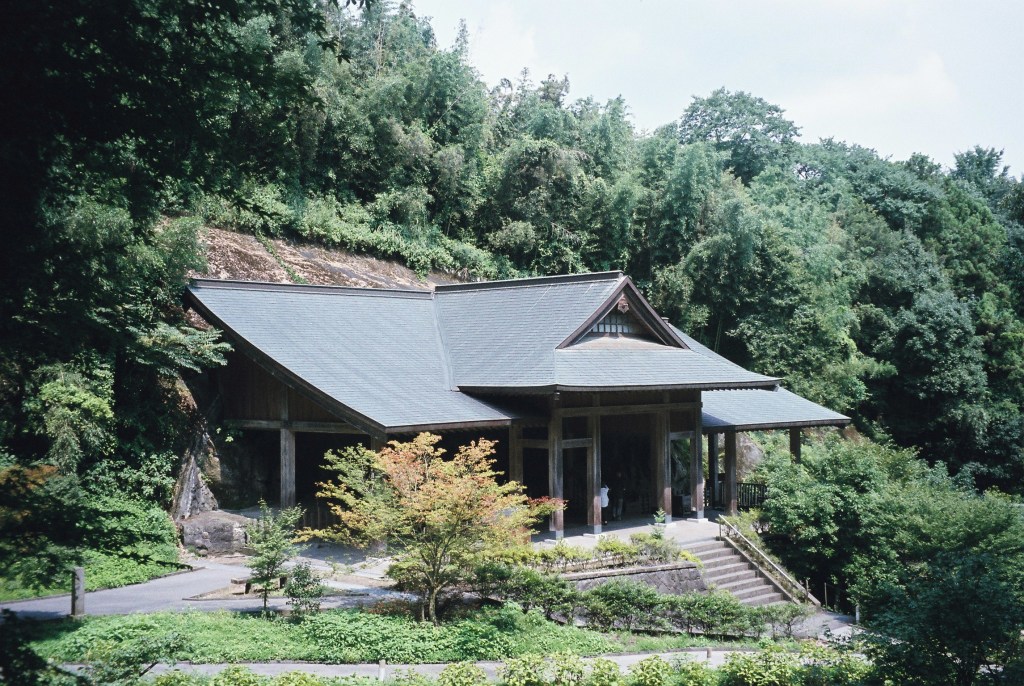
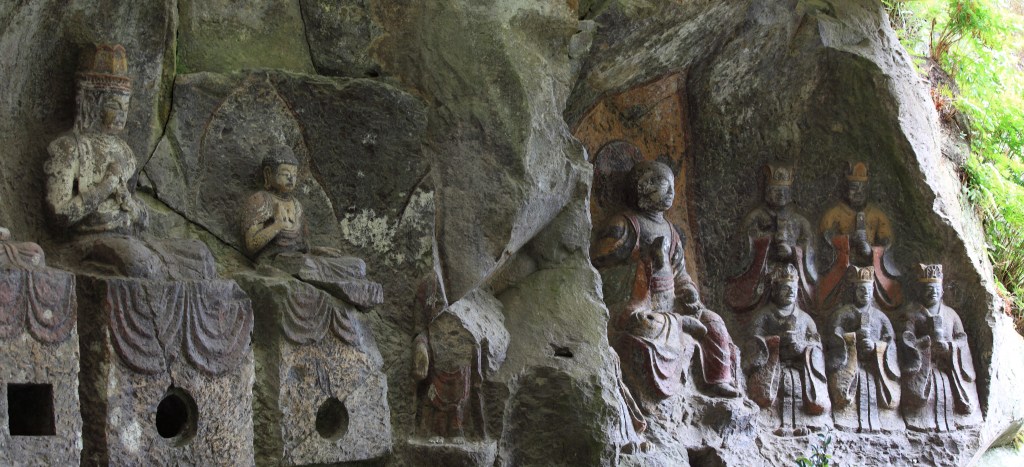
The Furuzono cluster and the Dainichi Nyorai
The Furuzono cluster is the climax of the visit and the image on every poster: a central Dainichi Nyorai about 2.8 metres high, carved in high relief and flanked by other figures, with the rock cut back to leave them standing out from the cliff. The face is the reason it is famous, with the faint red outline of the mouth and the deep-set eyes, and it was restored to its present form in 1993 after the head had fallen. Take your time here; it is the reason most people come.
The Hoki First cluster
The Hoki First cluster is made up of four galleries cut along the rock face, and together they hold more than twenty figures. The first gallery has three seated Buddhas and two standing bodhisattvas, the second a seated Amida with Yakushi Nyorai, the third a group including a Dainichi Nyorai, and the fourth eleven figures including a Jizo and the Ten Kings. It is the densest part of the site, and the place to look at details: jewellery, lotus pedestals and the small figures at the edges.
The Hoki Second cluster
The Hoki Second cluster has two galleries, and the first holds a splendid Amida Trinity with a central figure about five metres tall and two attendants, each carved with its own expression. The second gallery holds a group of smaller Amida figures known as the Nine Amidas. The scale of the trinity is the surprise of the site, because it is set back under its shelter and only reveals its size as you walk up.
The Sannosan cluster
The Sannosan cluster sits higher on the hillside, reached by a short climb, and it is known as the Hidden Jizo. The central figure has a round face with compact, childlike features, and the group is smaller and quieter than the others. The setting is part of the point: the figures are carved into a rock face with the valley behind you, and the walk between the clusters is what gives the site its atmosphere.
The carving technique
The figures are magaibutsu, carved in relief into the tuff rather than made as free-standing statues, and the technique is visible everywhere once you look for it. The stone is soft enough to cut and firm enough to hold detail, and the carvers used the natural shape of the rock rather than fighting it. The site was originally covered by a hut, which collapsed, and the figures were exposed for centuries before the restoration of the 1990s. Look at the edges of the groups, where the uncarved rock meets the figures.
The legend and the Oga clan
There is no document that explains the carvings, and two explanations fill the gap: the prevailing theory that the Oga clan, which ruled the area from the end of the twelfth century, commissioned them, and the local legend of a wealthy man or charcoal burner who carved them for his daughter. The site presents the legend as legend. Knowing both before you walk up changes how the figures read, because they were made to be permanent in a way that wooden statues could not be.
The volunteer guides
The site runs free volunteer guides for individual travellers between 10:00 and 15:00, for about an hour, with a booking three days ahead. They are local people who know the iconography and the archaeology, and they turn a row of carved figures into a set of identifiable Buddhas with names, attributes and dates. For a site where not every image is labelled, the guide is the difference between looking and understanding.
The Usuki town and the fire festival
Usuki is a small castle town with a reconstructed castle on the hill, the preserved Nioza merchant street below it, and the Inaba family residence, and the stone Buddhas are one part of a half day rather than the whole of it. The site also holds a fire festival on the last Saturday of August, when the approach and the clusters are lit by fire. It is a religious event rather than a show, so confirm the year’s arrangements with the town before planning around it.
Food and drink
- Usuki is a fugu town. The pufferfish is the local speciality, served as sashimi, hotpot and fried, and the restaurants around the station and the castle do it in season; the winter months are the classic fugu season, and the town’s reputation is built on it.
- Usuki somen is the other local food: thin wheat noodles, served cold with a dipping sauce in summer and in hot dishes in winter. It is a simple, everyday dish rather than a luxury one, and the shops in the town sell it dried to take home.
- The town has a small selection of restaurants rather than a dining district, and they keep town hours. Lunch is the reliable meal, and the choice narrows in the evening.
- The stone Buddhas site has a small rest area and vending machines rather than a restaurant, so eat before or after the visit. The town centre is a short drive or bus ride away.
- Buy the local sweets and the somen at the shops near the station rather than at the site, and try the fugu only at a restaurant that specialises in it. It is not a dish to improvise.
- If you are driving, the roadside stations and the farm shops on the way to Usuki sell the vegetables and the fruit of the Oita plain, and a picnic at the site is a reasonable plan in good weather.
Getting there and around
- By train, take the Nichinan line limited express from Oita to Usuki, about 35 minutes, and then a bus or taxi to the site. The bus from Usuki station to the Usuki Sekibutsu stop takes about 20 minutes and costs 200 yen, and the stop is at the entrance.
- The town also rents bicycles free at the station, and the ride to the site takes about 40 minutes on a mostly flat road. It is a pleasant alternative in good weather and a hard one in the rain.
- By car, leave the Higashi-Kyushu expressway at the Usuki interchange and drive about five minutes to the site, or about 15 minutes from Usuki port and the town centre. There is a free car park for 80 cars and 8 buses next to the entrance.
- From Beppu or Oita, the drive is about 40 to 60 minutes on the expressway, and the site combines naturally with a stop at Usuki town or a wider loop through Oita.
- The site is open every day from 9:00 to 17:00 with last entry at 16:30, and it is not closed for New Year. The bus timetable is limited, so check the return times before you go up.
- From Fukuoka or Kokura, the limited express down the Nichinan line makes Usuki a long but feasible day trip, and the journey is part of the reason the site stays quiet.
Where to stay
- Usuki has a small number of business hotels and inns, enough for a night but not a resort. The town is quiet in the evening and the restaurants close early.
- Beppu and Oita are the practical bases, with the onsen, the hotels and the restaurants, and Usuki is a half-day trip from either. Beppu adds the hot springs to the trip.
- Staying in Usuki is the way to see the stone Buddhas early in the morning before the coaches and to walk the merchant street in the evening. It is a slow pleasure rather than a convenient one.
- Book ahead for the fire festival on the last Saturday of August, when the town fills and the hotels with it.
Best time to visit
- Spring is mild and green, with the hillside fresh and the site comfortable to walk. The cherry blossom in the town and the castle grounds is the bonus, and the site is quiet outside Golden Week.
- Summer is hot and humid, with the rock face in full sun for part of the day and the cicadas loud. Go early, carry water, and note that the fire festival is on the last Saturday of August.
- Autumn is the best season for the site: the air is clear, the light on the carvings is low and warm, and the walk between the clusters is comfortable. November is the month to aim for.
- Winter is quiet and cold, with the shelters protecting the figures and the site almost empty. The light is flat but the details read well, and the town’s fugu season is at its peak.
Practical tips
- Book the free volunteer guide three days ahead if you want context. The site has good signage but the guide turns the four clusters into a story, and the booking is a phone call to the site office.
- Use the free multilingual audio guide. It works by scanning QR codes at each cluster with your own phone, and it covers Japanese, English, French, Korean and both Chinese scripts.
- Pay the 550 yen adult admission and consider the common ticket if you are also visiting the Inaba residence or the town museums. The two-site ticket is cheaper than two separate admissions.
- Allow two hours for the site. The path climbs between the clusters, the shelters are worth lingering in, and the visit is longer than the number of figures suggests.
- Wear shoes with grip. The path is stone and earth, some sections are steep, and the rock can be slippery after rain.
- Bring cash for the admission and the small shops, and check the bus times back to Usuki station before you start. The site is rural and the taxis are not waiting at the gate.
- Combine the carvings with Usuki town rather than treating it as a standalone stop. The castle, the merchant street and the fugu lunch are what make the journey worthwhile.
- If you are short of time, do the Furuzono and Hoki clusters and skip the climb to Sannosan. If you have the time, do the climb first and finish at Furuzono, which is the strongest ending.
Suggested day-trip outline
- The half day: the train from Oita to Usuki, the bus to the site, the Hoki clusters, Sannosan and Furuzono, and the bus back for lunch in the town. It fits into four hours including the travel.
- The full day: the stone Buddhas in the morning, the Usuki castle and the Nioza merchant street after lunch, and the Inaba residence if there is time. The town is small and the day is unhurried.
- The fugu day: the site in the morning, a fugu lunch in the town in winter, and the castle and the street in the afternoon. Book the restaurant, because the good ones fill.
- The Oita loop: Usuki with Beppu, using the expressway, with the stone Buddhas in the morning and the onsen in the evening. It is the natural pairing from Beppu.
- The fire festival: the site in the late afternoon, the festival in the evening, and a night in Usuki or Oita. Confirm the year’s date first, because it is tied to the last Saturday of August.
Before you go
Timetables, fares, admission fees, and seasonal access rules can change. Check the official tourism and transport sites linked below for the latest information before you travel.
Explore More of Japan
Published guides that pair with this one:
- Beppu Travel Guide: The Steam City and the Hell Springs
- Yufuin Travel Guide: Onsen Town Walks and Mount Yufu Views
- Kurokawa Onsen Travel Guide: A Small Hot-Spring Village in the Aso Caldera
- Fukuoka Travel Guide: Hakata Ramen, Yatai Stalls and a Compact Coastal City
- Kumamoto Castle Travel Guide: Kato’s Walls and a Rebuilt Keep
- Takachiho Gorge Travel Guide: Boats and Emerald Cliffs
Browse every Kyushu guide on this site for the rest of the region.
Sources
- sekibutsu.com — Access (checked 2026-11-04)
- sekibutsu.com (checked 2026-11-04)
- sekibutsu.com — Visitor guide (checked 2026-11-04)
- usuki-kanko.com (checked 2026-11-04)
- usuki-kanko.com (checked 2026-11-04)


Leave a Reply