Plan an independent visit to the 21st Century Museum of Contemporary Art in Kanazawa with highlights, access, ticket notes, and seasonal advice.
Operational details such as opening hours, admission fees, and train times can change. Prefer official pages and reconfirm before you travel (sources checked on 02 November 2026).
Why visit
- The 21st Century Museum of Contemporary Art in Kanazawa is one of the few museums in Japan that people visit for the building as much as for the art, and it earns that. It opened in 2004, was designed by the SANAA office of Kazuyo Sejima and Ryu Nishizawa, and is built as a low glass cylinder with no obvious front or back, so the museum presents itself to the city as a park rather than a monument. That concept is stated by the museum itself and it explains the layout: galleries of different shapes and heights are arranged inside a circular plan, with public space flowing between them.
- The site is divided into two zones with completely different rules, and understanding this before you arrive is the single most useful piece of planning. The Exhibition Zone requires a ticket and contains the galleries and most of the permanent works; it opens 10:00 to 18:00 and until 20:00 on Fridays and Saturdays. The Public Zone is free, opens 9:00 to 22:00, and holds the shop, the cafe, the library, the tea rooms and several permanent works on the lawn and in the corridors. You can walk into the building without paying anything at all, which surprises visitors who assume a museum of this reputation is ticketed at the door.
- The permanent collection is unusually recognisable for a contemporary art museum. Leandro Erlich’s The Swimming Pool is the work most people have seen in photographs, a shallow layer of water over a glass roof that lets visitors stand underneath and appear to be underwater. Olafur Eliasson’s Colour activity house is a glass pavilion on the lawn, James Turrell’s Blue Planet Sky frames a square of sky in a ceiling, and there are works by Anish Kapoor, Jan Fabre, Florian Claar and Patrick Blanc. Several of these are outdoors or in the free zone, which means a visitor with no ticket still sees real art rather than only a lobby.
- The museum is in the middle of Kanazawa’s cultural district, a short walk from Kenrokuen garden and from the museums around it, and that location is why it fits naturally into a Kanazawa itinerary rather than needing a detour. It is one minute on foot from the Hirosaka and 21st Century Museum bus stop, five minutes from Korinbo, and about a ten-minute bus ride from Kanazawa Station. The surrounding area, known as the Kenrokuen cultural forest, holds several museums within a few minutes of each other.
- One timing fact now matters more than any other. The museum has announced that it will close from 6 May 2027 until March 2028 for a major renovation, a period of roughly ten months during which the building will not be available. The museum marked its twentieth anniversary in 2024 and describes the renovation as the next stage of its life, and it also notes that it receives close to two million visitors a year. If your trip falls inside that window, the museum is not an option, and the surrounding cultural district is.
Top places and highlights
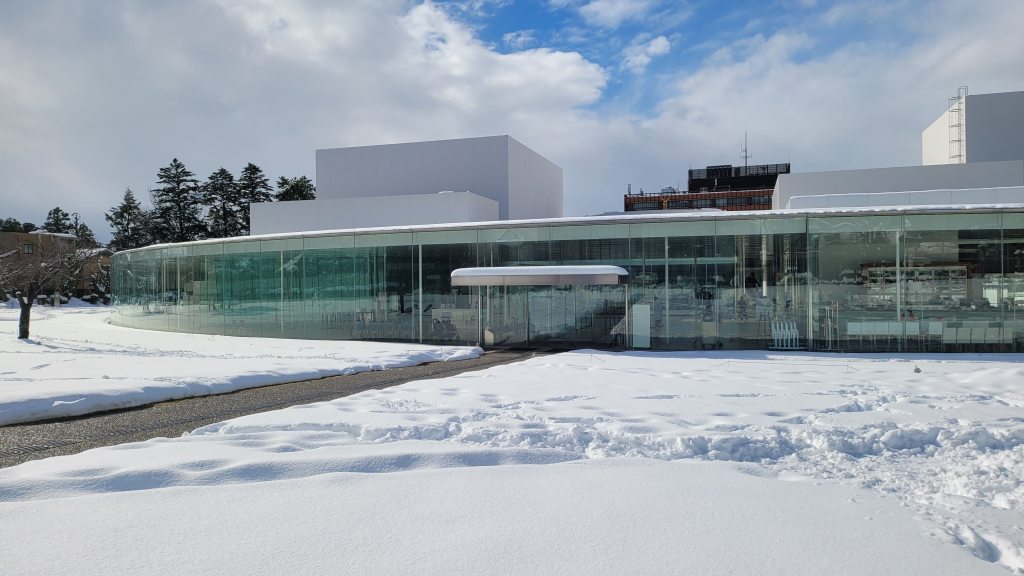
The building and the park concept
The museum was designed by SANAA and built as a flat glass cylinder with a diameter wide enough to contain galleries of different sizes without a hierarchy of front and back. The concept the museum uses is a museum open to the city like a park, and the effect is that the lawn, the corridors and the entrances run into the surrounding streets rather than being sealed behind a facade. Walk a full circle outside before going in: the building has no single main face, and the glass walls mean the exhibitions are partly visible from the pavement. This is architecture you experience by moving around it, not by photographing one elevation.
The Swimming Pool by Leandro Erlich
The Swimming Pool is the museum’s most famous work and the one that requires a decision. It is a layer of water over a glass ceiling, with a space beneath it that visitors can enter, so that people standing on the surface look down into a pool and people below look up at them through rippling water. Entry to the underground section is controlled and the museum runs a separate reservation system for it, so check the current rule before you plan your day around it. The work is in the Exhibition Zone, which means it needs a ticket, and it is the reason many visitors come at all.
Colour activity house by Olafur Eliasson
Colour activity house is a pavilion of three curved glass walls arranged around a central outdoor lamp, and the glass is tinted in the three colours of the subtractive model, cyan, magenta and yellow. The museum’s own description is explicit about the reference, and the result is that the circular interior changes colour as you walk around the lamp, because you are looking through different combinations of the tinted walls. It is on the lawn in the free zone, which makes it the best introduction to the museum for anyone who arrives before buying a ticket, and it is one of the works children respond to immediately.
Blue Planet Sky by James Turrell
Blue Planet Sky is a room with a rectangular opening in the ceiling that frames a section of sky, and the only content is the light and weather that pass through it. It is one of the works that rewards sitting rather than looking: the sky changes, the frame holds it still, and the effect depends on the hour and the season in a way a photograph cannot capture. It is in the museum rather than outdoors, which means it is also a place to rest in the middle of a visit, and it is the work most likely to be remembered by visitors who expected the Swimming Pool to be the highlight.
The public zone, free and open late
The Public Zone is open from 9:00 to 22:00, costs nothing, and contains more than a lobby. There is a museum shop open 10:00 to 18:30, extended to 20:30 on Fridays and Saturdays; a cafe restaurant called Fusion21, open 10:00 to 20:00; an art library with the same hours as the exhibition galleries; and tea rooms that are open 9:00 to 17:00 when a tea ceremony is not being held. The long public hours make the museum usable in the evening, when the galleries are shut but the building and the lawn are still alive, which is unusual for a Japanese museum.
The lawn and outdoor works
The lawn around the building holds permanent works that are visible without a ticket, including Colour activity house and Fernando Romero’s Wrapping, a pavilion with six bulging directions that children are meant to enter and play inside. Patrick Blanc’s Green Bridge crosses a glass corridor with a planted wall, and Jan Fabre’s The Man Who Measures the Clouds stands in the grounds. The outdoor works are the reason the museum works as a park: you can cross the site, sit on the grass and look at art without committing to a ticket or a schedule, and local residents use it that way.
The exhibition programme
The galleries run a changing programme of special exhibitions alongside collection exhibitions drawn from the museum’s holdings, and the content changes several times a year. The museum publishes current, scheduled and past exhibitions with dates and whether each is free or paid, which is the page to check rather than any list written in advance. Because the exhibition rooms differ in shape, height and size, the same artist looks different here than in a neutral white cube, and the museum designs each show around the room it is given. That variability is the reason a repeat visit is worth making.
Food and drink
- Fusion21 is the museum’s cafe restaurant, open 10:00 to 20:00, and it is inside the building rather than a separate concession. Its hours are longer than the exhibition galleries, which makes it useful in the evening when the art is closed, and it is the obvious stop if you are spending a long time in the building. The museum notes that group bookings and private hire can make it unavailable, so it is worth checking at the desk if you are counting on it for a meal.
- Korinbo is the nearest commercial district, five minutes on foot, and it has the densest concentration of restaurants in central Kanazawa, including department store dining floors and branches of the local chains. The bus stop for Korinbo is served by buses from terminals 8 to 10 at Kanazawa Station, so arriving there and walking to the museum is a legitimate route rather than a detour.
- Kanazawa’s food reputation rests on seafood, and the obvious meal is sushi or a seafood bowl, but the city is also known for its vegetables, its sweets and its gold leaf. Omicho Market is the traditional place to eat fish, about fifteen minutes on foot or a short bus ride from the museum, and it is a lunch destination rather than an evening one. Combining the market for lunch with the museum for the afternoon is the standard local pattern.
- Coffee and sweets are a Kanazawa speciality in their own right, and the area between Korinbo and Kenrokuen has a dense cluster of old cafes and Japanese sweet shops. The museum’s own tea rooms are open 9:00 to 17:00 when a tea ceremony is not being held, and they are a quieter option than the cafe for a break inside the building rather than a full meal.
Getting there and around
- The museum is at 1-2-1 Hirosaka in central Kanazawa, a short bus ride from Kanazawa Station. From the east exit bus terminals, Hokutetsu local buses leave from terminals 3 and 8 and stop at Hirosaka and 21st Century Museum, one minute on foot from the entrance; buses from terminals 8 to 10 stop at Korinbo, about five minutes away and a ten-minute ride.
- The Kanazawa Loop Bus leaves from terminal 7 at the east exit and stops at Hirosaka and 21st Century Museum near Ishiura Shrine, a ride of about twenty minutes and one minute on foot. The Kanazawa Shopping Bus, which runs only at weekends and on holidays, also leaves from terminal 7 and stops at the same place, with a stop for Kenrokuen at Mayumizakiguchi.
- A taxi from the east exit taxi stand takes about ten minutes, which is the simplest option with luggage or in heavy rain. The distance is short enough that the fare is modest, and the driver will know the museum by name.
- From Komatsu Airport, the airport limousine bus takes about forty minutes to Kanazawa Station west gate, from which the local bus continues to the museum. This makes the museum reachable on the day of arrival if your flight lands in the morning, and the museum’s public zone being open until 22:00 means an evening arrival still gives you the building and the lawn.
- By car, use the Kanazawa City Hall and Art Museum car park, which is underground between the city hall and the museum, with space for 319 vehicles and hours of 8:30 to 23:00. The first 30 minutes are free and the charge after that is per 30 minutes, with validation available inside the museum; on weekends and busy seasons the car park and the surrounding roads are congested, so public transport is the easier plan. Large buses cannot park here and must use public coach parks.
Where to stay
- Kanazawa Station is the most practical base, because every bus route to the museum starts there and the shinkansen connects the city to Tokyo and the Kansai region. The station area has the widest range of hotels and is where the airport bus terminates, which matters on arrival and departure days.
- Korinbo and the Kenrokuen area is the better base for sightseeing, since the museum, the garden, the castle park and the old districts are all within walking distance. The trade is fewer large hotels and higher prices, and the reward is that you can walk to the museum in five minutes and to Kenrokuen in ten.
- The Higashi Chaya district and the areas along the Sai and Asano rivers have smaller guesthouses and machiya conversions, which suit travellers who want the old-town atmosphere rather than convenience. The museum is a bus ride or a twenty-minute walk from there, and the walk through the old streets is part of the appeal.
Best time to visit
- Spring is the reason many people come to Kanazawa at all, with Kenrokuen’s cherry trees a short walk from the museum, and the combination makes the whole district busy. The museum gets crowded in the same weeks, and the quieter strategy is to see the garden early and the museum in the late afternoon, when the galleries thin out.
- Summer is hot and humid in Kanazawa, and the museum is a good air-conditioned refuge in the middle of the day. The lawn and the outdoor works are at their best in the early morning and evening, and the public zone staying open until 22:00 makes an evening visit genuinely possible.
- Autumn is the strongest season for the city and for the museum, with comfortable walking, Kenrokuen’s maples and a programme that usually includes significant exhibitions. It is also when the museum is busiest, and the Friday and Saturday evening opening until 20:00 is the practical way to see the galleries without a crowd.
- Winter brings snow to Kanazawa and the garden’s famous protected pines, and the museum is a warm place to spend an afternoon when the weather turns. The one thing to check in any season is the closure calendar: the Exhibition Zone closes on Mondays, or the following weekday when Monday is a public holiday, and the museum publishes a detailed list of closure dates that includes temporary openings and closings. A Monday trip is a wasted one unless the date is an exception.
Practical tips
- Decide what you are paying for. The Public Zone is free, including the lawn, the shop, the cafe, the library and several permanent works; the Exhibition Zone needs a ticket and includes The Swimming Pool and the galleries. The ticket price depends on the exhibition, so check the current programme rather than budgeting from an old figure, and remember that collection and special exhibitions are priced separately.
- Check the closure calendar, not just the day of the week. The Exhibition Zone closes on Mondays, or the next weekday when Monday is a holiday, and the museum publishes a list of dates that also includes temporary openings and extra closures. The current list runs into 2027, and it is the only reliable source for a specific date.
- Plan around the 2027 closure. The museum has announced a closure from 6 May 2027 to March 2028 for renovation. If your trip falls in that window, nothing on this page applies and the surrounding museums are the alternative, so check the date before building a Kanazawa itinerary around this building.
- Go late on Friday or Saturday. The Exhibition Zone is open until 20:00 on those two nights instead of 18:00, and the museum’s own advice is that the afternoon and evening are calmer than the middle of the day. The extra two hours are the difference between seeing the galleries properly and queuing for the Swimming Pool.
- Reserve the Swimming Pool separately if you want the underground view. Entry to the space beneath the water is controlled by a reservation system that is separate from the exhibition ticket. Check how it works on the day you buy your ticket, because the rule is specific to that work and the museum updates it.
- Use the bus terminals rather than guessing. Local buses to Hirosaka and 21st Century Museum leave from terminals 3 and 8 at the east exit of Kanazawa Station, buses to Korinbo from terminals 8 to 10, and the Loop Bus from terminal 7. Knowing the terminal number saves a lap of the bus concourse, which is large.
- Do not drive on a weekend if you can avoid it. The underground car park holds 319 cars and is shared with the city hall, and the museum warns that the car park and the surrounding roads are congested at weekends and in busy seasons. Validation inside the museum reduces the base charge, but it does not create a space.
Suggested day-trip outline
- Start at Kanazawa Station and take a local bus from terminal 3 or 8 to the Hirosaka and 21st Century Museum stop, a ride of about ten minutes. Arrive for the 10:00 opening of the Exhibition Zone, or earlier if you want to walk the outside of the building while it is quiet.
- Walk the full circle outside first. The building has no front, and the glass walls show different parts of the interior from each side. The lawn works, including Colour activity house and Wrapping, are free and take fifteen minutes, and they set up the logic of the place before you pay for anything.
- Buy a ticket for the Exhibition Zone and go to The Swimming Pool early, because it is the work with a queue and a separate reservation rule. Then work through the galleries at whatever pace the current exhibitions deserve, rather than trying to see everything.
- Take a break in the Public Zone: the shop, the library or the tea rooms, all of which are free to enter. If you are visiting on a Friday or Saturday, this is the point to slow down rather than leave, because the galleries stay open until 20:00 and the evening is the calmest part of the day.
- Leave the museum and walk ten minutes to Kenrokuen, or five minutes to Korinbo for a meal. If you are eating fish, Omicho Market is a short bus ride away and is a lunch destination, so the order that works is market for lunch, museum for the afternoon, and Kenrokuen in the late light.
Before you go
Timetables, fares, admission fees, and seasonal access rules can change. Check the official tourism and transport sites linked below for the latest information before you travel.
Explore More of Japan
Published guides that pair with this one:
- Kanazawa Travel Guide: Kenrokuen and Teahouse Districts
- Shirakawa-go Travel Guide: UNESCO Gassho Village, Access, and Day-Trip Tips
- Takayama Travel Guide: Hida Old Town and Alps Access
- Gokayama Ainokura Guide: The Quiet Side of the Thatched Villages
- Hakusan and Shirayama Hime Shrine Guide: Ishikawa’s Sacred Mountain
- Fukui Prefectural Dinosaur Museum Travel Guide: Highlights, Access, and Planning
- Wakasa Obama Guide: Fukui’s Old Port and the Five-Colour Noodles
- Izu Peninsula Travel Guide: Coast, Hot Springs and the Geopark
- Karuizawa Guide: Highland Walks, Old Ginza and Shiraito Falls
- Tojinbo Cliffs Guide: Fukui’s Basalt Coast
- Jigokudani Snow Monkey Park Travel Guide
- Mount Fuji Climbing Guide: Yoshida Trail, Fees and Huts
- Nagoya Travel Guide: Castle, Miso Food and a Practical Base for Central Japan
- Eiheiji Travel Guide: A Working Zen Monastery in Fukui
Browse every Chubu guide on this site for the rest of the region.
Sources
- kanazawa21.jp (checked 2026-11-02)
- kanazawa21.jp (checked 2026-11-02)
- kanazawa21.jp (checked 2026-11-02)
- kanazawa21.jp (checked 2026-11-02)
- kanazawa21.jp (checked 2026-11-02)
- kanazawa21.jp (checked 2026-11-02)
- kanazawa21.jp (checked 2026-11-02)


Leave a Reply