Planning Kochi on a Sunday? This English guide covers the street market, what to eat, the castle and Hirome Market.
Operational details such as opening hours, admission fees, and train times can change. Prefer official pages and reconfirm before you travel (sources checked on 05 November 2026).
Why visit
- The Sunday Market in Kochi is not a craft fair or a tourist market. It is the city’s weekly food shop, running along the street below Kochi Castle since 1690, and that is exactly why it is worth an hour of your morning.
- Around three hundred stalls line roughly a kilometre of the Otemon-dori road every Sunday, selling vegetables, fruit, dried fish, knives, garden plants and cooked food. Prices are ordinary shop prices, not event prices.
- It is free, it needs no booking, and it opens early, so it fits into a travel day without displacing anything else. You can walk it before the castle opens and still be on a train by midday.
- The vendors are the growers. Almost all come from within Kochi prefecture, from Muroto in the east to Otsuki in the west, which means what is on the table tells you what the season is doing in this part of Shikoku.
- Kochi food is easy to like: bonito seared over straw, sushi wrapped in leaves, fried sweet potato, yuzu, ginger and tomatoes grown under plastic in the warm coastal climate.
- The market sits between Kochi Castle and Hirome Market, with the covered shopping arcade alongside, so a single morning covers a castle, a street market and a food hall on foot.
- Because it runs every week, it is one of the few sights in Japan you can build an itinerary around rather than hope to catch. If your dates include a Sunday, this is the reason to spend it in Kochi.
Top places and highlights
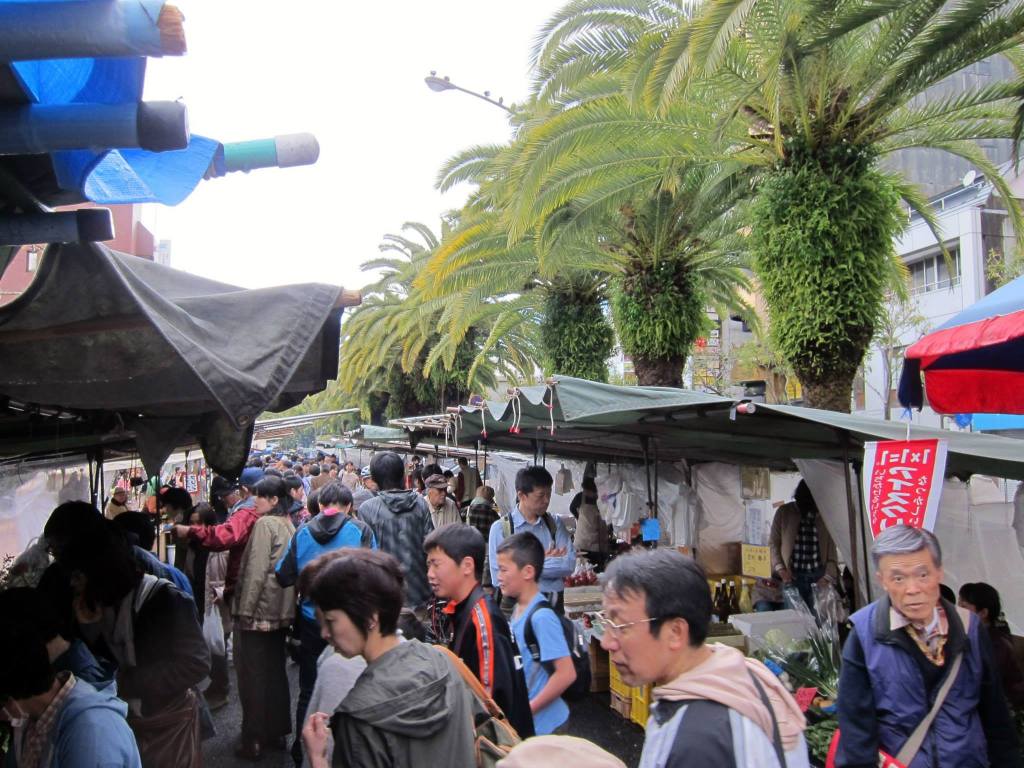
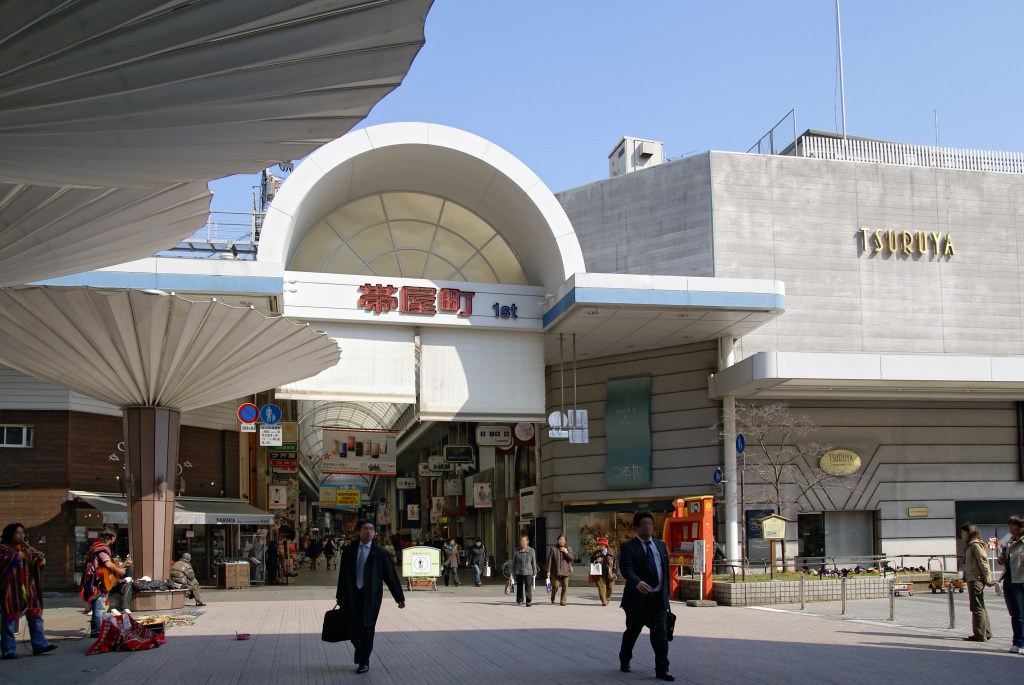
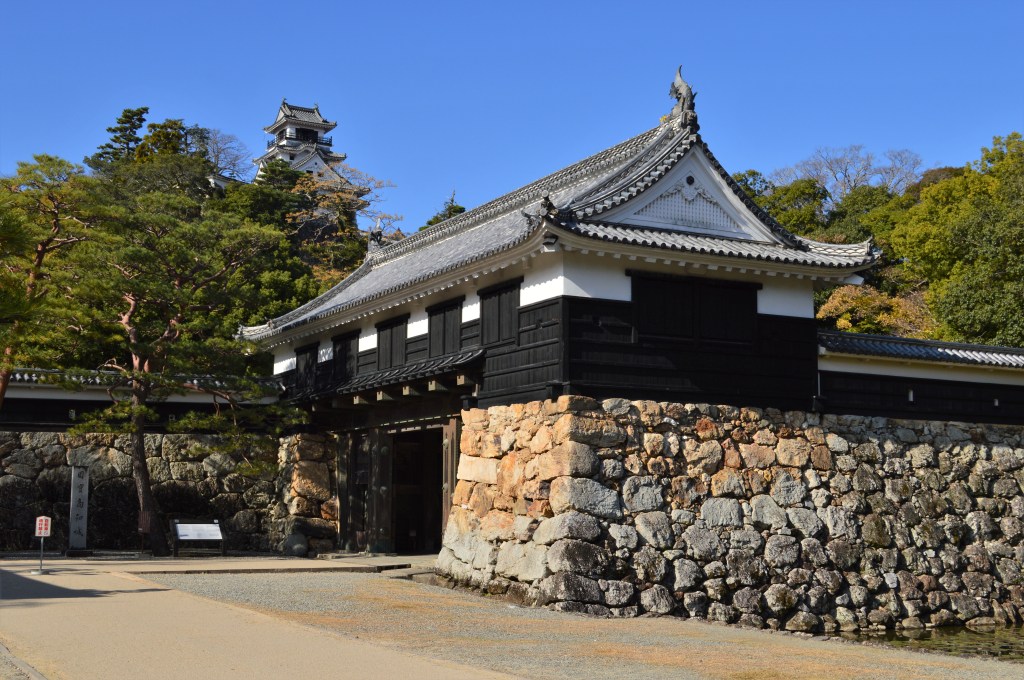
The market itself, along Otemon-dori
The market occupies the southern two lanes of Otemon-dori, the road that runs east from the outer gate of Kochi Castle, and stretches about a kilometre with roughly three hundred stalls. It has run since 1690, when the Tosa domain fixed market days by decree, and it became a Sunday market in 1876 after Japan adopted the solar calendar and Sundays became the official day off. What you notice first is that it is not curated: bundles of aubergine and spring onions, crates of tomatoes and ginger, dried bonito, pickles, seedlings, secateurs, brooms, and knife sharpeners working at a wheel. The city describes it as a living market visited by about seventeen thousand people on a Sunday, local shoppers included. It is closed on 1 and 2 January and during the Yosakoi festival period from 10 to 12 August, and it never runs on any other day of the week.
Breakfast from the stalls
The best reason to arrive early is that you can eat your way along the street instead of sitting down. Look for imoten, thick slices of sweet potato fried in a light batter, sold hot and eaten standing; inaka-zushi, sushi pressed with vinegared rice and fish and wrapped in persimmon or bamboo leaves, which travels well and makes a good train lunch; and grilled or dried fish bought from the stall that dried it. Fruit is cheap and seasonal: tomatoes treated as a fruit, mandarins in winter, peaches and grapes in late summer. Several stalls sell cooked food from a griddle or a pot, and the queues at those stalls are mostly local, which is the only review you need. Bring cash in small notes and coins, and expect to eat with your hands or standing at the edge of the road.
Knives, tools and the non-food half of the market
Roughly two thirds of the stalls are agricultural, which means the rest are the practical things a household in Kochi needs: knives and secateurs, whetstones, hoes and sickles, brooms, baskets, work clothes, pots, and plants. The knife stalls are the ones worth slowing down for. Kochi has a long history of bladesmithing, and the sellers here sharpen on the spot and will explain what a blade is for, though the conversation will be in Japanese. Even if you buy nothing, this side of the market is a good corrective to the idea that Japanese craft only exists in museum shops: these are tools sold to people who will use them this week. Prices are marked and not usually negotiable, and carrying a knife home means putting it in checked luggage.
Kochi Castle, a few minutes uphill
The market’s west end sits almost under Kochi Castle, one of the twelve original castles in Japan whose keep survives from the Edo period, and the only one in Shikoku. Walk up through the Otemon gate and the outer courtyard to the keep, which stands on a hill in the middle of the city with the mountains behind it. The castle grounds are free to enter; the keep and the palace building charge a modest admission, sold together at the gate. Because the market finishes around midday and the castle opens at nine, the natural order is market first, then castle, then lunch. Allow an hour for the castle and its grounds. The site also holds the reconstructed residence of the domain’s chief retainer, which is included in the keep ticket and is usually quiet.
Hirome Market, the covered food hall
A few minutes west of the market, Hirome Market is a covered hall of about sixty stalls and restaurants arranged around shared tables, where you buy from a counter and carry your tray to any free seat next to whoever is already there. It is the easiest place in the city to eat katsuo no tataki, bonito seared briefly over a straw fire and served thick-cut with salt or a soy dressing, along with local sake poured from coin machines. The hall is open from 10:00 to 23:00 Monday to Saturday and from 9:00 on Sundays, though individual shops keep their own hours, and it closes for a few days each year, in 2026 including 1 January, 3 to 5 February, 3 and 4 June and 7 and 8 October. On Sundays the south entrance is the one in use because of the market.
Obiyamachi and the arcade
The covered shopping arcade that runs parallel to the market is where the city actually shops on a weekday, and on Sunday it becomes an extension of the scene, with people carrying market bags between the two. It is the place to buy the non-food things you may have forgotten, to find a coffee, or to escape rain without leaving the area. Note the way the arcade and the market were designed to coexist: in the early twentieth century, when the market moved into Obiyamachi, shops rented a third of their frontage to stallholders and goods were laid out on top of the shop shutters. That arrangement shaped the street you walk today. Harimaya bridge, the small red bridge that gives the city its most famous song, is a short walk south through the arcade.
Katsuo no tataki, and why Kochi cooks it this way
Bonito is the backbone of Kochi’s food culture, and katsuo no tataki is the dish to understand before you eat it. The fish is skewered, seared fast over burning straw so that only the outer layer cooks, then sliced thick and served with salt or a vinegar and soy dressing, with garlic and herbs alongside. The straw fire is not theatre: it gives the smoky crust in seconds without cooking the centre. The season is traditionally split, with the spring run considered the leaner and the autumn run the fattier, and locals have strong opinions about which is better. You will find it in restaurants, in Hirome Market, and sometimes as a takeaway from market stalls. Several places also serve it as a rice bowl, which is the cheapest way to try it properly.
The other street markets through the week
Kochi runs several smaller street markets on fixed weekdays, all under the same city scheme, and if you are in town on the wrong day they are the answer. The Tuesday market occupies about 280 metres of the Uo-machi 4 and 5 district, with stalls laid out on boards over a narrow water channel, and is the one most worth seeking out for its odd setting. The Thursday market runs in front of the prefectural government office, directly south of the castle, and the Friday market under the railway viaduct in Atago-machi is the smallest of the group. They are much smaller than the Sunday market, a fraction of the stalls, and open from early morning into the afternoon. Check the city’s street market page for current hours, because they differ from the Sunday market’s.
Food and drink
- Katsuo no tataki, bonito seared over straw and served thick-cut with salt or a soy dressing, is the dish to order first in Kochi, at lunch or with sake in the evening.
- Inaka-zushi, sushi pressed in vinegar with fish and vegetables and wrapped in leaves, is sold at the market and is designed to be carried, which makes it the best train food in the city.
- Imoten, a thick slice of sweet potato in a light batter, is fried to order at the market and eaten hot while you walk.
- Buy fruit and vegetables at the market rather than in a shop: tomatoes, ginger, yuzu, aubergine and whatever is in season arrive direct from growers within the prefecture.
- Hirome Market is the practical place to try several local dishes in one sitting, including bonito, sushi, fried chicken nanban and local sake from coin machines.
- The city’s drinking culture is open and informal, and standing counters and shared tables are normal. Tipping is not practised anywhere.
Getting there and around
- The market runs along Otemon-dori in central Kochi. It is about fifteen minutes on foot from JR Kochi station, or a short tram ride to the Hasuike-machi-dori stop, which puts you at the eastern end.
- From Kochi airport, buses reach the city in around thirty minutes, and the station area is the natural place to leave luggage before walking to the market.
- There is no car park for the market and the road is closed to traffic while it operates, so do not plan to drive to the stall line. Use paid car parks in the Obiyamachi area if you must drive.
- If you are coming from outside Shikoku, the JR lines and the highway bus network both converge on Kochi station, and the market is walkable from there.
- Sunday is the only day the main market operates. The Tuesday, Thursday and Friday markets are much smaller and serve different streets.
- Allow a comfortable half day if you want the market, the castle and Hirome Market together; the walking between them is flat and short.
Where to stay
- Hotels cluster around Kochi station and in the Obiyamachi and Harimaya bridge area; the latter puts you within a few minutes of the market on foot, which is worth paying a little more for on a Saturday night.
- Business hotels in Kochi are plentiful and reasonably priced, and the city is compact enough that any central hotel works.
- Sunday nights are quieter than Saturdays, and the market does not run, so a Sunday arrival means waiting a week for the market; plan your dates around the day.
- Onsen accommodation exists outside the city in the mountains and along the coast, but staying there in order to reach a Sunday market means a very early start.
Best time to visit
- Spring brings strawberries, early vegetables and the castle’s cherry trees, usually late March into early April, which is the busiest and best combination of market and blossom.
- Summer is hot and humid in Kochi, but the market starts early enough to be pleasant; expect tomatoes, aubergine, peaches and the city’s festival energy in early August, when the market closes for three days.
- Autumn is the most comfortable season for walking the full kilometre, with rice, mushrooms, citrus and the fattier autumn bonito arriving through October and November.
- Winter is mild by Japanese standards and the market is at its calmest. Expect mandarins, leafy vegetables and dried fish, and check the weather, since the stalls are open to the sky.
Practical tips
- Go early. Stalls are fully set by around six or seven in the morning and the best produce goes first; by early afternoon sellers are packing up.
- Carry cash in small denominations. Most stalls are not set up for cards, and you will want coins for small purchases.
- Take a bag. There are no shopping carts and you will end up carrying what you buy along a kilometre of street.
- Do not plan to drive. The road is closed to traffic during the market and there is no dedicated parking.
- Check the calendar: the market is closed on 1 and 2 January and from 10 to 12 August, and it never runs on a weekday.
- Hours are reported differently by different official pages, so treat the morning as the reliable window and confirm current times on the city’s Sunday market page before you go.
- If you are buying a knife, remember that it cannot go in hand luggage, and ask the seller to wrap it properly for checked baggage.
- Combine the market with the castle and Hirome Market in that order: market, castle, lunch. Doing it in reverse wastes the freshest part of the day.
Suggested day-trip outline
- 07:00 Start at the east end of Otemon-dori near Hasuike-machi-dori and walk the market slowly, eating breakfast from the stalls as you go.
- 08:30 Reach the west end under Kochi Castle, buy fruit or inaka-zushi for later, and walk up through the Otemon gate.
- 09:00 Kochi Castle: the outer grounds, the keep and the reconstructed palace building, about an hour in total.
- 10:30 Walk down through Obiyamachi arcade, browse the shops, and stop at Harimaya bridge on the way south.
- 11:30 Lunch at Hirome Market: bonito seared over straw, a shared table, and a glass of local sake if you are not driving.
Before you go
Timetables, fares, admission fees, and seasonal access rules can change. Check the official tourism and transport sites linked below for the latest information before you travel.
Explore More of Japan
Published guides that pair with this one:
- Kochi Castle Travel Guide: The Keep and Palace That Both Survive
- Kochi and Katsurahama Guide: The Pacific Coast and Ryoma
- Cape Muroto Travel Guide: Where the Pacific Meets the Geopark
- Shimanto River Travel Guide: Japan’s Last Clear Stream and the Boats That Drift It
- Oboke Gorge Travel Guide: The Yoshino River between the Cliffs
Browse every Shikoku guide on this site for the rest of the region.
Sources
- city.kochi.kochi.jp (checked 2026-11-05)
- city.kochi.kochi.jp (checked 2026-11-05)
- city.kochi.kochi.jp (checked 2026-11-05)
- city.kochi.kochi.jp (checked 2026-11-05)
- hirome.co.jp — Access (checked 2026-11-05)
- hirome.co.jp (checked 2026-11-05)
- kochi-tabi.jp (checked 2026-11-05)


Leave a Reply