A practical English guide to Yabakei in Oita: the Aonodomon tunnel, Keishuho cliffs, Rakanji temple and the Hitome Hakkei viewpoint, with bus access from Nakatsu.
Operational details such as opening hours, admission fees, and train times can change. Prefer official pages and reconfirm before you travel (sources checked on 05 November 2026).
Why visit
- Yabakei is a gorge country rather than a single sight, spread across the western hills of Oita where the Yamakuni river has cut through soft volcanic rock and left cliffs, pinnacles and potholes in odd shapes. It has been famous for centuries, and by the Meiji period it was being sold to Japanese tourists alongside Nikko and Matsushima. The landscape has not been improved or themed; it is a working river valley with a few temples and a lot of rock.
- The two things most people come for are the Aonodomon, a tunnel dug through the cliff by one man with a hammer and chisel over thirty years, and Rakanji, a temple built into a cliff face with thousands of stone figures in caves and galleries above the river. Both are genuinely extraordinary rather than merely old.
- Then there is the autumn colour. The Hitome Hakkei viewpoint above the Shin-Yabakei valley claims eight separate rock formations in one view, and the gorge is classed as one of the three great autumn-leaf sites of Japan along with Nikko and Arashiyama. In early to mid November the whole valley turns, and the maples along the road at Hisashi-momiji hang over the asphalt for a hundred metres.
- It is also easy to reach from Nakatsu, which has the castle and the karaage, and the bus runs about once an hour. This is a very good day out from Fukuoka or Beppu and almost nobody from outside Japan does it.
Top places and highlights
Aonodomon
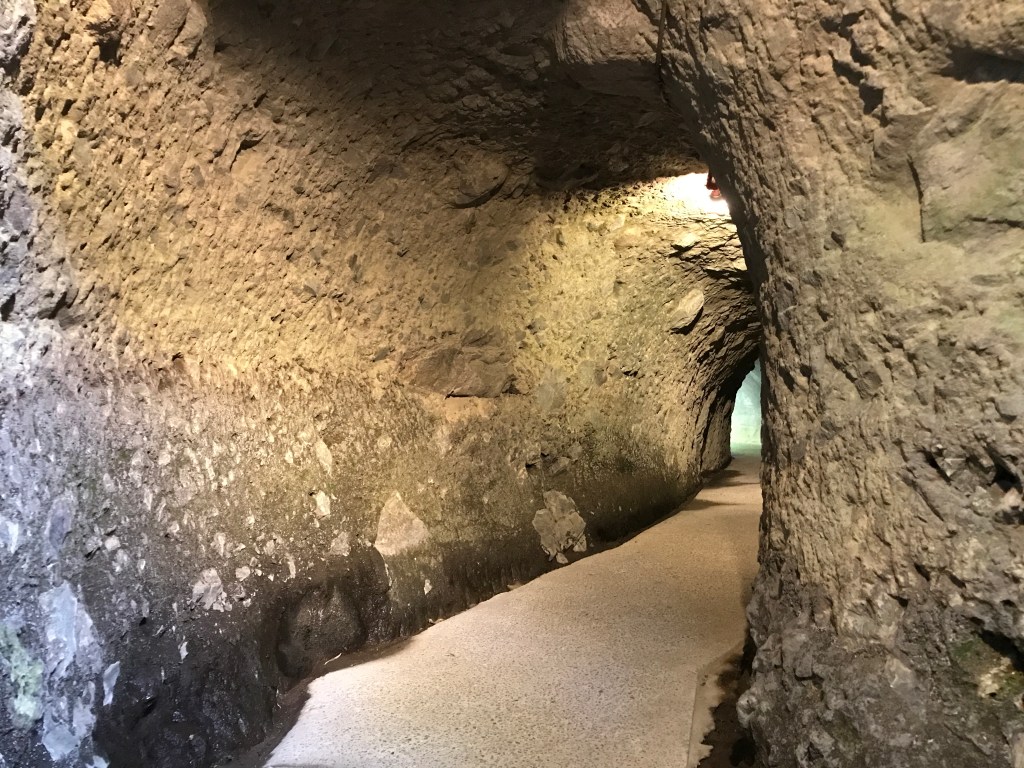
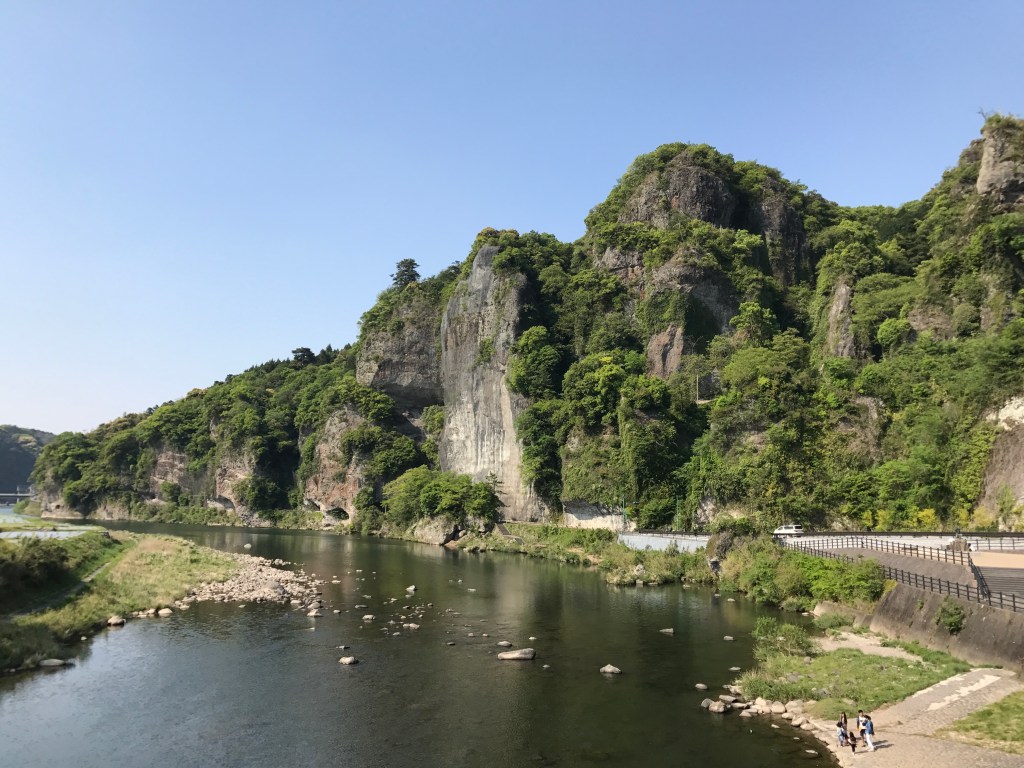
The Blue Tunnel is a passage cut through the base of the Keishuho cliffs beside the Yamakuni river, and it exists because the old road around the cliff was so narrow that travellers and horses fell into the water. A monk named Zenkai began cutting the tunnel by hand in 1735 and finished it about thirty years later, working with a hammer and chisel; the story was turned into a novel by Kikuchi Kan and is one of the best-known tales in Japanese literature. The tunnel is about 144 metres long, with windows knocked through the rock to let in light and air, and walking through it with the river below and the cliff above is the point of the visit. It is free, open at all hours, and lit. On the far side, the road continues to the Keishuho cliffs, and there are restaurants and a car park at the entrance.
Keishuho and the river
Keishuho is the cluster of rock pinnacles rising straight out of the Yamakuni river next to the tunnel, seventy or eighty metres of columnar rock with trees growing out of the cracks, and it is best seen from the road bridge or from the riverside path below. The river here is shallow and clear, with rapids between the rocks, and in summer people walk down to the water. It is a five-minute walk from the tunnel entrance and there is no charge. Photographers should come in the late afternoon when the cliff casts a shadow across the water, or in the autumn when the maples on the far bank are lit.
Rakanji
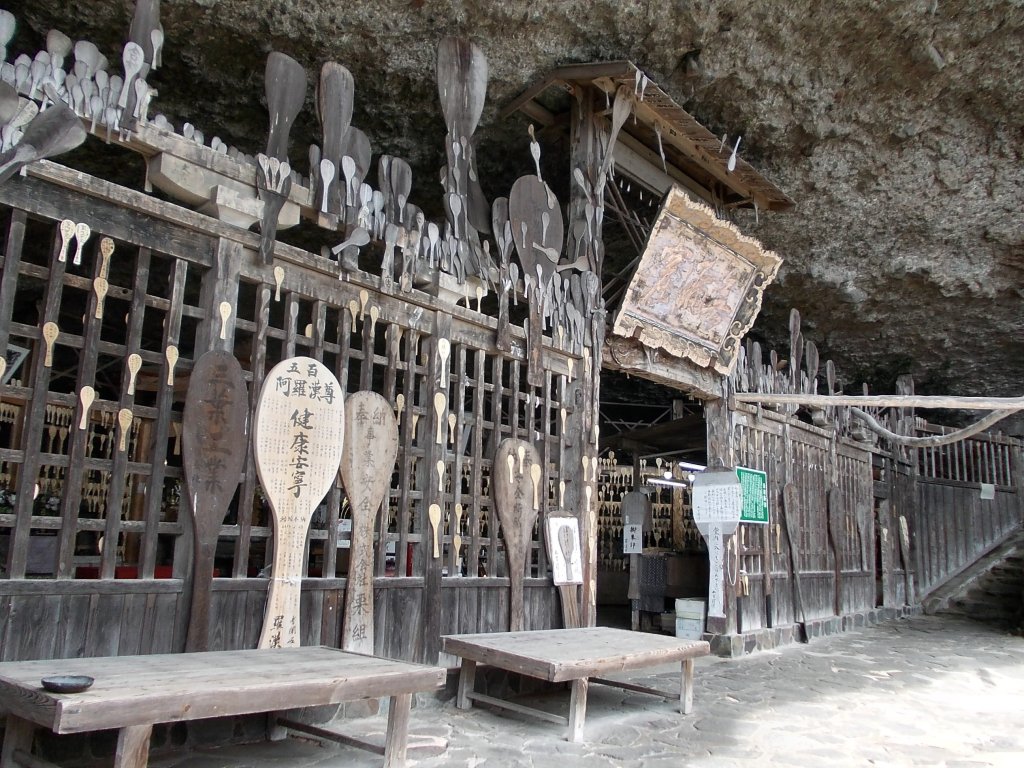
Rakanji is a Soto Zen temple built into the cliff of Mount Rakan, reached by a path up from the car park, and it holds thousands of stone Buddhas and arhats in natural caves and in the halls that have been built around them, including a set of five hundred arhats that is the oldest stone group of its kind in Japan. The main hall and the Fusaiji pavilion sit against the rock face, with a gallery looking out over the valley. Since 2015 the whole stone figure group has been a national important cultural property. Entry requires a permit from the reception at the Niomon gate, for a donation of 1,000 yen for adults and 500 for children, and the gate is open from 8.30 to 3.30. It is a steep twenty-minute walk from the car park, and the path is closed without notice in bad weather. The access is awkward: bus to Nakajima and then a community bus that does not run on Wednesdays, Saturdays or Sundays, or a taxi for 25 minutes from the station.
Hitome Hakkei
The name means eight views at a glance, and the viewpoint above the Shin-Yabakei valley looks across eight named rock formations at once, including a pair of rocks like a couple, a group of rocks like monkeys, and a peak shaped like a hawk’s nest. It is the classic image of Yabakei, and in November it is one of the most crowded places in Kyushu. There is a car park for 256 vehicles, a row of soba shops and souvenir stalls, and a short path to the viewpoint, which is a few minutes from the road. Access by public transport is limited: the bus from Nakatsu takes about ninety minutes with a change at Kakizaka, and runs on weekdays only, so most visitors come by car.
Hisashi-momiji and the maple road
Hisashi-momiji is a stretch of the road into Shin-Yabakei where the maples lean out over the asphalt for about a hundred metres, their branches forming an eave, which is what the name means. It is not a park or an attraction, just a road, and that is why it works: you walk under the trees with the valley on one side. In autumn it is lit at night, and the combination of the red leaves and the dark road is better than the daytime view. Buses stop at the Shin-Yabakei car park, a minute away, on the same weekday-only service as Hitome Hakkei.
Keisekien garden and the cycling road
Keisekien is a Japanese garden built to mark the completion of the Yabakei dam, 20,000 square metres of pond, stone, trees and waterfalls using the dam water to recreate the gorge in miniature, and it is a good autumn stop with a soba restaurant inside. The Maple Yabakei cycling road uses the trackbed of an abandoned railway for about twenty kilometres along the valley, with tunnels and bridges, and bicycles can be rented at the cycling terminal near Kakizaka, at Fusuien and at Yamakuni, and dropped off at any of the three. In November the entire route is red and yellow, and it is the best way to see the gorge if you have a day rather than an afternoon.
Food and drink
- Karaage is Nakatsu’s dish, and the town has dozens of shops selling it by weight; eat some before or after the gorge, since the valley itself has only a handful of restaurants.
- Soba is the Yabakei staple, grown on the terraces in the valley and served cold; the shops at Hitome Hakkei and Keisekien are the reliable ones.
- Sobanko soft ice cream, made with buckwheat flour, is the local oddity and is sold at the roadside stations.
- The restaurants at the Aonodomon entrance serve set meals of river fish, chicken and soba, and are the best bet for lunch if you are travelling by bus.
- Yabakei dam holds fish, and the valley restaurants serve ayu in summer, grilled with salt.
Getting there and around
- The rail gateway is JR Nakatsu on the Nippo line, about 15 minutes from Kokura by shinkansen and limited express, and about an hour from Beppu.
- From Nakatsu station, buses run about once an hour to the Aonodomon and Keishuho area, taking 25 minutes, with a stop a minute from the tunnel. The fare is around 700 yen and payment is cash only, with change available up to 1,000 yen.
- For Rakanji, take the bus to Nakajima and change to the community bus for the temple, which does not run on Wednesdays, Saturdays or Sundays. A taxi from the station takes about 25 minutes and is the practical alternative.
- For Hitome Hakkei and Hisashi-momiji, the bus takes about 90 minutes with a change at Kakizaka, and it runs on weekdays only, a handful of times a day, for around 1,200 yen.
- By car, leave the Higashi-Kyushu expressway at Nakatsu and take the Nakatsu-Hita road to the Aonodomon and Rakanji interchange, three minutes from the temple car park and ten from the tunnel. Hitome Hakkei is 45 to 60 minutes further on.
- The road through the gorge is narrow in places and can be closed after heavy rain, and in the autumn the traffic into Shin-Yabakei backs up for kilometres.
Where to stay
- Shin-Yabakei has onsen inns along the valley, which put you at the viewpoint before the coaches arrive and let you see the night illumination.
- Nakatsu has business hotels near the station and is the practical base for the tunnel and the temple, with the castle and the karaage shops in walking distance.
- Yabakei Onsen and the inns around the dam are quieter and cheaper, with little around them but the river.
- Beppu and Yufuin are within an hour and a half by car and make a luxurious base, but the drive in the autumn traffic is slow.
Best time to visit
- Autumn is the season: the maples turn from late October in Shin-Yabakei to mid-November around Aonodomon, and the roads are busy at weekends.
- Spring brings cherry and fresh green, and the nemophila around Aonodomon in April and May is a smaller local draw.
- Summer is hot and humid but the gorge is cooler than the plain, and the river is low and clear for walking.
- Winter is quiet, with bare rock and occasional snow, and some of the valley restaurants close.
- Avoid weekends in November if you can, and check the road conditions after rain at any time of year.
Practical tips
- Rent a car if you can. The buses reach the tunnel and the temple with effort, but Hitome Hakkei is weekdays only and effectively needs a vehicle.
- Check the day of the week for Rakanji’s community bus, which does not run on Wednesday, Saturday or Sunday.
- Carry cash. The buses take coins only, and several of the valley shops do not take cards.
- Walk through the Aonodomon tunnel in both directions, and take the riverside path below to see the Keishuho cliffs from the water.
- For Rakanji, allow a couple of hours including the climb, and wear shoes with grip; the path is steep and wet.
- Go early for Hitome Hakkei in November. The car park fills by mid-morning and the road in can take an hour.
- Combine the tunnel and the temple with Nakatsu castle and karaage, since the buses pass through the town anyway.
Suggested day-trip outline
- Morning: bus from Nakatsu station to Aonodomon, walk the tunnel and the riverside path under the Keishuho cliffs.
- Late morning: taxi or bus to Rakanji, the climb and the stone figures, an hour and a half at the temple.
- Lunch: back at the Aonodomon entrance for soba and river fish, or karaage in Nakatsu.
- Afternoon: drive or bus to Keisekien and the dam, then on to Hisashi-momiji and Hitome Hakkei for the late light.
- Evening: return to Nakatsu for the castle and dinner, or stay at an onsen inn in Shin-Yabakei and see the illumination.
Before you go
Timetables, fares, admission fees, and seasonal access rules can change. Check the official tourism and transport sites linked below for the latest information before you travel.
Explore More of Japan
Published guides that pair with this one:
- Takachiho Gorge Travel Guide: Boats and Emerald Cliffs
- Beppu Travel Guide: The Steam City and the Hell Springs
- Yufuin Travel Guide: Onsen Town Walks and Mount Yufu Views
- Kokura Castle Travel Guide: A Rebuilt Keep in Kitakyushu
- Usuki Stone Buddhas Travel Guide: Japan’s National Treasure Cliff Carvings
- Tanegashima Travel Guide: Rockets, Firearms History and Quiet Beaches
- Tsushima Island Travel Guide: Aso Bay, Watatsumi Shrine and Izuhara
- Arita Travel Guide: Saga’s Porcelain Town
- Hirado Travel Guide: Nagasaki’s Island of Churches and Castles
Browse every Kyushu guide on this site for the rest of the region.
Sources
- sites.google.com (checked 2026-11-05)
- city-nakatsu.jp (checked 2026-11-05)
- nakatsuyaba.com (checked 2026-11-05)


Leave a Reply