Plan a visit to Hirado in Nagasaki, with its castle, the oldest Protestant church in Japan and the old Dutch trading post.
Operational details such as opening hours, admission fees, and train times can change. Prefer official pages and reconfirm before you travel (sources checked on 04 November 2026).
Why visit
- Hirado is a small island at the western edge of Kyushu that was, for a few decades in the early 1600s, Japan’s front door to Europe. The Dutch trading post was set up here in 1609, before it was ordered to move to Dejima in 1641, and the English factory followed in 1613. The stone warehouse of 1639 has been rebuilt and the story is laid out where it happened.
- The island is also one of the oldest Christian sites in Japan, and not only as a story of persecution. Francis Xavier landed at Hirado in 1550, the church that bears his name stands on the hill above the town, and the view of its spire crossing the roofs of the Buddhist temples below is the image the town is known by.
- Hirado Castle sits on the point above the harbour, a hilltop castle with a keep that was rebuilt in the 20th century but with the stone walls, the layout and the view of the strait intact. From the top the whole geography makes sense: the channel, the bridge to the mainland, and the island’s position on the old sea route to China.
- The Matsura family ruled Hirado for more than 600 years without being transferred, which is rare in Japanese history, and their house and papers survive as the Matsura Historical Museum. The collection and the building together give the island a continuity that most castle towns lost, and the tea ceremony practised by the family is still taught there.
- The island is still a working fishing and farming place. Hirado beef and Hirado flounder are known beyond Kyushu, the port sells the catch of the day, and the restaurants serve a local champon with a soy-based chicken broth that is different from the Nagasaki version. This is not a reconstructed town: the economy under the sights is real.
- Cross the bridge to Ikitsuki and the story changes again. The island was a centre of organised whaling in the Edo period and a place where hidden Christians kept their faith after the ban, and its museum and churches hold both histories. The road along its west coast, the Ikitsuki Sunset Way, is one of the best coastal drives in Nagasaki.
Top places and highlights
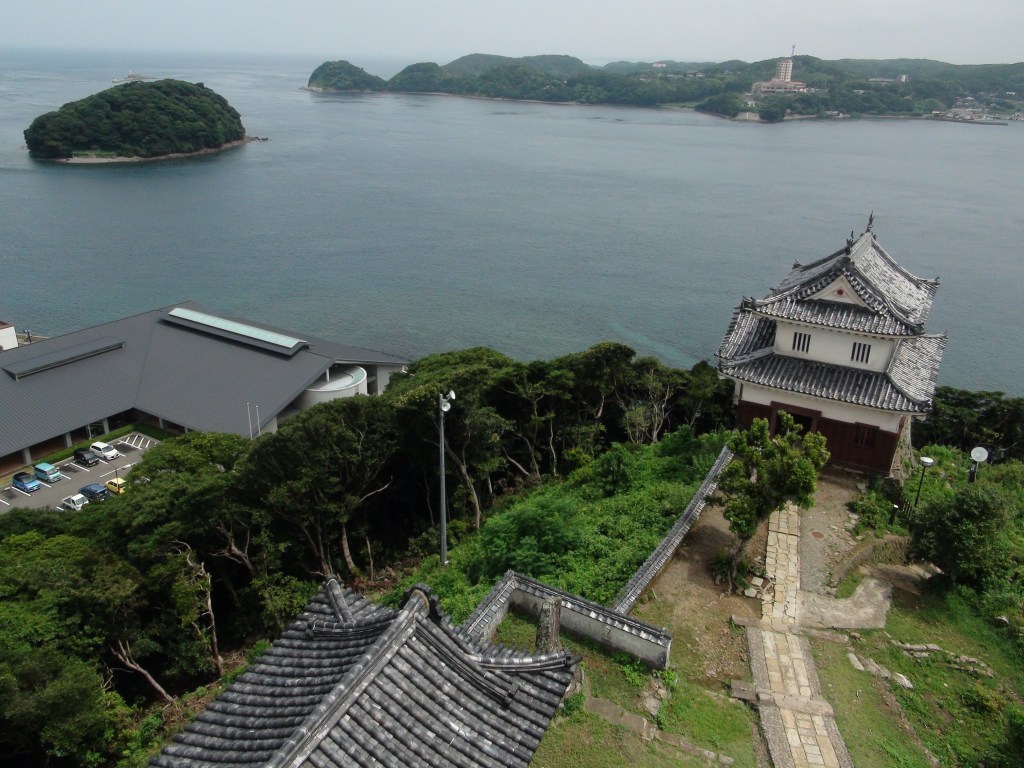
Hirado Castle
The castle stands on the hill above the harbour, on the site of the earlier Hirado fortress, and the present keep is a reconstruction with a museum inside and a viewing floor at the top. The stone walls, the gates and the position are original enough to explain the place, and the view over the strait and the bridge is the best on the island. Admission is 520 yen for adults, 310 for high school students and 200 for primary and junior high pupils. It is open from 8:30 to 18:00 from April to September and 8:30 to 17:00 from October to March, and it closes on 30 and 31 December.
The Dutch Trading Post
The Hirado Dutch Trading Post is a reconstruction of the 1639 stone warehouse, the first Western-style stone building in Japan, and it opened in 2011 on the site of the old compound. Inside are documents and trade goods from the 33 years when Hirado was the Dutch base in Japan, before the move to Dejima. Admission is 310 yen for adults and 210 for school pupils, and a combined ticket with the Matsura Historical Museum is 880 yen. It is open from 8:30 to 17:30 with last entry at 17:00, and it closes for three days in the third week of June.
Hirado Xavier Memorial Church
The church was built on its present hilltop site in 1931, replacing an earlier church of 1913, and its pointed roof and cross are the landmark of the town. Francis Xavier landed at Hirado in 1550 and the church commemorates him. The famous view is from the lane below, where the church rises behind the roofs of Komyo-ji and Zuirin-ji, the Buddhist temples of the same hillside, and the mixture of religions in one frame is the picture most visitors come for. The church is an active parish, so visitors should keep to the permitted areas.
The Matsura Historical Museum
The museum occupies the former Matsura family residence, built in 1893 and known as the Tsuruga-mine residence, and it holds the documents and objects of a family that ruled Hirado from the Kamakura period to the Meiji Restoration without a transfer of domain. The garden and the tea house, Kanun-tei, belong to the Shinnen-ryu school of tea that the lords practised, and tea can be taken overlooking the garden and the sea. It is a short walk from the church and combines naturally with the Dutch trading post.
Ikitsuki Island
Cross the Ikitsuki bridge and the island opens into a different Hirado: a whaling and fishing community with its own museum, the Shima no Yakata, which covers the Edo-period whaling organisation of the Masutomi group and the hidden Christian faith that survived on the island. The west coast road, the Ikitsuki Sunset Way, runs about 10 kilometres along the sea with no traffic lights, and the cliffs and the open horizon are the reason to drive it slowly. The island is about 26 minutes by car from Hirado Castle.
Kasuga village and Mount Yasumandake
Kasuga, on the north of Hirado island, is a World Heritage component of the Hidden Christians of Nagasaki and Amakusa, and the village kept its faith through the ban with the household rituals of the nando-gami. The village information centre, Katarina, has displays and local storytellers, and the walk up Mount Yasumandake, the island’s highest point, is a pilgrimage route as well as a viewpoint. It is about 24 minutes by car from the castle area.
The harbour and Hirado Seto Market
The port exchange plaza at Hirado Sambashi is the arrival point for the buses and the boats, with the tourist information desk and a car park that is free for the first two hours and then 100 yen per 30 minutes. The market at Tabira, on the mainland side of the bridge, sells the island’s fish, vegetables, kamaboko and sake, and its upstairs restaurant looks over the strait and the bridge. It is the practical stop before or after crossing.
Kawachi Pass
The pass on the road across the middle of Hirado island looks down on the town, the harbour and the strait from above, and it is the classic overlook of the island. It is a short detour by car between the port and the northern villages, and the view explains how the town is folded into the hills. The light is best in the late afternoon, when the harbour and the bridge turn gold.
Food and drink
- Hirado champon is the local version of the Nagasaki dish and it is different: the broth is usually soy-based chicken rather than pork bone, sometimes with flying fish stock, and the toppings are the vegetables and seafood of the island. It is the everyday lunch of the town and the shops that serve it are ordinary restaurants rather than attractions.
- Hirado flounder is one of the island’s claims to fame, with a fast current offshore that firms the flesh, and the season runs through the winter. The town holds a flounder festival from mid January to the end of March, when restaurants and inns put on limited menus. Hirado beef is the other local brand, raised on the island and known for lean, clean flavour rather than heavy marbling.
- Ikitsuki preserves a whaling cuisine that is rare elsewhere, with whale meat served as sashimi, cooked in hot pots and as preserved products, and the restaurants on the island also serve the day’s fish. The dried flying fish called ago is a Hirado speciality, roasted and eaten as a snack or used as stock.
- Hirado has a long sweet tooth with a European origin: castella and other confections are said to have arrived with the missionaries and traders 400 years ago, and the town’s shops still sell them. The local shochu, distilled from sweet potato at the western tip of Japan, is the drink to try with the fish.
Getting there and around
- By public transport, take the Nishi-Kyushu line or the Matsuura Railway to Sasebo or Tabira-Hiradoguchi, and then the bus. The Nishi-Hi Bus from Sasebo station to Hirado Sambashi takes about 1 hour 32 minutes, and the Matsuura Railway’s Tabira-Hiradoguchi station is the westernmost railway station in Japan, with buses onward across the bridge.
- By car, the Nishi-Kyushu Expressway brings you to the Saza or Sasebo interchange, and from there the route follows the coast to the Hirado bridge, roughly an hour from Sasebo. The bridge connects Tabira on the mainland to Hirado island, and the drive across it is the moment the trip becomes an island trip.
- Parking in the town centre is at the Hirado port exchange plaza, with 59 spaces, free for the first two hours and 100 yen per 30 minutes after that. The castle has no dedicated car park at its gate, and drivers are asked to use the shared car park at the Mirai Soseikan and the library and walk up.
- The town centre is walkable. The port, the Dutch trading post, the Matsura museum, the church and the castle are all within about 20 minutes on foot, with a hill in the middle. A car is needed for Ikitsuki, Kasuga and the coastal roads.
- Allow a full day for the town and a second for the island. Hirado is not a place to see between two buses: the bus from Sasebo takes an hour and a half each way, and the northern villages and Ikitsuki need their own time.
Where to stay
- Hirado has a small number of hotels and ryokan in the town centre and along the coast, and staying the night is the way to see the harbour in the evening and the castle before the day visitors arrive. The inventory is limited, so book ahead in spring and autumn.
- Ikitsuki and the northern part of Hirado have guesthouses and small inns, and staying there puts the sunset road and the hidden Christian sites at the start of the day rather than at the end of a long drive.
- Sasebo, about an hour away, has the widest choice of hotels and the best transport connections, including the Shinkansen at Sasebo station. It works as a base for Hirado, but the island rewards an overnight of its own.
Best time to visit
- Spring is the best all-round season, with the castle hill and the town gardens in flower and the sea calm. The flounder season is ending, but the weather and the light are at their most reliable for the walk between the church and the temples.
- Summer is beach season on the island, with Neshiko and Hitotsuku on the west coast, and the ferry traffic to the islands picks up. The town is hot and the hills are green, and the evening on the harbour is the best part of the day.
- Autumn is clear and dry, and the drive along the Ikitsuki Sunset Way is at its best. The flounder season has not yet started, but the seafood is good and the crowds are thin.
- Winter is the season of the flounder, with the festival from mid January to late March, and of the whale cuisine on Ikitsuki. The weather is raw and the sea is grey, but this is when the island’s food culture is at its most serious.
Practical tips
- Start at the castle for the view, then walk down through the town. The castle explains the geography, and the walk from the castle through the temple lanes to the church and the Dutch trading post is the best half-day on the island.
- Check the Dutch trading post’s June closure. It shuts for three days in the third week of June, which is easy to miss when planning. The castle closes only on 30 and 31 December.
- Buy the combined ticket if you are seeing both museums. The Dutch trading post and the Matsura Historical Museum sell a joint ticket for 880 yen, which is cheaper than the two separately.
- Use the port car park and walk. The castle has no car park at the gate, and the town’s lanes are narrow. The port exchange plaza is free for two hours, which covers the castle and the town centre if you are efficient.
- Give Ikitsuki its own half-day. The island is 26 minutes from the castle by car, and the museum, the churches and the sunset road together need more time than a quick loop. The bridge itself is worth the detour.
- Eat the champon at lunch. The local restaurants are small and many close in the evening, and the champon is a lunch dish. Book dinner at the inn or eat in Sasebo on the way back.
- Respect the churches. The Xavier Memorial Church and the churches on Ikitsuki are active parishes, not museums, and services and local rules take priority over photographs. The view of the church from the lane below does not require entering.
Suggested day-trip outline
- Arrive at Hirado Sambashi by bus or car and park at the port exchange plaza. Walk up to Hirado Castle first, see the museum and the view from the keep, then come down through the temple lanes to the Xavier Memorial Church for the classic view of the spire over the roofs.
- Continue to the Matsura Historical Museum for the family collection and the tea house, then walk to the Dutch Trading Post and the harbour. Have Hirado champon for lunch in the town centre.
- In the afternoon, drive across the island to Kawachi Pass for the overlook, then on to Kasuga village and the Katarina centre for the hidden Christian history. Return to the town for the evening or stay on the island.
- On the second day, cross to Ikitsuki and spend the morning at the Shima no Yakata museum, then drive the Sunset Way along the west coast. Eat whale cuisine or the day’s fish on the island before returning over the bridge.
- If you have a third day, take the boat to one of the smaller islands or drive the coast north of the town, and use the extra time for the beaches and the quieter villages. Hirado rewards the slower version.
Before you go
Timetables, fares, admission fees, and seasonal access rules can change. Check the official tourism and transport sites linked below for the latest information before you travel.
Explore More of Japan
Published guides that pair with this one:
- Kujukushima and Sasebo Guide: Islands, Cruises and the Naval Port
- Karatsu Travel Guide: Pottery, a Castle, and the Saga Coast
- Arita Travel Guide: Saga’s Porcelain Town
- Nagasaki Travel Guide: Harbor History, Hills, and Kyushu Flavors
- Nagasaki Atomic Bomb Museum Travel Guide: Highlights, Access, and Planning
- Nagasaki Bio Park Travel Guide: Highlights, Access, and Planning
- Shimabara Castle Travel Guide: A Reconstructed Keep in Nagasaki
- Unzen Onsen Guide: Hot Springs on an Active Volcano
- Sengan-en Travel Guide: Kagoshima’s Shimazu Garden and Volcano Views
Browse every Kyushu guide on this site for the rest of the region.
Sources
- hirado-castle.jp — Visitor guide (checked 2026-11-04)
- hirado-castle.jp (checked 2026-11-04)
- hirado-shoukan.jp (checked 2026-11-04)
- hirado-net.com (checked 2026-11-04)
- hirado-net.com (checked 2026-11-04)
- sasebo99.com (checked 2026-11-04)
- hirado-net.com (checked 2026-11-04)


Leave a Reply