Plan an independent visit to Railway Museum Omiya in Saitama with the main sights, food ideas, access checks, and seasonal notes.
Operational details such as opening hours, admission fees, and train times can change. Prefer official pages and reconfirm before you travel (sources checked on 02 November 2026).
Why visit
- The Railway Museum in Omiya is the most serious railway museum in Japan, and it is serious in a way that surprises people who arrive expecting a train-themed children’s attraction. It opened on 14 October 2007 as the centrepiece of JR East’s 20th anniversary project, is built and run by the East Japan Railway Culture Foundation, and occupies a 19,800 square metre building on a 42,500 square metre site with about 9,500 square metres of display area. The scale is the point. This is not a shed with a few locomotives; it is a national collection with an institutional argument behind it.
- The collection answers a question most visitors have never asked: what did the first train in Japan actually look like? Locomotive No. 1, the engine that ran when Japan’s first railway opened between Shimbashi and Yokohama in 1872, is here, and it stands in the same hall as a 0 Series Shinkansen and an E5 Series Shinkansen. Seeing 1872 and the present in one room compresses a century and a half into a single walk, and that is the museum’s central trick. The museum displays 36 rolling stock items across the site, from steam locomotives and imperial carriages to container wagons.
- The building is organised into five stations rather than chronological rooms, and the names tell you what each does: Rolling Stock, Science, Job, Future and History. The Rolling Stock Station holds the largest exhibition area and uses video, audio, lighting and ICT to recreate the noise and weight of the machines in service. The Science Station deals with the principles that make a train run and the signalling that keeps two trains from meeting. The Job Station is about the people who keep the railway running, and the Future Station is an imaginative exhibit where visitors build an avatar and explore a version of future rail. This structure is why the museum works for adults without children.
- The 2018 renovation changed the museum substantially. A new south building opened in July 2018 and the main building was fully renovated at the same time, which is what created the five-station layout and added the Job, Future and History stations. Before that the museum was closer to a traditional vehicle hall. The date matters if you are reading older accounts, because descriptions of the museum as a two-zone history-and-learning facility refer to the pre-2018 building and no longer match what you will walk through.
- Access is unusually easy for a museum of this size. It sits beside Tetsudo-Hakubutsukan Station on the New Shuttle, the people mover that runs from Omiya Station, and it is one stop and a one-minute walk from the platform. Omiya is a shinkansen stop on the Tohoku, Joetsu and Hokuriku lines and a major JR East hub, so the museum can be a stop on a longer rail trip rather than a dedicated excursion. From Tokyo it is a straightforward half-day, and the museum’s own route guidance covers transfers from Haneda, Narita and Tokyo Station.
Top places and highlights
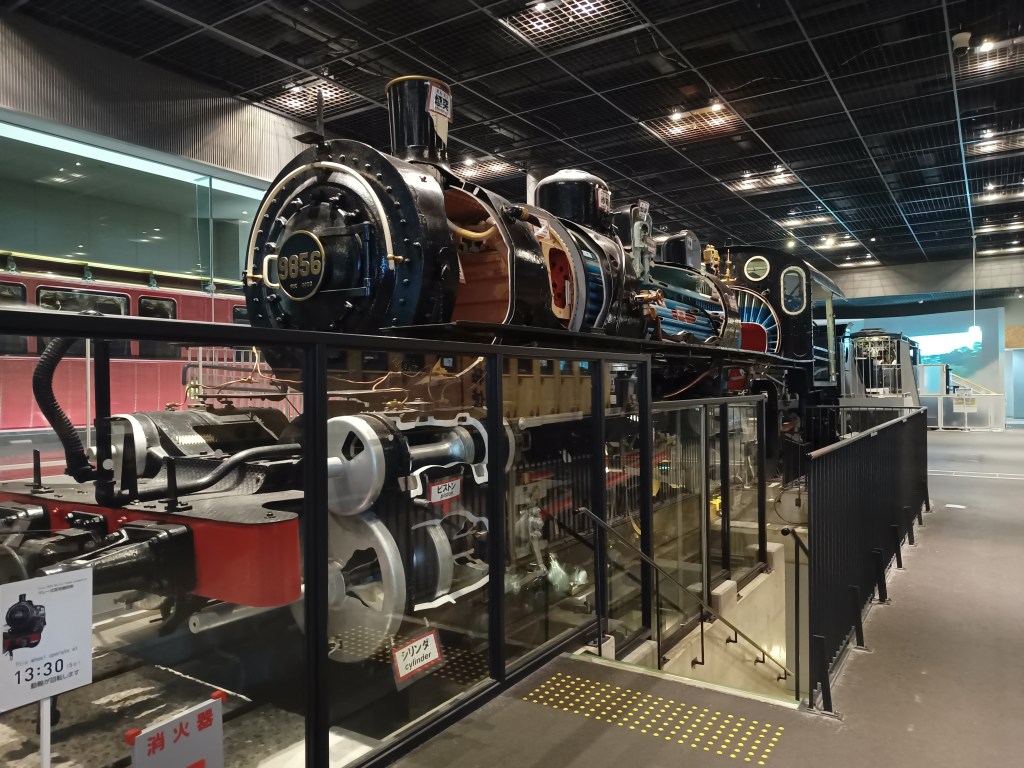
Locomotive No. 1 and the Rolling Stock Station
The Rolling Stock Station occupies the largest exhibition area in the museum and holds 36 vehicles, and the one to find first is Locomotive No. 1, the engine that worked Japan’s first railway when the line between Shimbashi and Yokohama opened in 1872. It is small, Victorian and unmistakably foreign-built, which is the historical point: Japan’s railway began with imported machines and ended up exporting shinkansen. Around it the hall runs through the classes that carried the network, including the C57 135 that hauled the last scheduled steam service in 1975 and a line of electric locomotives from the ED17 to the EF66. The hall is staged with lighting and sound rather than left as a car park of trains.
The shinkansen line-up
Few museums let you walk from a 0 Series Shinkansen to an E5 Series in a few dozen paces. The collection includes a 0 Series car and a 0 Series cab section, a 200 Series, a 400 Series, an E1 Series double-decker and an E5 Series car, so the fleet reads as a design history rather than a single famous train. The 0 Series is the one that matters most for a first-time visitor, because it is the shape that defined the word shinkansen for the rest of the world, and standing beside the nose makes clear how much lower and rounder later designs became. Photographs are allowed in the hall, and the vehicles are close enough to photograph without a wide lens.
The imperial carriages
The museum holds six imperial carriages, numbered 1, 2, 7, 9, 10 and 12, and they are the part of the collection that most visitors do not expect. These are the coaches built for the imperial family, finished to a standard far above any public carriage, and they sit in the collection as evidence of how the railway was used by the state rather than only by passengers. The detailing is the thing to look at: the interiors are preserved as working rooms rather than museum reconstructions, and the difference in materials between an imperial car and a 31 series passenger carriage a few metres away is the clearest illustration of what class meant on a Japanese train.
The Science Station
The Science Station is on the second and third floors of the main building and it is where the museum becomes genuinely educational rather than a display of beautiful machines. The exhibits answer questions that most travellers have never had answered: what makes a train stay on the rails, how braking distances work at speed, and how the signalling system prevents two trains from occupying the same section of track. The approach is interactive, with equipment you operate rather than labels you read, and it is pitched so that an adult with no engineering background can follow it. If you have an hour and one child who likes mechanisms, this is where to spend it.
The Job Station
The Job Station is in the south building and is built around railway work as a profession rather than trains as objects. The exhibits use live-action video and real tools to show how precision, punctuality and teamwork keep a railway running, and the framing is deliberately about responsibility: the museum asks visitors to imagine being the person who has to be right every time. This is the section that explains why Japanese trains run to the minute, and it is more interesting to most adults than any single locomotive. It also connects to the museum’s broader point that the railway is a system of people, not a collection of vehicles.
The simulators
The museum runs driving simulators for a D51 steam locomotive, an E5 Shinkansen and trains on the Tokaido, Keihin-Tohoku and Yamanote lines, and they are booked through reservation terminals inside the museum rather than bought at the entrance. The D51 is limited to junior high school age and above, while the other simulators allow elementary school children. There is a charge per simulator session, and slots go early on busy days, so the practical advice is to book as soon as you enter rather than after the vehicle hall. The E5 and D51 are the two most sought after, and the D51 is the one that feels least like a video game.
The History Station and the museum’s lineage
The History Station on the third floor of the south building traces Japanese railway technology from 1872 forward, using documents and photographs to show what each era demanded of the railway and how engineers responded. What makes it more than a timeline is the museum’s own history: this institution is the successor to the Transportation Museum in Chiyoda, which began in 1921 near Tokyo Station to mark fifty years of Japanese railways, moved into the former Manseibashi Station building in 1936, was renamed the Transportation Museum in 1948, and closed on 14 May 2006 before the collection moved here. The museum is therefore part of the history it displays.
Food and drink
- The museum has a cafeteria inside the building, which makes it possible to spend a full day without leaving the site, and that matters because the museum’s own guidance is that a tour takes about two hours before you add the interactive exhibits. In practice families with children spend four hours or more here, and having food on site removes the need to walk back to the New Shuttle in the middle of the day. Check the current opening hours at the entrance, since the cafeteria keeps its own schedule rather than following the museum’s 10:00 to 17:00 day.
- Omiya Station is the alternative and it is only one stop away on the New Shuttle. The station has department store restaurant floors and a dense cluster of shops and casual restaurants on both sides, including the Lumine and Sogo buildings, and it is where most local visitors eat before or after the museum. The advantage is choice and the disadvantage is that you leave the museum to get it, so it suits a plan where the museum is one part of a day in Omiya rather than the whole of it.
- Ekiben is worth knowing about here in a way that is not true at most museums. The Railway Museum is a railway museum beside a railway station, and the Omiya area is a traditional ekiben market, so a bento bought at the station and eaten around the visit fits the subject. The museum does not allow eating in the exhibition halls, so this is a plan for before entry or after exit rather than a picnic among the locomotives.
- For a longer day, Saitama Shintoshin is two stops further on from Omiya in the other direction and has a large mall with a food hall, and the Omiya district itself has everything from standing soba to chain family restaurants. If you are travelling with children and want to end the day easily, eat at Omiya Station before boarding the train back to Tokyo, because the shinkansen and the Utsunomiya and Takasaki lines all leave from there and the trip home can be long.
Getting there and around
- The easiest route is JR to Omiya Station, then the New Shuttle, the automated people mover, one stop to Tetsudo-Hakubutsukan Station. The museum is a one-minute walk from the station, which is named after it. Omiya is served by the shinkansen and by the Utsunomiya, Takasaki, Saikyo, Keihin-Tohoku and Shonan-Shinjuku lines, so the connection is simple from Tokyo, from the north, and from the Joetsu and Hokuriku shinkansen corridors.
- From Tokyo Station the trip is roughly half an hour to Omiya plus the shuttle, and from Ueno or Shinjuku it is comparable. Because Omiya is a shinkansen stop, the museum also works as a break in a longer journey: a traveller heading to Sendai or Niigata can stop, leave luggage in a coin locker at Omiya, spend the middle of the day in the museum and continue. The one thing to check is shuttle frequency, because the New Shuttle is a short people mover rather than a metro line.
- By car, the museum is about 4 kilometres from the Shintoshin-Nishi exit of the Shuto Saitama Shintoshin line, about 5 kilometres from the Yono exit of the Shuto Saitama Omiya line, about 9 kilometres from the Iwatsuki interchange on the Tohoku Expressway and about 13 kilometres from the Okegawa-Kano interchange on the Ken-O Expressway. The approach is via Route 17, turning right at the Taisei 3-chome intersection, then left at the Tetsudo-Hakubutsukan (Taisei) Station intersection. Parking is limited and fills on holidays, so the museum itself recommends public transport.
- Parking costs 1,000 yen per day for a standard car and 2,040 yen for a bus, and the car park closes when the museum closes, which catches out anyone who leaves a car and goes into Omiya for dinner. There is a designated accessible parking area in the P3 car park. If you are using car navigation, the museum warns that searching by address or phone number can fail to find it, and suggests searching for the station’s old name, Taisei, because the station was renamed after the museum opened.
- From the airports, the museum’s own guidance covers transfers from Haneda and Narita, but the shape of the trip is the same in both cases: into central Tokyo by train or bus, then a JR line to Omiya and the New Shuttle. Allow two hours from Narita and about an hour from Haneda, and treat the museum as a full half-day rather than a quick stop on a transit day.
Where to stay
- Omiya is the practical base if the museum is the reason for the trip. The station area has business hotels within a few minutes of the New Shuttle platform, and staying here means you can be at the museum for opening without a Tokyo commute. It is a working city rather than a tourist one, with a good restaurant and shopping cluster around the station, and it is also well placed for Saitama’s other sights.
- Tokyo is the base most visitors actually use, and it works because Omiya is a shinkansen stop with frequent connections. Staying in Ueno, Tokyo or Shinjuku puts the museum within a comfortable half-day, and the trade is a train ride rather than a walk. If you are in Tokyo for a week, this is a day trip rather than a move.
- Saitama Shintoshin, two stops from Omiya, has larger modern hotels and the Saitama Super Arena nearby, so it suits a trip built around an event as well as the museum. It is quieter in the evenings than Omiya and has less street-level choice of restaurants, but the rooms are generally larger for the price and the rail connection to Omiya is short.
Best time to visit
- Spring weekends are the museum’s busiest period outside the school holidays, because the New Shuttle and the parkland around Omiya make it an easy family outing. The museum suggests buying tickets in advance, and on a cherry blossom weekend the difference between an advance ticket and a same-day purchase is the difference between walking in and queueing. Early arrival also matters for the simulator reservations.
- Summer school holidays fill the museum with families, and the simulator booking terminals are the first thing to go. The building is air-conditioned and the halls are large, so it copes better with a crowd than a small museum would, but the Rolling Stock Station around the most famous vehicles becomes difficult to photograph in the middle of the day. Late afternoon entry is the workaround, and the last entry is 16:30.
- Autumn is the best season for a visit if you have a choice. The weather is comfortable for the walk from the shuttle, the summer crowds have gone, and the museum’s outdoor areas are usable. It is also the season when school groups are fewer than in May and June, when Japanese schools run their excursions.
- Winter is quiet except for the New Year holiday, when the museum closes. Note the weekly pattern rather than only the season: the museum is closed every Tuesday, so a Tuesday in any season is a wasted trip. The museum publishes an annual calendar of opening days, and a special exhibition can change the pattern, so check the calendar for your date rather than assuming the Tuesday rule is the only closure.
Practical tips
- Book before you go. The museum states that advance reservation is recommended, tickets can be bought online without registering an account, and same-day tickets are sold from vending machines at the entrance from 11:00. On a busy day the machine queue is the slowest way in, and the 11:00 start means an early arrival without a ticket leaves you waiting.
- Know the two price tiers. Same-day admission is 1,600 yen for adults, 600 yen for elementary, junior high and high school students, and 300 yen for preschool children aged three and over. Advance purchase is cheaper at 1,500, 500 and 200 yen respectively. Children under three are free. Payment at the museum takes cash, transport IC cards and credit cards.
- Book the simulators as soon as you are inside. They are reserved through terminals in the museum, cost extra per session, and the D51 is restricted to junior high school age and older while the others allow elementary children. The D51 and E5 Shinkansen are the two that sell out first, and arriving at 10:00 and going straight to the terminal is the difference between riding one and watching.
- Plan on two hours for the collection and three to four if you have children. The museum’s own estimate of about two hours does not include the interactive exhibits, the simulators or a meal, and the site is large enough that a rushed visit means walking past most of it. The building is split across a main building and a south building, so check the floor guide rather than trying to read the layout from the halls.
- Check the calendar for the Tuesday closure and the New Year holiday. The museum is closed every Tuesday and over the New Year period, and the opening-day calendar for each fiscal year is published on the official site. If your trip is built around a specific exhibition, check that too, because the calendar and the exhibition dates do not always align.
- Consider the passes only if they fit. The annual passport is 6,200 yen for adults, 2,500 for students and 1,000 for preschool children and is valid for one year for the named holder, which only makes sense for a local. The weekday afternoon pass is 4,800, 2,000 and 800 yen and is valid only after 12:00 on weekdays, which is a real saving for a half-day visit but useless at weekends.
- Do not drive unless you have to. Parking is 1,000 yen a day, the car park closes with the museum, and the museum itself asks visitors to use public transport on holidays because the lot fills. The New Shuttle from Omiya is one stop and a minute’s walk, and the whole trip is easier without a car. If you do drive, navigate to the station’s old name, Taisei, rather than the museum’s address.
Suggested day-trip outline
- Arrive for the 10:00 opening. Buy or show your advance ticket, then go directly to a simulator reservation terminal before anything else, because the D51 and E5 slots are the only part of the visit that can be lost by waiting. Once a slot is booked, the rest of the day can be arranged around it.
- Start in the Rolling Stock Station in the main building. Find Locomotive No. 1 first for the 1872 starting point, then work through the steam and electric locomotives, the passenger carriages and the imperial carriages, and finish with the shinkansen line-up so that the design progression reads in order. This hall alone can take an hour if you read the labels.
- Move to the Science Station on the upper floors of the main building and work through the interactive exhibits, then cross to the south building for the Job Station and the History Station. The Job Station is the one adults tend to underrate, and the History Station explains the museum’s own lineage from the 1921 museum near Tokyo Station.
- Take the simulator slot in the middle of the day, then eat. If you are using the museum cafeteria, this is the natural break; if you are going to Omiya, ride the shuttle one stop, eat around the station and come back, which costs time but gives a much wider choice.
- Finish with the Future Station and any special exhibition, then the museum shop, and leave by 16:30 at the latest for the last entry cut-off. If you are continuing by shinkansen, the walk back to Tetsudo-Hakubutsukan Station and the one-stop ride to Omiya puts you on the platform in about ten minutes, which is why this museum works as a stop on a longer rail journey rather than a dedicated day.
Before you go
Timetables, fares, admission fees, and seasonal access rules can change. Check the official tourism and transport sites linked below for the latest information before you travel.
Explore More of Japan
Published guides that pair with this one:
- Kawagoe Travel Guide: Warehouse Streets Near Tokyo
- Tokyo Travel Guide: Neighborhoods, Transport and a First-Timer’s Plan
- Asakusa and Senso-ji Travel Guide: Temple Gates, Nakamise and the Sumida River
- Chichibu Travel Guide: A Mountain Town and a Night Festival
- Nagatoro Guide: The Arakawa River and Saitama’s Stone Town
- Ikaho Onsen Guide: Gunma’s Stone-Step Hot Spring Town
- Nasu Highland Travel Guide: Onsen, Farms and the Emperor’s Summer Retreat
- Ashikaga Flower Park Guide: The Wisteria Tunnels and When to Go
- Hitachi Seaside Park Travel Guide: Nemophila, Kochia, and the Pacific
Browse every Kanto guide on this site for the rest of the region.
Sources
- railway-museum.jp (checked 2026-11-02)
- railway-museum.jp — Visitor information (checked 2026-11-02)
- railway-museum.jp — Access (checked 2026-11-02)
- railway-museum.jp (checked 2026-11-02)
- en.wikipedia.org) (checked 2026-11-02)


Leave a Reply