Plan a visit to Mount Nokogiri and Nihonji temple in Chiba, with the cliff carvings, the ropeway, access, and walking notes.
Operational details such as opening hours, admission fees, and train times can change. Prefer official pages and reconfirm before you travel (sources checked on 03 November 2026).
Why visit
- Mount Nokogiri is a quarried mountain on the Boso Peninsula, and Nihonji is the temple that occupies its southern slope. The combination is unusual: a 1,300-year-old temple whose grounds are 100,000 tsubo of worked stone, where the quarrying that supplied building stone for the Kanto region left cliffs, caves and terraces that the temple then filled with carvings. You are walking through an industrial landscape that became a sacred one, and that is the reason it looks like nowhere else in Japan.
- The carvings are the attraction. The great Buddha is a 31-metre figure of Yakushi Nyorai, begun in 1783 and restored in 1966, and it is the largest carved stone Buddha in Japan by height. The Hyakushaku Kannon is a 30-metre relief of the goddess carved over six years from 1960 into a quarry face, and the Sen-gohyaku Rakan is a hillside of more than a thousand small figures set among trees. None of these is a single sight; they are distributed across a mountain, which is why the route you take matters more here than at most temples.
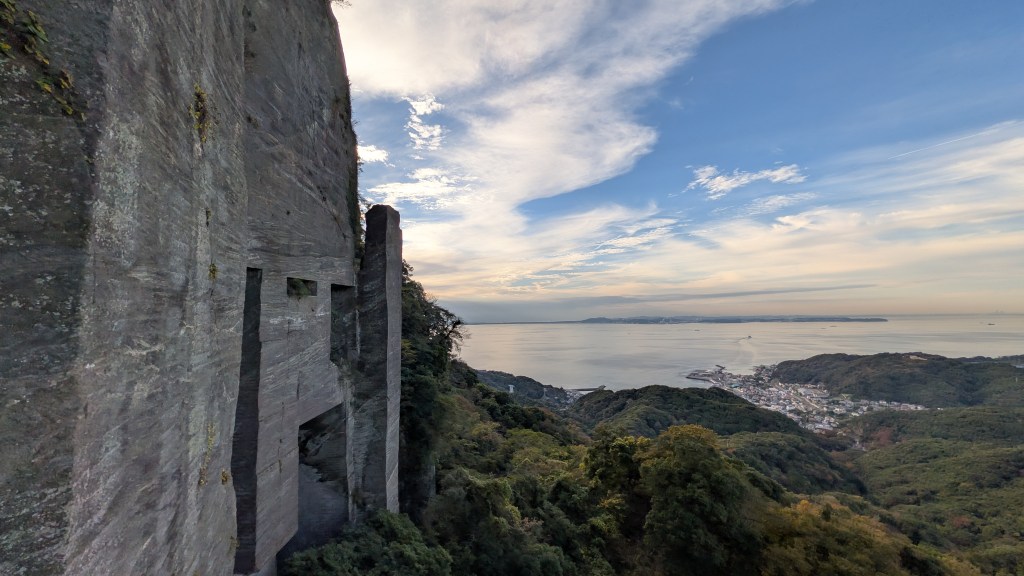
- The mountain’s name is descriptive. The ridge above the temple was cut in vertical slices by quarrying, and the skyline looks like the teeth of a saw, which is what nokogiri means. The stone from here, Boshu stone, was used for buildings and walls across the Kanto region, including the seawalls of Yokosuka and the foundations of much of Tokyo’s older masonry. Seeing the cut faces up close, with the tool marks still visible, is the part of the visit that most people do not expect.
- The Jigoku Nozoki, the peek into hell, is the viewpoint that made the mountain famous on social media. It is a rock ledge that juts out over a cliff with nothing beneath it, looking out over Tokyo Bay, the Boso Peninsula and, on a clear day, Mount Fuji. It is genuinely exposed and not a theme-park prop, and the approach is a steep flight of stairs from the west gate. It is the single sight most visitors come for, and it takes about ten minutes from the ropeway.
- The practical advantage is proximity to Tokyo. The ropeway base is eight minutes on foot from Hamakanaya Station on the JR Uchibo Line, which is reachable from Tokyo without a car, and the whole mountain is a day trip rather than an expedition. The catch is that the temple has five separate entrances and the mountain is steep, so the difference between a good visit and a miserable one is which gate you start from and whether the ropeway is running.
Top places and highlights
The great stone Buddha
The Nihonji Daibutsu is a 31-metre carving of Yakushi Ruriko Nyorai, begun in 1783 and restored in 1966, and it is the largest stone Buddha in Japan by height. It is cut directly into the hillside rather than assembled from blocks, and the effect is different from the bronze Buddhas of Kamakura or Nara: the figure seems to come out of the rock rather than sit on it. Reaching it from the east gate takes two to three minutes up a flight of stairs, which is the shortest approach on the mountain.
The Jigoku Nozoki ledge
The peek into hell is a rock outcrop above a vertical drop, reached from the west gate by about three minutes of gentle climb and then four to five minutes of steep stairs to the summit viewpoint. From the ledge you look down the cliff to the bay below, and across to the Boso Peninsula and, when the air is clear, Mount Fuji. It is unfenced in the way that Japanese mountain viewpoints often are, and it is not suitable for anyone unsteady on their feet or afraid of heights.
The Hyakushaku Kannon
The hundred-shaku Kannon is a 30-metre relief carved over six years from 1960 into a wall of quarried stone, and it is about a minute from the west gate, down the stairs and to the left before the climb. It is the newest of the great carvings and the most dramatic in its setting, because the quarry face around it is bare and the figure appears out of a cliff. Most visitors pass it on the way to the summit, and it deserves better than that.
The 1,500 Rakan
The Sen-gohyaku Rakan is a hillside covered with more than a thousand small stone figures, each with a different face and posture, set into the slope among trees. It is the part of Nihonji that rewards walking rather than looking, because the figures are scattered rather than lined up, and the path through them is the route between the west gate and the great Buddha. It is also the quietest part of the mountain, since most visitors stop at the summit and turn back.
The main hall and the new three-storey pagoda
The middle of the mountain holds the Hatto, the main hall, the Yakushi Honden, the Daikokudo and the Busshari-to, an octagonal three-storey pagoda completed in 2025. The pagoda is new enough that most guides do not mention it, and it is the one part of the temple that is unambiguously modern. The Jizō Hall, the temple bell, which is an Important Cultural Property and is currently stored inside the Hatto after typhoon damage, and the 800-year-old Yoritomo cycad are all in the same area.
The quarry faces and the saw-tooth ridge
The mountain was quarried for Boshu stone, and the vertical cut faces are still there, with tool marks and drill holes visible on the rock. The ridge line that gives the mountain its name is the edge of that quarrying, and it is best seen from the ropeway as you ascend rather than from inside the temple grounds. It is the detail that makes the place legible as a working landscape rather than only a religious site.
The view over Tokyo Bay
The summit viewpoint and the Jigoku Nozoki look out over Tokyo Bay towards the Miura Peninsula, and the Boso hills fall away on the other side. On a clear winter day Mount Fuji is visible across the bay, which is why the mountain is busiest in the cold months despite the wind. The view is the payoff for the climb, and it is also why the ropeway being closed matters so much.
Food and drink
- There is no restaurant inside the temple grounds, and the only public toilet is below the great Buddha square, with no mains water on the mountain and a request to conserve what there is. That means food and drink need planning rather than discovering, and carrying water is not optional on a warm day.
- Hamakanaya, at the ropeway base, is the practical place to eat before or after, with seafood restaurants around the port and the station. The town is a fishing port and the local speciality is the catch landed there, which is a better reason to eat than convenience.
- The Tokyo Bay ferry terminal is a 15-minute walk from the ropeway base, and the ferry to Kurihama across the bay is a way to arrive or leave that turns the trip into a loop rather than a there-and-back. It also puts you at the port where the food is, rather than at the mountain where it is not.
- Kisarazu and Kimitsu, on the way from Tokyo by train, have the usual range of options near their stations, and eating there on the way out avoids relying on the small number of places at Hamakanaya that keep sightseeing hours.
Getting there and around
- By train, take the JR Uchibo Line to Hamakanaya Station, which is eight minutes on foot from the ropeway base station along Route 127 towards Tateyama. For the omotesando walking route, get off at Hota Station instead, where the trail to the temple gate takes about 30 minutes to the trailhead and about 45 minutes to the Niomon gate.
- From Tokyo, the route is the JR Uchibo Line from Tokyo Station to Hamakanaya or Hota, or the highway bus from Tokyo, Shinjuku, Shibuya, Shinagawa or Yokohama to Kisarazu or Kimitsu, then the train to Hamakanaya. Coming by Tokyo Bay Ferry from Kurihama takes 35 minutes to Hamakanaya port, and the ropeway is then a 15-minute walk.
- By car, take the Aqua Line from Kawasaki through Kisarazu and leave at the Kyonan Hota interchange for the temple, or the Futtsu Kanaya interchange for the ropeway. The temple’s own directions from the Kyonan Hota interchange involve turning left out of the interchange, going towards Kisarazu at the first intersection, then turning right opposite a fishing tackle shop on Route 127, passing under the railway and turning left about 200 metres further on.
- The mountain has a ropeway from Hamakanaya to the summit, four minutes each way, running every 15 minutes and more often when busy, with the last ascent around 17:00 in the normal season and 16:00 in winter. It is the difference between a steep climb and a short ride, and it stops in strong wind, so the service status is worth checking on the day.
- The temple itself has five gates with different approaches: the west gate near the summit for the ropeway and the paid mountain road, the Daibutsuguchi gate in the middle of the paid road, the east gate from the free Nokogiriyama sightseeing road car park, the north gate near the Hyakushaku Kannon for walkers from Hamakanaya, and the omotesando gate for walkers from Hota. Choosing the wrong gate is the most common mistake here.
Where to stay
- Hamakanaya is the closest place to stay, a small port town with a handful of inns and guesthouses within walking distance of the ropeway. Staying here puts you at the mountain before the day visitors arrive, which matters on a clear winter weekend.
- Kisarazu, about 30 to 40 minutes away by car, has business hotels and the widest choice of restaurants on the Boso side, and it is the practical base for anyone arriving by highway bus from Tokyo. The mountain becomes a half-day rather than the whole trip.
- Tateyama, further south along the coast, suits anyone combining Nokogiri with the southern Boso coast and the ferry to Oshima. The drive between the two is part of the appeal, and the accommodation is more resort-oriented than Kisarazu’s business hotels.
Best time to visit
- Winter is the season for the view, with the clearest air and the best chance of seeing Mount Fuji across the bay, and it is also when the ropeway runs its shorter winter hours from 16 November to 15 February, closing at 16:00 rather than 17:00. Cold, clear days are the ones to aim for, and the wind that clears the air is also the wind that stops the ropeway.
- Spring brings the cherry blossom around the temple and the port, and it is the busiest period after the autumn colour, with school groups on weekdays. The wild flowers on the quarried slopes are at their best in April and May, and the stone holds heat, so the mountain warms earlier than the surrounding plain.
- Summer is hot and humid, and the mountain has little shade on the quarry faces and no water supply, which makes it the least comfortable season despite being the greenest. If you go in summer, start at opening time at 9:00 and carry more water than you think you need, and remember that the last entry to the temple is 15:00.
- Autumn, particularly November, is the strongest all-round season: the maples and the views are both good, the air begins to clear, and the ropeway is still on its longer hours until 15 November. The trade is crowds at the Jigoku Nozoki, which is a small ledge and does not absorb a queue well.
Practical tips
- Decide which gate you are using before you set off. The great Buddha and the main hall are two to three minutes up the stairs from the east gate, while the Jigoku Nozoki and the Hyakushaku Kannon are near the west gate. The mountain’s own guidance warns that walking from the great Buddha back up to the west gate takes 30 to 40 minutes of climbing, so people who want both should plan to move between the gates by car or ropeway rather than on foot.
- Check the ropeway status on the day. It runs every 15 minutes, takes about four minutes, and stops in strong wind, which is common on this coast in winter and spring. The operator posts suspensions on its site, and a stopped ropeway turns a short visit into a steep climb or a change of plan.
- Go in the morning and be aware of the last entry. The temple is open 9:00 to 16:00 with last entry at 15:00, and the gate staff enforce it. Arriving at 15:30 means being turned away regardless of how far you have come, and the same applies to the ropeway’s last ascent.
- Pay at the gate and keep the ticket. Admission is 700 yen for adults and 400 yen for children from 4 to junior high age, groups of 30 or more pay 630 and 360 yen, and holders of a disability certificate pay half with one carer also at half. Re-entry between the gates requires showing the ticket, which is how the east and west gate system works for people moving by car.
- Wear shoes with grip and accept the stairs. The temple states plainly that the grounds are paved but that there are many stairs because it is a mountain, with some sections difficult to walk. The climb from the west gate to the summit is a steep four to five minutes of steps, and the route between the gates is a real hike.
- Carry water and expect no facilities on the mountain. The only public toilet is below the great Buddha square, mains water is not supplied, and there is no food for sale in the grounds. Hamakanaya at the ropeway base is the place to eat, drink and use a proper toilet before going up.
- If you cannot manage stairs, use the paid mountain road. The temple’s own guidance for wheelchair users is to park at the mid-mountain car park on the paid road and approach the great Buddha square from the Daibutsuguchi gate, which it describes as possible with assistance. That route avoids the stairs from the east gate, and it is the most accessible way to see the main carving.
Suggested day-trip outline
- Take the JR Uchibo Line to Hamakanaya and walk eight minutes to the ropeway base, or drive to the Futtsu Kanaya interchange and park at the ropeway. Go up on the first ropeway you can catch, and check the summit view before committing to the rest of the mountain.
- From the west gate, see the Hyakushaku Kannon first, about a minute down the stairs and to the left, then climb the three minutes of gentle slope and four to five minutes of steep steps to the Jigoku Nozoki and the summit viewpoint. This is the part to do while the air is clearest and the ledge is least crowded.
- Walk down through the Sen-gohyaku Rakan to the middle of the mountain, and see the Hatto, the Yakushi Honden and the new Busshari-to pagoda, then continue to the great Buddha at the base of the east side. This is the long version of the visit, and it takes the better part of three hours including stops.
- If you have a car, do it the other way round: drive the paid mountain road to the west gate area for the Kannon and the summit, then drive down and around to the free east gate car park for the great Buddha and the main hall, which is two to three minutes up the stairs. That is the temple’s own recommendation for seeing the sights with the least walking.
- Eat at Hamakanaya afterwards, or take the Tokyo Bay Ferry to Kurihama for a different route home. Either way, leave the mountain before the 15:00 last entry closes the gates, and do not plan a late afternoon start in winter when the ropeway stops at 16:00.
Before you go
Timetables, fares, admission fees, and seasonal access rules can change. Check the official tourism and transport sites linked below for the latest information before you travel.
Explore More of Japan
Published guides that pair with this one:
- Kamakura Travel Guide: Great Buddha, Temples, and a Tokyo Day Trip
- Enoshima Travel Guide: Island Shrines and a Coastal Day Trip from Tokyo
- Chichibu Travel Guide: A Mountain Town and a Night Festival
- Tokyo Travel Guide: Neighborhoods, Transport and a First-Timer’s Plan
- Yokohama Travel Guide: Harbour, Chinatown, and a Day Trip from Tokyo
- Sawara Travel Guide: A Merchant Town on the Water in Chiba
- Meiji Jingu and Harajuku Travel Guide: Shrine Forest, Takeshita Street and Omotesando
- Railway Museum Omiya Travel Guide: Highlights, Access, and Planning
- Ikaho Onsen Guide: Gunma’s Stone-Step Hot Spring Town
- Nagatoro Guide: The Arakawa River and Saitama’s Stone Town
Browse every Kanto guide on this site for the rest of the region.
Sources
- nihonji.jp (checked 2026-11-03)
- nihonji.jp (checked 2026-11-03)
- nihonji.jp — Access (checked 2026-11-03)
- mt-nokogiri.co.jp (checked 2026-11-03)


Leave a Reply