Plan a walk in Sandankyo Gorge in Hiroshima, with the open trail sections, the boat crossings, bus access, and current closures.
Operational details such as opening hours, admission fees, and train times can change. Prefer official pages and reconfirm before you travel (sources checked on 03 November 2026).
Why visit
- Sandankyo is a 13-kilometre gorge cut by the Shibaki River through the mountains north-west of Hiroshima, and it is designated a Special Place of Scenic Beauty, the highest category the national government uses for a natural landscape. The appeal is not a single viewpoint but a walk along the water between cliffs, past pools and waterfalls, with the river always on one side. It is the kind of place where the point is the two hours of walking rather than the photograph at the end.
- The gorge is close to Hiroshima in a way that most of Japan’s great gorges are not. It is about an hour from the city by car on the expressway, and there is a public bus that runs from Hiroshima Bus Center directly to the main entrance, which means a gorge that would normally require a rental car is reachable without one. That combination of quality and accessibility is unusual and it is the main practical argument for putting Sandankyo on a Hiroshima itinerary.
- It is also a walking gorge rather than a viewing gorge, and the trail network is what makes it work. From the main entrance the path follows the river to Kurobuchi in about 50 minutes at a gentle pace, and the section from Mizunashi entrance up to Sandandaki waterfall is about 30 minutes. There are two small boats, at Kurobuchi and Sarutobi, that take you across pools rather than along the river, and they add a short crossing to what is otherwise a walk.
- The gorge is currently carrying a serious caveat, and this is the most useful thing a guide can tell you. As of 30 September 2026, two sections of the trail are closed: the section between Yokogoguchi and Yoshigahara including the Sandandaki junction, passable only on days when the Sarutobi boat is operating and not at all in rain, and the section between Sandandaki and Shimo Mochinoki, with no reopening date announced. The town repeats that the closed sections are dangerous and must not be entered.
- Because of those closures, the realistic visit has changed shape. The main entrance to Kurobuchi route, about 2.7 kilometres and 50 minutes each way, is open; the Mizunashi entrance to Sandandaki and to Sarutobi and Nidan falls is open at about 1.5 kilometres and 30 minutes. What is no longer possible is walking the full length of the gorge from one end to the other. Anyone planning on the classic through-walk should read the town’s notice before travelling and expect a there-and-back visit instead.
Top places and highlights
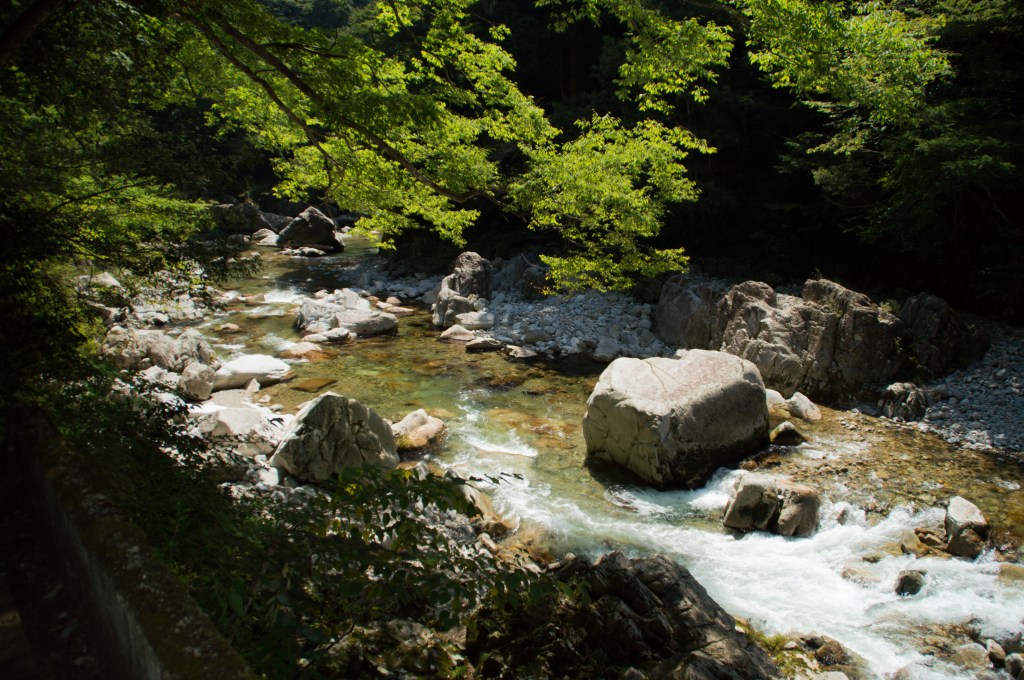
The main entrance to Kurobuchi
The classic Sandankyo walk starts at the main entrance and follows the river about 2.7 kilometres to Kurobuchi, which takes around 50 minutes each way at an easy pace. The path passes Nagabuchi almost immediately and Akataki waterfall at about 20 minutes, then continues between cliffs to the deep green pool at Kurobuchi. This is the section the town describes as the most popular route, and it is the one that is fully open, which makes it the default plan.
Kurobuchi and its boat
Kurobuchi is the pool at the end of the main entrance route, and it is the scenic centre of the gorge: a deep basin of green water under cliffs, reached after the walk rather than before it. There is a boat here that crosses the pool, and Kurobuchi-so is the only place to eat inside the gorge, open on the same days as the boat. The boat does not run every day and stops for weather or high water, so it is a bonus rather than a fixture.
The Mizunashi entrance and Sandandaki waterfall
The second entrance gives access to the upper part of the gorge, and its short route is about 1.5 kilometres to Sandandaki waterfall in roughly 30 minutes. It is the alternative to the main entrance rather than an addition, because the trail between the two is closed in the middle. The Mizunashi car park has 200 spaces and charges 500 yen for a standard car, and there is no public transport to it, so this side is for drivers only.
The Sarutobi boat and Nidan falls
Beyond Sarutobi, the second boat crosses to give access to Nidan falls, about 1.5 kilometres and 30 minutes from Mizunashi. The Sarutobi boat is irregular rather than scheduled and runs only on its operating days, which currently decide whether the Yokogoguchi section is open at all. The town directs enquiries about its operation to the Osorakan ecology campsite, and the boat is cancelled in rain, so it is the least predictable element of the visit.
The autumn colour
The gorge is at its most visited in autumn, with the colour usually peaking from late October to late November, and it moves through the gorge from the far end back towards the main entrance, starting at Sandandaki and Nidan falls and reaching the entrance later. That pattern is useful if you are choosing a date: the same week that looks past its peak at one end may be just right at the other. The town runs a combined bus and walking ticket in the season, from 1 October to 18 December.
The drive in from Hiroshima
The road from Hiroshima to the gorge passes through Kake and then climbs to the Togouchi interchange, and the last stretch on Route 191 turns off at the Sandankyo junction and reaches the entrance in about 15 minutes from the interchange. It is a short drive through real mountain country rather than a suburban approach, and the roadside station at Togouchi, immediately by the interchange, is the practical stop for information and food before the gorge.
Food and drink
- Inside the gorge there is exactly one place to eat, Kurobuchi-so, and it is open on the same days as the Kurobuchi boat. That means it cannot be relied on: if the boat is not running, the restaurant is not either. Anyone planning to eat at the far end of the walk should carry food as a fallback rather than counting on it.
- The nearest reliable eating is at the roadside station at Togouchi, Kinmu Togouchi, immediately by the Togouchi interchange, which has local food and produce and is where most visitors stop on the way in or out. It is also the place to buy a bear bell, which the town recommends carrying in the gorge.
- Kake, on the road between Hiroshima and Togouchi, is a small town with restaurants and shops rather than a sight, and it is a sensible lunch stop if you are driving and want something before the last climb. It is also where the prefectural route from Hiroshima passes through, so it costs nothing extra in detour.
- Hiroshima itself is an hour away and has everything, which makes Sandankyo a half-day or a day out rather than a place to plan meals around. The genuinely local food here is simple mountain cooking rather than a cuisine, and the honest advice is to eat in the city or at the roadside station and treat the gorge as the walk it is.
Getting there and around
- By public transport, the Hiroshima Electric Railway bus runs from Hiroshima Bus Center to the Sandankyo main entrance, with both expressway and ordinary-road services, and the town’s current timetable lists four expressway departures a day towards Sandankyo and two back, plus six ordinary-road departures towards the gorge and eight back. There is also one ordinary bus a day from Kabe Station towards the gorge and two back.
- The expressway bus is the fast option and the ordinary bus is the frequent one, and both take the same final approach to the main entrance. The bus drops you at the entrance itself rather than at a distant car park, which is what makes the gorge practical without a car. Note that there is no public transport at all to the Mizunashi entrance.
- By car from Hiroshima, take the Chugoku Expressway to the Togouchi interchange, then Route 191 and turn left at the Sandankyo junction, about 15 minutes to the main entrance. For the Mizunashi entrance, take the same interchange and the town road for about 40 minutes, with the last section narrow and closed to vehicles over seven metres long.
- Parking at the main entrance is 500 yen for a standard car with 500 spaces, free for motorcycles, free for tourist buses on weekdays and 1,000 yen at weekends and holidays. At Mizunashi, parking is 500 yen with 200 spaces, 300 yen for motorcycles, 2,000 yen for a micro bus, and large tourist buses cannot enter at all.
- There is no shuttle between the main entrance and Mizunashi and no bus between them either, which matters because the trail between the two ends is closed. The town points visitors to two car-share vehicles, one at the main entrance and one at the roadside station, as the way to connect the two sides of the gorge without moving your own car.
Where to stay
- Togouchi and the area around the interchange have the closest accommodation, including the Ikoi no Mura facility that appears in the local taxi fare table, and staying here puts the gorge at the start of the day rather than the end of a drive. It is a small mountain base rather than a resort.
- Hiroshima city is the practical base for most visitors, an hour away by car and reachable by bus, with the full range of hotels and restaurants. Sandankyo becomes a day trip, and that is how most people do it.
- The roadside station area and the campsites along the river suit anyone travelling with a vehicle and wanting to be in the gorge early. Camping is the realistic budget option here, and it also puts you in place for the first light on the water, which is the best hour in the gorge.
Best time to visit
- Autumn is the season the gorge is known for, with colour from late October to late November, and the town runs a combined bus and walking ticket from 1 October to 18 December that includes a one-day bus pass and a choice of extras for 2,000 yen, valid at the gorge, the Togouchi interchange bus center and Kake. It is the busiest period and the one where the bus is the sensible way in.
- Summer is the green season, with the gorge at its coolest relative to the city and the river running clear. It is also the season of sudden rain, which makes the path slippery, raises the water and stops the boats, and the town warns specifically about how slick the trail becomes when wet.
- Spring is quiet and the water is high from snowmelt upstream, which makes the waterfalls stronger and the crossings less certain. It is a good season for the walk and a poor one for the boats, and the absence of crowds is the compensation.
- Winter is not a closed season here but a serious one: the gorge has no lighting and the town asks walkers to be back at the main entrance by 17:00, with a walking window of 7:30 to 17:00. Snow and ice on the trail make it a different proposition, and the boats stop. The town’s advice to carry a bear bell applies in the warmer months, when bears are active in the gorge.
Practical tips
- Read the closure notice before you go. Two sections are closed as of 30 September 2026: Yokogoguchi to Yoshigahara including the Sandandaki junction, open only when the Sarutobi boat runs, and Sandandaki to Shimo Mochinoki, with no reopening date. The town states plainly that the closed sections are dangerous and must not be entered, so plan a there-and-back route rather than a through-walk.
- Choose your entrance deliberately. From the main entrance the open route is about 2.7 kilometres to Kurobuchi in 50 minutes; from Mizunashi it is about 1.5 kilometres to Sandandaki or to Sarutobi and Nidan falls in 30 minutes. There is no path between the two ends and no bus either, so you cannot do one and leave from the other without a car-share or a taxi.
- Do not count on the boats. The Kurobuchi boat does not run every day and stops for weather and high water, and the Sarutobi boat is irregular by design and cancelled in rain. Kurobuchi-so, the only place to eat in the gorge, keeps the same days as the boat, so a boat cancellation removes both the crossing and the lunch.
- Carry a bear bell. The town says bears can appear in the gorge and sells bells at the roadside station, which is a small thing that is worth taking seriously in a place with no lighting and limited phone signal. Parts of the gorge have no mobile coverage at all.
- Be out by 17:00. The gorge has no lighting, the town sets the walking window at 7:30 to 17:00, and the last bus leaves from the entrance rather than waiting. The same warning covers the trail when wet, which the town describes as extremely slippery.
- Pay for parking in cash. The main entrance and Mizunashi car parks charge 500 yen for a standard car, and the arrangements are simple machines rather than card terminals. Motorcycles park free at the main entrance and for 300 yen at Mizunashi.
- Take the seasonal bus ticket in autumn. The combined ticket at 2,000 yen covers a one-day bus pass and a choice of extras and is valid at the gorge, Togouchi and Kake from 1 October to 18 December, which is cheaper than the return fare plus the parking if you are coming from the city without a car.
Suggested day-trip outline
- Take the expressway bus from Hiroshima Bus Center to the Sandankyo main entrance, or drive to the Togouchi interchange and on to the entrance on Route 191. Arrive by mid-morning, both because the walk takes two hours and because the light reaches the water best before the afternoon.
- Walk from the main entrance along the river, past Nagabuchi and Akataki waterfall at about 20 minutes, and on to Kurobuchi at about 50 minutes. Take the crossing if the boat is running, and stop at Kurobuchi-so if it is open, which it will be on the same days as the boat.
- Return the same way rather than attempting to continue through the gorge, because the section beyond is closed. The walk back is the same 50 minutes and looks different in the other direction, so it is not wasted time.
- If you have a car and want the upper gorge, drive round to the Mizunashi entrance and walk 30 minutes to Sandandaki, or on to Sarutobi if the boat is operating. Do not try to connect the two halves on foot, and do not rely on a bus between them, because there is neither a path nor a service.
- Stop at the roadside station at Togouchi on the way out for food and local produce, and take the bus or drive back to Hiroshima before dark. In autumn, use the combined bus and walking ticket rather than paying the return fare and the parking separately.
Before you go
Timetables, fares, admission fees, and seasonal access rules can change. Check the official tourism and transport sites linked below for the latest information before you travel.
Explore More of Japan
Published guides that pair with this one:
- Hiroshima Peace Memorial Travel Guide: The Park, the Dome, and the Museum
- Miyajima Travel Guide: Itsukushima Shrine, the Floating Torii, and a Hiroshima Day Trip
- Iwami Ginzan Travel Guide: UNESCO Silver Mine in Shimane
- Mount Daisen Guide: Tottori’s Sacred Mountain
- Tsuwano Travel Guide: The Little Kyoto of San’in
- Hiroshima City Museum of Contemporary Art Travel Guide: Highlights, Access, and Planning
- Okunoshima Travel Guide: The Rabbit Island with a Difficult History
- Onomichi Travel Guide: Temple Walks and the Shimanami Kaido Gateway
- Tomonoura Travel Guide: A Tide-Waiting Port in Fukuyama
- Adachi Museum of Art Travel Guide: Highlights, Access, and Planning
Browse every Chugoku guide on this site for the rest of the region.
Sources
- cs-akiota.or.jp (checked 2026-11-03)
- cs-akiota.or.jp — Access (checked 2026-11-03)
- akiota.jp (checked 2026-11-03)


Leave a Reply