Plan a visit to Shukkeien in Hiroshima, a 1620 daimyo garden rebuilt after 1945, with access, hours and what to see.
Operational details such as opening hours, admission fees, and train times can change. Prefer official pages and reconfirm before you travel (sources checked on 03 November 2026).
Why visit
- Shukkeien is a daimyo garden in the middle of Hiroshima, built from 1620 by Asano Nagaakira, the first lord of the Hiroshima domain, as the garden of his villa. The designer was Ueda Soko, a senior retainer who was also a tea master in the lineage of Sen no Rikyu, and that combination is why the garden feels like a tea garden at the scale of a landscape: the paths are composed as a sequence of views, and the pavilions are placed where you stop rather than where you look.
- The name is a poem. It means the garden that shrinks the scenery, and it comes from a preface written by the Confucian scholar Hayashi Razan at the request of the second lord, which says that the mountains and the sea are shrunk into this ground and the landscape gathered into this tower. The garden does exactly that: a pond, hills, valleys, a bridge, a tea house and a borrowed view, compressed into a few hectares so that a walk of half an hour covers a journey of a hundred kilometres.
- Its history is the reason it matters. The garden was donated to Hiroshima Prefecture by the Asano family in 1940 and designated a Place of Scenic Beauty in the same year, and five years later it was destroyed by the atomic bomb. The restoration began in 1949 and took about thirty years, and the garden you walk through is a reconstruction, done from photographs, drawings and surviving stonework. That is unusual among Japanese gardens and it changes how you read it: this is a place that was rebuilt rather than preserved.
- The garden is a circuit, and the circuit is the point. You enter through the gate, pass the Sensui-tei shop, and follow the path around the pond, crossing the stone bridge, climbing the artificial hill, and arriving at the tea house Seifukan, a sukiya-style building used for tea ceremonies. The composition changes at every step, which is what a kaiyu-shiki garden is for, and the recommended way to see it is slowly and in one direction.
- The practical case is excellent. It is in the centre of Hiroshima, a minute from the Shukkeien-mae tram stop, next to the Hiroshima Prefectural Art Museum, and the admission is 350 yen for adults with a combined garden and museum ticket at 660. High school students and under, and anyone 65 or over, enter free. It is open every day except 29 to 31 December, and it is free on 4 May and 3 November.
- The setting makes it a natural half day. The garden sits beside the museum and within walking distance of Hiroshima Castle and the Peace Memorial Park is a tram ride away, so it fits into a city itinerary rather than requiring a detour. It is also the best place in the city to sit still, which after the Peace Memorial Museum is not a small thing.
Top places and highlights
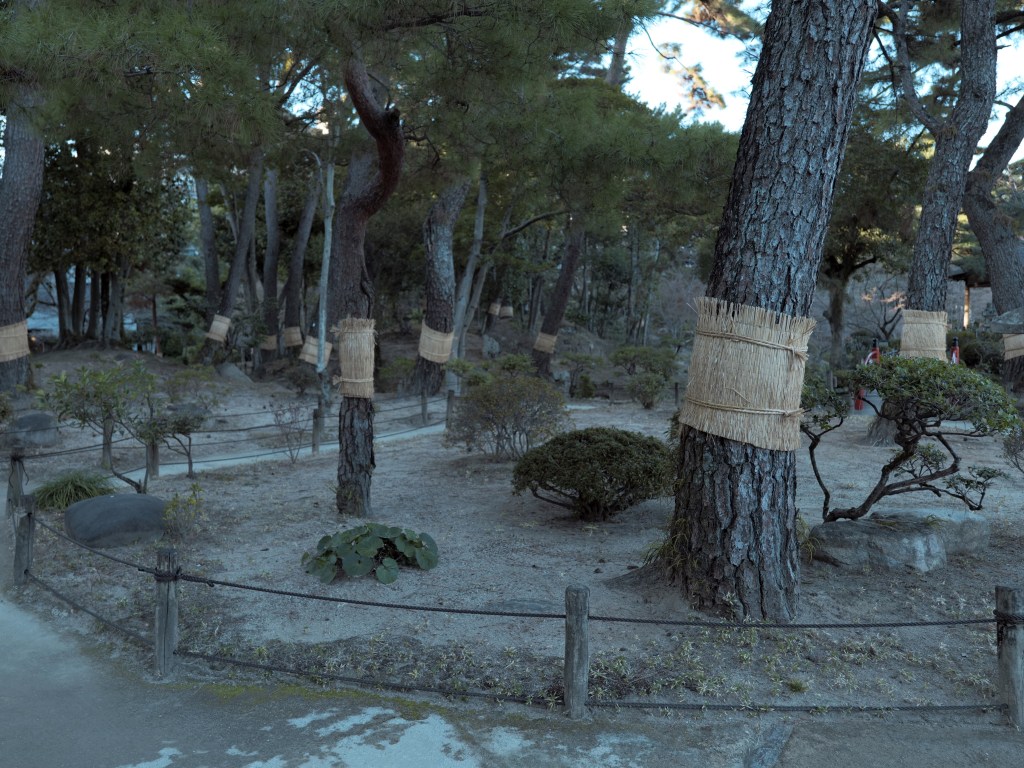
The circuit and the pond
The garden is built around a large pond with islands, and the path circles it through a sequence of deliberately composed views, which is what the kaiyu-shiki form means. The scale is small and the variety is the trick: a valley, a hill, a bamboo grove, a stone bridge and an open water view follow each other within a few hundred metres. Walk it in one direction and slowly, and the design does the rest.
The tea house Seifukan
Seifukan is the sukiya-style tea house in the garden, and it can be hired for tea ceremonies at 6,000 yen an hour with the garden admission on top. It is the building that explains the garden’s design logic, since Ueda Soko was a tea master and the paths are laid out to bring guests to a tea house rather than to a viewpoint. Tea ceremonies are held through the year and some are open to the public.
The artificial hills and the borrowed view
The garden compresses mountains, valleys and a coastline into a few hectares, and the hills are built rather than found. The name comes from a line about shrinking the mountains and the sea into one place, and the effect is best seen from the high points of the path where the pond reads as a bay and the mounds as a range. It is a landscape designed to be read rather than merely looked at.
The reconstruction
The atomic bomb destroyed the garden in 1945, and the restoration that began in 1949 took about thirty years. The stone lanterns, the bridge and the layout were rebuilt from records, and the garden is therefore a document of both the Edo period and the postwar city. It is one of the few places in Hiroshima where the destruction and the recovery can be seen in the same view without a museum panel.
The seasons
The garden is planted for the year: plum in February, cherry in late March and early April, iris and azalea in May, lotus on the pond in summer, maples in late November. It is a garden that rewards return visits rather than a single one, and the planting is dense enough that something is always at its peak. The autumn colour against the water is the most photographed.
The Prefectural Art Museum next door
The Hiroshima Prefectural Art Museum is beside the garden, and the combined ticket is 660 yen for adults and 350 for university students, which is barely more than the garden alone. The museum’s collection covers Hiroshima-related art and Japanese and Western painting, and the combination makes a natural half day. The garden’s own shop, Sensui-tei, is at the entrance and sells souvenirs and light meals.
The free days
The garden is free on 4 May, Greenery Day, and on 3 November, Culture Day, and the museum’s collection galleries are also free on 4 May. Those are the busiest days of the year and the days when the garden belongs to the city rather than to tourists, which is worth knowing if you want either the quiet or the crowd.
Food and drink
- The garden’s shop, Sensui-tei, sells light meals and sweets at the entrance, and it is a rest stop rather than a restaurant. Matcha and a sweet in the tea house setting is the traditional thing to have in a garden like this.
- Hiroshima’s food is okonomiyaki, and the city has hundreds of places, from the counters of Okonomi-mura to the small shops in the back streets. It is a cabbage pancake with noodles, egg and pork, cooked in front of you on a hot plate, and it is the meal to have in the city.
- The oysters of Hiroshima Bay are the other speciality, in season from autumn to spring, and they are served raw, grilled and in rice. The city’s anago, the sea eel, is the local sushi topping and the anagomeshi is the dish to order.
- The area around Hatchobori and the garden has cafes and small restaurants, and the basement food halls of the department stores are the practical option for a picnic in the garden, though eating is only allowed at the tables under the wisteria trellis by the museum lawn.
Getting there and around
- Take the Hiroshima Electric Railway from Hiroshima Station on the Miyajimaguchi or Eba line to Hatchobori, change to the Hakushima line, and get off at Shukkeien-mae, which is about a minute on foot from the gate. The whole journey takes about 15 minutes.
- By car, the garden is in the centre of the city and has a paid car park, 400 yen for the first hour and 200 for each 30 minutes after, with buses at 800 and 400. Parking is free for disabled visitors and their carers who park and enter under the exemption scheme.
- The garden is open from 9:00 to 18:00 from 16 March to 15 September with last entry at 17:30, and from 9:00 to 17:00 from 16 September to 15 March with last entry at 16:30. It closes only from 29 to 31 December.
- Admission is 350 yen for adults and 150 for university students, with high school students and under and anyone 65 or over free, and the combined garden and museum ticket is 660 for adults and 350 for university students. Groups of 20 or more pay 250 and 100.
- The garden is a 15-minute walk from Hiroshima Castle and about 20 minutes on the tram from the Peace Memorial Park, so it fits naturally into a day in the city. The museum next door shares the site and the car park.
Where to stay
- Hiroshima has hotels of every kind around the station, Hatchobori and the Peace Memorial Park, and the garden is within a tram ride or a walk of most of them. Staying near Hatchobori puts the garden, the castle and the shopping streets within walking distance.
- Miyajima, 30 minutes by train and ferry, has ryokan and the famous shrine, and staying there makes Hiroshima a two-centre trip. The island is quiet in the evening after the day visitors leave.
- The onsen of Hiroshima Prefecture are inland, and they are a separate trip. For the garden, the city centre is the base, and the garden is best visited in the morning before the tour groups.
Best time to visit
- Spring is the garden’s best season, with plum in February, cherry in late March and April, and the azaleas and iris in May. The garden is busy but never crowded, and the paths through the blossom are the classic photographs.
- Summer is green and hot, with the lotus on the pond and the shade of the trees, and the garden is a relief from the city heat. The longer opening hours from mid-March to mid-September make an evening visit possible.
- Autumn is the strongest season for colour, with the maples turning in late November and the reflection in the pond at its best. It is the most photographed month and the busiest outside the cherry season.
- Winter is quiet and bare, with the garden’s structure visible without the foliage, and the camellias and the winter plum giving some colour. The shorter hours from mid-September close the gate at 17:00, and the light goes early.
Practical tips
- Take the combined garden and museum ticket. It is 660 yen against 350 for the garden alone, and the museum next door is worth the difference. The two together make a proper half day.
- Check the free days before you plan. The garden is free on 4 May and 3 November, and the museum’s collection is free on 4 May. They are also the busiest days, so the free entry is a trade rather than a gift.
- Bring proof of age if you are 65 or over. The exemption is applied at the gate and requires a public document such as a driving licence, health insurance card or My Number card, and without it the full admission is charged.
- Walk the circuit in one direction and do not shortcut it. The garden is composed as a sequence and cutting across the middle breaks the design. The path takes about 40 minutes at a slow pace, and the tea house and the hill are on the far side.
- Do not bring a picnic blanket. Leisure sheets are prohibited, and eating is allowed only at the tables under the wisteria trellis in the lawn by the museum. The rule is enforced, and it keeps the moss and the grass intact.
- Visit early in the morning. The garden opens at 9:00, the tour groups arrive later, and the light on the pond is best before the sun is high. The city’s own citizens use it as a morning walk, which is the way to see it.
- Combine it with the castle and the Peace Memorial Park in that order. The castle is 15 minutes away on foot, the park is a tram ride, and the garden is the calmest of the three, which makes it either a good start or a good end to the day.
Suggested day-trip outline
- Take the tram to Shukkeien-mae and enter at 9:00 when the gate opens. Buy the combined ticket at 660 yen if you intend to see the museum, and leave your bag at the lockers if you have one.
- Walk the circuit slowly, starting at the pond and following the path over the bridge and up the hill, then to the tea house Seifukan. Stop at the high points for the view across the water, which is where the design of the garden is legible.
- Sit at the Sensui-tei at the entrance for matcha and a sweet, or have a light meal there, then go next door to the Prefectural Art Museum for an hour. The museum and the garden share a site and a ticket.
- Walk 15 minutes to Hiroshima Castle, or take the tram to the Peace Memorial Park, and eat okonomiyaki in the evening at one of the counters in the city centre. The garden is the quiet part of the day and the park is the necessary one.
- In late November, come back for the maples, which are the best colour of the year, and in late March for the cherry. The garden is small enough that a second visit in another season is a different garden rather than a repetition.
Before you go
Timetables, fares, admission fees, and seasonal access rules can change. Check the official tourism and transport sites linked below for the latest information before you travel.
Explore More of Japan
Published guides that pair with this one:
- Hiroshima Peace Memorial Travel Guide: The Park, the Dome, and the Museum
- Miyajima Travel Guide: Itsukushima Shrine, the Floating Torii, and a Hiroshima Day Trip
- Okayama Korakuen Travel Guide: A Garden Beside the Castle
- Kurashiki Travel Guide: Bikan Canal District
- Sandankyo Gorge Travel Guide: Trails, Boats, and Access from Hiroshima
- Hiroshima City Museum of Contemporary Art Travel Guide: Highlights, Access, and Planning
- Okunoshima Travel Guide: The Rabbit Island with a Difficult History
- Onomichi Travel Guide: Temple Walks and the Shimanami Kaido Gateway
- Tomonoura Travel Guide: A Tide-Waiting Port in Fukuyama
Browse every Chugoku guide on this site for the rest of the region.
Sources
- shukkeien.jp — Visitor guide (checked 2026-11-03)
- shukkeien.jp (checked 2026-11-03)
- shukkeien.jp (checked 2026-11-03)
- hiroshimacvb.jp (checked 2026-11-03)
- city.hiroshima.lg.jp (checked 2026-11-03)


Leave a Reply