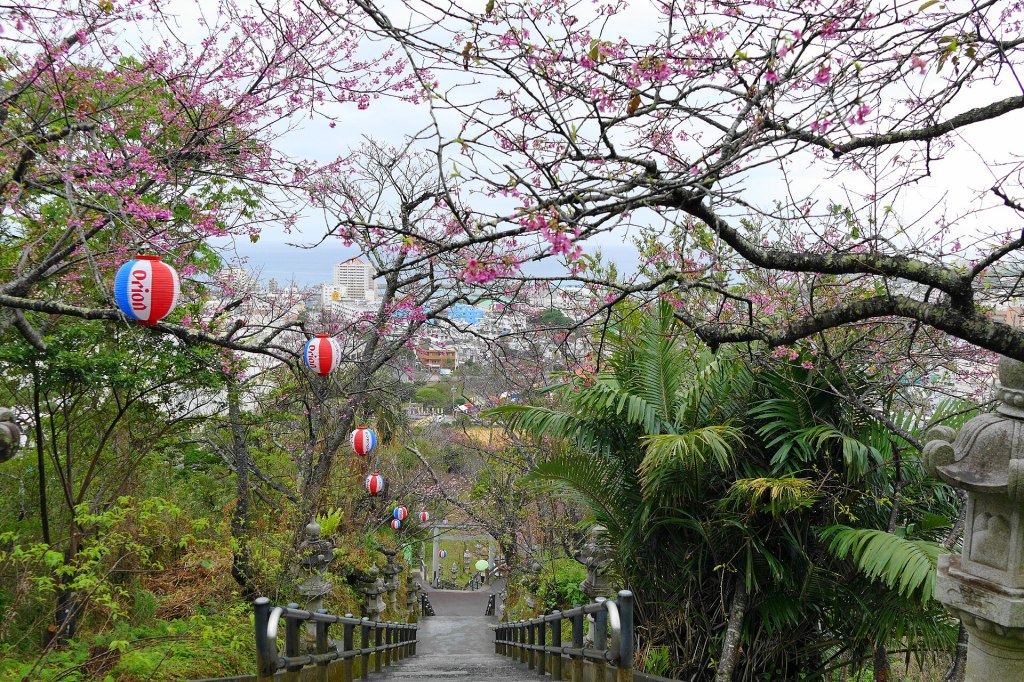
Plan a visit to Nago Castle Park in northern Okinawa, with its hilltop ruins, subtropical forest and January cherry blossoms.
Operational details such as opening hours, admission fees, and train times can change. Prefer official pages and reconfirm before you travel (sources checked on 04 November 2026).
Why visit
- Nago Castle Park is the reason Okinawa has a cherry season at all. The castle is a small one, a hilltop fort of the northern kingdom of Nago rather than one of the great fortresses of the Ryukyu court, and almost nothing of it remains above ground, but the slopes around it were planted with kanhi-zakura, the deep pink cherry of the subtropics, and the result is a forest that blooms in late January while the rest of Japan is still in winter.
- That timing is the whole point. The kanhi-zakura opens from late January into mid-February, and the city holds its cherry festival at the end of January, at the foot of the hill and in the streets below, which makes it the earliest big cherry festival in the country. It is not the pale blossom of Kyoto: the flower is a strong crimson-pink, the trees are dark and dense, and the effect against the green of the subtropical forest is nothing like a Japanese spring postcard.
- The site is a proper park rather than a ruin with a car park. The Nago Central Park covers 71 hectares planned and about 59 in service, on the slopes of Mount Nago above the city, with the castle site, the cherry garden, a nature observation area, a lookout, an open lawn and a visitor centre at the north entrance. It is one of the prefecture’s wide-area parks, and it is used as a park by the city rather than preserved as a monument.
- The view is the other reason to climb. The lookout near the top of Mount Nago gives the whole of Nago city below and the East China Sea beyond it, with the green of the hills on either side, and the water is the emerald colour that the Okinawan coast is known for. It is one of the few places on the island where you see a city, a forest and the sea in the same frame, and it is free.
- The castle itself is the historical layer. Nago was one of the small kingdoms of the north before the Ryukyu unification, and the fort on this hill guarded the inlet below. The stonework that remains is fragmentary, and the interest is in the position rather than the masonry: you can see exactly why the hill was chosen, because the whole coast and the river mouth are in view. The city has marked the site and the paths, and the walk between the gates is short.
- The practical case is that it is close to the resort coast and free. Nago is the gateway to the northern half of the island, 20 minutes from Churaumi and an hour from Naha on the expressway, and the park is on the edge of the town rather than out in the forest. There is a visitor centre with toilets and a shop, the cherry season has food stalls and a festival, and the rest of the year it is a quiet wooded hill with a view.
Top places and highlights
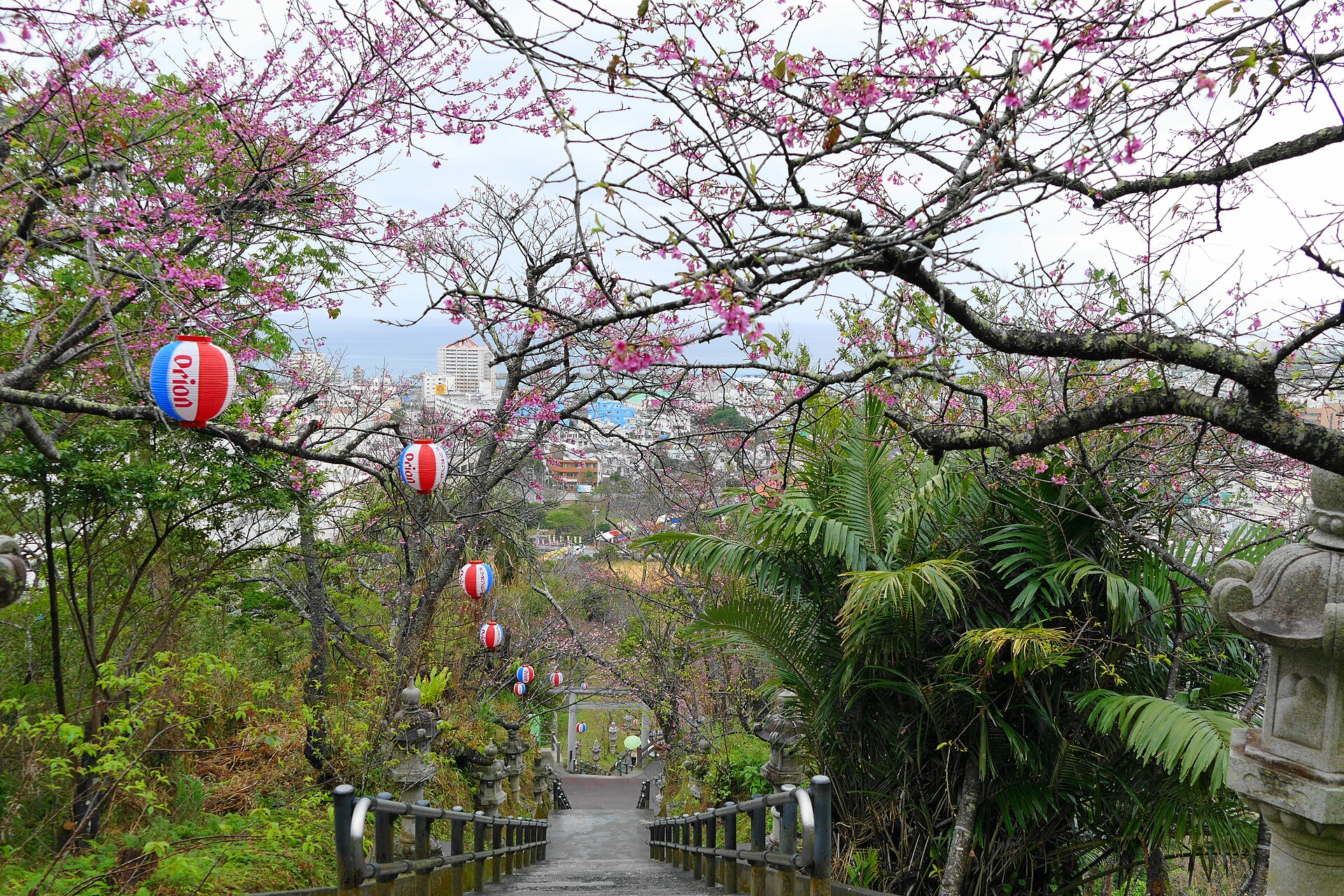
The kanhi-zakura in bloom
The cherry here is Prunus campanulata, the Taiwan cherry, with a crimson-pink flower that opens downward like a bell, and it blooms from late January to mid-February rather than in April. The slopes of the castle site and the cherry garden around it are planted densely, and the blossom against the evergreen forest is the photograph everyone comes for. The best weeks are the last days of January and the first of February.
The Nago Cherry Blossom Festival
The city holds its festival at the end of January, with the 64th edition on 30 and 31 January 2027. It spreads from the castle park to the Sakura Park stage, the Nago crossroads street, which becomes a pedestrian zone, and the fishing port, with brass bands, a costume parade, street dance and the local stage acts. The street party runs from 11:00 to 20:30, and the port is used for parking and a garden event.
The castle site
Nangusuku, the castle of Nago, sits on the ridge of the hill and consists of a few enclosures with fragmentary stone walls and a marked path. It is not a restored castle and there is nothing to enter, and that is the honest appeal: the position explains the place, with the town and the coast below and the mountains behind. The south entrance is reached by a staircase from the car park.
The lookout over Nago
The observation point near the summit looks down on the city and out over the East China Sea, and on a clear day the water is the deep emerald of the Okinawan coast. It is a short walk from the castle site and the paths are shaded, and it is the place to understand the geography of the north. The view is free and open at any hour.
The visitor centre Subaco
The north entrance has a visitor centre with a shop, toilets, a meeting room and information on the park, and it is where the guided walks and the local events start. It is the practical base for a visit and the place to ask about the state of the blossom, since the season moves by a week or two from year to year. The park office is on 0980-52-7434.
The forest and the birds
The park is mostly mountain, with a nature observation area and a botanical garden of the local plants, and the woodland holds the birds of the Yanbaru rather than the species of the city. The paths through it are quiet even in the festival, and the walk from the north entrance to the castle site takes about half an hour through the trees. It is a forest walk with a view at the end.
Nago itself
The town below the hill is the largest in the north, with the market, the restaurants and the coastline, and the festival fills its streets. It is the base for Churaumi, Kouri Island and the Yanbaru, and the park is a 10-minute drive from the centre. The town’s Orion beer and the local food are the reward after the climb.
Food and drink
- Nago is the largest town in the north and has the widest choice of food on this coast: Okinawa soba, the pork dishes, the tacos that came from the American presence, and the seafood of the port. The market and the streets around the crossroads are where the local eating is concentrated.
- The local speciality is the Nago pineapple and the tropical fruit of the north, sold at the roadside stands and the market, and the juice is worth stopping for. The town also has the Orion brewery, and the beer is on every menu in the north.
- The festival food is part of the experience in late January: the stalls around the park and the street sell the standard matsuri food, and the fishing port hosts a garden event with local produce. It is not fine dining, and it is the right thing to eat while walking under the blossom.
- The seafood of the north is good and simple, and the restaurants around the port serve it as sashimi, in bowls and grilled. The Okinawan sweets, the beni-imo and the sata-andagi, are the things to take away.
Getting there and around
- By car, take the Okinawa Expressway to the Kyoda interchange and Route 58 north into Nago, then use the north entrance, which is the recommended route for cars and the only one for large buses. The south entrance has a narrow road and is the way to the castle site on foot via the staircase.
- By bus, the route from Naha is the bus to the Nago bus terminal, about two hours from the Naha terminal, then a local bus or a taxi to the park, or the walk to the Nago Castle entrance stop, which is about seven minutes from the gate. The expressway buses are faster than the ordinary route.
- The park is free and has no gate or ticket, and it is open at all hours, with the visitor centre and the shop keeping daytime hours. The cherry festival is also free, and the only costs are the parking and the food.
- Parking is at the north and south entrances, and during the festival the traffic arrangements change and the fishing port is used as a temporary car park. The city publishes the arrangements with the festival programme, and arriving early is the only reliable strategy in the last weekend of January.
- The park is on the edge of Nago, 10 minutes by car from the town centre and about 20 minutes from the Churaumi aquarium, which makes it a natural stop on the way north or back. Naha is about an hour and a half by expressway.
Where to stay
- Nago has hotels and resorts along the coast and business hotels in the town, and it is the natural base for the north. Staying in Nago puts the park, the aquarium and the Yanbaru within half an hour.
- The resort coast of Onna is 40 minutes south, with the larger hotels and the beaches, and Nago is a day trip from it. The northern resorts around Okuma and Ada are the other direction and are quieter.
- The festival weekend fills the town, and the hotels of Nago and the surrounding coast should be booked well ahead for the last weekend of January. The rest of the year the town is comfortable and the rates are ordinary.
Best time to visit
- Late January and early February are the season, with the kanhi-zakura in flower and the festival on the last weekend of January. It is the only time the park is crowded, and it is the reason to come.
- Spring after the blossom is green and quiet, with the forest at its freshest and the view at its clearest, and the park belongs to the city again. The heat has not yet built and the walks are comfortable.
- Summer is hot and humid, and the park is a forest walk in the shade rather than an outing in the open. The early morning and the evening are the only sensible hours, and the festival is a distant memory.
- Autumn and early winter are the best months for the view and the walking, with dry air and clear water below, and the park is empty. The blossom is still two months away, and the town is at its calmest.
Practical tips
- Book the last weekend of January early if you want the festival. The town fills with visitors from the rest of the island, the hotels raise their rates, and the roads around the park are managed by the police. The blossom itself is worth seeing on a weekday without any of that.
- Check which entrance your route needs. Cars and coaches use the north entrance off Route 58, and the castle site is reached by the staircase from the south car park. The south road is narrow, and driving to it in the festival is a mistake.
- Go early in the morning for the photographs. The blossom slopes face the town and the light comes over the hill, and the car parks at the castle site are small. The festival crowds arrive from mid-morning.
- Wear shoes with grip. The paths to the castle site are stone steps and packed earth, and they are slippery after rain, which the island gets even in January. The walk up from the south entrance is short and steep.
- Do not expect a castle. There are fragments of wall and a marked site, and the value is the position and the view rather than the architecture. Anyone who comes for a restored keep will be disappointed, and anyone who comes for a hilltop forest and a festival will not.
- Combine it with Churaumi and the north. The park is 20 minutes from the aquarium and on the way to Kouri Island and the Yanbaru, and a morning at the park followed by the aquarium is a natural day in the north.
- Ask at the visitor centre about the state of the blossom. The season moves with the weather, and the staff at Subaco know whether the trees on the upper slopes have opened. The park office number is 0980-52-7434.
Suggested day-trip outline
- Drive up from Nago in the morning, or take the bus to the Nago Castle entrance stop and walk the seven minutes to the gate. Start at the north entrance and the visitor centre, then take the path through the forest towards the castle site.
- Walk the castle enclosures and the cherry slopes, and continue to the lookout over the town and the East China Sea. The whole loop takes about an hour and a half at an easy pace, and the view is the reward for the climb.
- In the last weekend of January, come down into the town for the festival: the stage at Sakura Park, the pedestrian street with the parade and the street dance, and the food stalls. The street party runs from 11:00 to 20:30 and the port is used for parking.
- Eat in Nago in the evening, at the market or one of the town’s restaurants, and stay the night so the blossom can be seen again at dawn without the crowd. The town is the base for the aquarium and the northern coast the next day.
- Outside the season, the park is a quiet forest walk with a view and a picnic lawn, and it combines with the market and the coast for a half day. The walk is short enough to fit around a flight or a drive north.
Before you go
Timetables, fares, admission fees, and seasonal access rules can change. Check the official tourism and transport sites linked below for the latest information before you travel.
Explore More of Japan
Published guides that pair with this one:
- Cape Hedo Travel Guide: Okinawa’s Northernmost Point
- Kouri Island Travel Guide: The Heart Rock and a Bridge over Emerald Water
- Nakijin Castle Ruins Travel Guide: A World Heritage Gusuku
- Cape Zanpa Travel Guide: Yomitan’s Cliffs and Lighthouse
- Shikinaen Garden Travel Guide: Naha’s Ryukyu Royal Garden
- Okinawa Prefectural Museum and Art Museum Travel Guide: Highlights, Access, and Planning
- Okinawa Peace Memorial Park Guide: Mabuni and the Battle Sites
- Tokashiki Island Guide: A Kerama Day Trip from Naha
Browse every Okinawa guide on this site for the rest of the region.
Sources
- nangusuku-osi.jp (checked 2026-11-04)
- nangusuku-osi.jp (checked 2026-11-04)
- pref.okinawa.jp (checked 2026-11-04)
- nagomun.or.jp (checked 2026-11-04)
- jalan.net (checked 2026-11-04)


Leave a Reply