Plan a visit to Ushiku Daibutsu in Ibaraki, one of the tallest Buddha statues in the world, with access, hours and what to see.
Operational details such as opening hours, admission fees, and train times can change. Prefer official pages and reconfirm before you travel (sources checked on 03 November 2026).
Why visit
- Ushiku Daibutsu is 120 metres tall, and the number is not decorative: it represents the twelve lights of Amida Nyorai, the Buddha it depicts, at ten metres each. When it was completed in 1995 it was recognised by Guinness as the tallest bronze statue in the world, and it is still one of the tallest statues of any kind on earth. What matters for a visit is the scale at close range: the statue’s face is 20 metres from chin to hairline, its hands are larger than a house, and standing at the base you cannot see the head without stepping back.
- The statue is not a monument in a park but the centre of a working temple. It belongs to the Jodo Shinshu Otani-ha school, whose head temple is Higashi Honganji in Tokyo’s Asakusa, and the surrounding site, Ushiku Jōen, is a temple complex that includes a columbarium and cemetery. That is worth knowing before you go: this is a place where people come to mourn and to pray, and the statue is an object of devotion rather than a photo opportunity, even though it is both.
- The interior is the part that surprises people. The statue is hollow, with five levels inside, and you walk up through them: a dark passage that opens into light, a hall of copying sutras with about 77 seats, a space surrounded by some 3,400 small Buddha figures, a chamber holding relics, and finally the observation deck at 85 metres, at chest height, with windows looking out over the Kanto Plain. On a clear day you can see Tokyo Skytree and Mount Fuji, which makes the statue a viewpoint as well as a monument.
- The garden around the base is a designed Pure Land, with the Shaka Sanzon statues, a gate, a pond and the paths that lead to the statue’s feet. It is a religious landscape rather than a garden for strolling, and the design is meant to move you towards the Buddha rather than to display plants. The result is a place that is at once solemn and slightly surreal, which is the honest description of a 120-metre Buddha in rural Ibaraki.
- The practical case is simple. It is free to park, the admission is modest, it is three minutes from an expressway interchange and reachable by bus from a Joban Line station, and it takes two to three hours. It is the kind of sight that fits into a day between Tokyo and Tsukuba, or into a drive between Narita and the Joban coast, and it delivers something you will not see anywhere else in Japan.
- There is also a small animal area, the Fureai Garden, which runs on Sundays and public holidays only and closes in December and February, with a monkey show. It is not the reason to come, and its presence tells you something about how the site is marketed to families, but it is there and it is included in the garden admission.
Top places and highlights
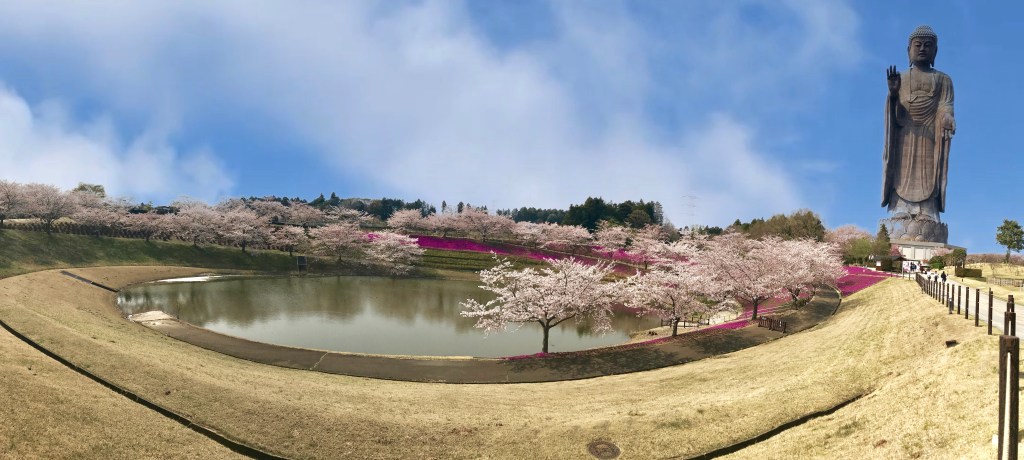
The statue itself
At 120 metres, the Amida Buddha is the tallest bronze statue in the world by the Guinness record it received in 1995, and the height is a doctrinal reference to the twelve lights of Amida. From the approach path the figure fills the sky, and the scale only becomes legible when you stand beside the lotus pedestal and look up. The bronze has weathered to a green-grey, and the face is calm in the way that large Buddhist sculpture usually is, which makes the size feel less like spectacle than it might.
The five levels inside the statue
The interior is a sequence rather than a single room. You move from a dark passage into a lit space, past a hall with about 77 seats for sutra copying, through a world of roughly 3,400 small Buddha figures, and into a chamber holding relics, with the observation deck at the top of the climb at 85 metres. The sutra copying is an extra charge from 500 yen, and the whole interior is included in the set ticket rather than the garden ticket.
The observation deck at 85 metres
The deck sits at the statue’s chest, with windows facing out over the Kanto Plain, and it is the only place in Ibaraki where you look out from inside a Buddha. On a clear day the Tokyo Skytree and Mount Fuji are visible, and the flat farmland below makes the scale of the plain obvious. It is a small room and it gets crowded on holidays, so it is worth going up early in your visit rather than at the end.
The Pure Land garden
The garden is laid out as a Pure Land, with the Shaka Sanzon statues and the Hatsugan-mon gate on the approach, a pond, and paths that bring you to the statue’s feet. It is included in the cheaper garden ticket and it is where most of the photographs are taken, including the classic reflection in the pond. It is a religious landscape rather than a flower garden, and walking it slowly is the way to understand what the site is for.
The Fureai Garden animals
The small animal area opens on Sundays and public holidays only, and closes entirely in December and February, with a monkey stage on the days it runs. It is included in the garden admission and it is aimed at families with small children rather than at the statue’s visitors. It is a curiosity rather than a highlight, and knowing the schedule saves a disappointed child.
The New Year service
The temple opens at 23:00 on New Year’s Eve and stays open until 01:00, with a service at 23:45 at the gate in the garden and a New Year service at 00:30 on the third level of the statue. The first three days of January are free to enter, and a service is held every hour on the statue’s third level. It is the one time the site operates at night, and it is a religious event rather than a light-up.
The cemetery and columbarium
Ushiku Jōen is a working cemetery and columbarium as well as a temple, with graves and a hall for memorial services, and this is the part of the site most visitors do not realise exists. Walking past it changes the tone of the place: the giant Buddha is the centre of a place where families come to remember the dead, and the scale is meant to be comforting rather than impressive. Be quiet and do not photograph people at the graves.
Food and drink
- There is a shopping and food area at the entrance with souvenir shops and simple meals, and it is the practical place to eat without leaving the site. The food is ordinary rather than memorable, and the appeal is convenience rather than cooking.
- The local speciality in Ushiku is lotus root, renkon, which grows in the shallow ponds of the area and is used in the temple’s own cooking and sold pickled and dried in the shops. It is the thing to buy that is specific to the place rather than a generic souvenir.
- Ushiku city and nearby Ami have restaurants, including the large outlet mall at Ami Premium Outlets a short drive away, which has a food court and is the obvious stop if you are driving. It is a shopping destination rather than a food one.
- Tokyo is 50 minutes away by train, and Tsukuba is 30 minutes by car from the interchange, so the realistic plan is to eat before or after rather than to make the statue a meal destination. The site’s own food exists to keep you there for two hours, not to be the reason you came.
Getting there and around
- By train, take the JR Joban Line to Ushiku Station and leave by the east exit, where bus stop 2 serves the Kanto Railway bus to Ushiku Jōen and the Ami Premium Outlets bus, both of which stop at Ushiku Daibutsu. The ride is 20 to 30 minutes, and the fare is about 730 yen on weekdays and 560 yen on the weekend direct service.
- There is a free shuttle bus on Saturdays, Sundays and public holidays only, running from the east exit bus terminal and back, roughly hourly from 10:30 to 15:30 outbound and 10:50 to 14:50 returning. It is the cheapest option and the one that requires the least planning, but it does not run on weekdays.
- By car, leave the Ken-o Expressway at the Amihigashi interchange and follow the road towards Ryugasaki, turning right at the Shimokuno intersection, which puts you at the site in about three minutes and two kilometres. The Ushiku-Ami interchange also works, and from Tokyo’s Misato interchange the drive is about 35 minutes, from Tsukuba Chuo about 16, from Mito about 41 and from Narita about 27.
- Parking is free, with 820 spaces, which is unusual for a sight of this size and one of the reasons it works as a road-trip stop. There is no charge and no booking, and the car park is beside the entrance.
- The site is open from 9:30 and closes at 17:00 on weekdays and 17:30 on weekends and holidays from March to September, and at 16:30 for everyone from October to February. The reception for the set ticket closes 45 minutes before the gates and for the garden ticket 30 minutes before, which in winter means the interior shuts at 15:45.
Where to stay
- Ushiku is a residential and agricultural city with a few business hotels near the station, and staying there makes the statue a morning visit rather than a journey. It is not a destination town in its own right.
- Tsukuba, about 30 minutes away, has the widest range of hotels in the area and is a better base for combining the statue with Mount Tsukuba. It is a planned city with good roads and a lot of green space.
- Tokyo is the realistic base for most visitors, since Ushiku is under an hour on the Joban Line from Ueno and the statue is a half-day trip. Tsuchiura, one stop closer, has hotels and a castle park and is the alternative if you want to stay outside the city.
Best time to visit
- Spring is the best season for the garden, with the approach and the pond at their greenest and the weather good for the walk to the statue’s feet. The site is busy on weekends in April and May, mostly with families and tour groups.
- Summer is hot and the garden has limited shade, and the interior of the statue is a relief from the sun because it is cool and enclosed. The observation deck is at its clearest in the morning, before the haze builds over the plain.
- Autumn is the strongest season overall, with clear air for the view from 85 metres, the garden at its best and comfortable walking. November is when Mount Fuji and the Skytree are most likely to be visible from the deck, and it is also the busiest month.
- Winter closes earlier, at 16:30, and the last entry to the interior is 15:45, which requires an early start. The compensation is the clearest air of the year and the New Year services, when the temple opens at 23:00 on 31 December and admission is free for the first three days of January.
Practical tips
- Buy the set ticket rather than the garden ticket. The garden is 600 yen for adults and the set with the interior is 900, and the interior, with its five levels and the 85-metre deck, is the part that makes the visit different from looking at a large statue. Children are 500 for the set and 400 for the garden, and under-threes are free for both.
- Watch the reception times in winter. From October to February the site closes at 16:30, the set ticket stops selling 45 minutes before that and the garden ticket 30 minutes before, so the interior is closed by 15:45. Arriving at 15:00 in winter gives you less than an hour inside.
- Check the day for the animal garden. The Fureai Garden opens on Sundays and public holidays only, and it closes entirely in December and February. It is included in the garden admission, so a family with small children should plan around the day rather than be disappointed.
- Use the weekend shuttle bus from Ushiku Station. It is free and runs hourly from 10:30 on Saturdays, Sundays and holidays, while the regular bus costs about 730 yen on weekdays. The trade is the fixed timetable, with the last return at 14:50.
- Remember that this is a temple and a cemetery. The statue belongs to the Jodo Shinshu Otani-ha school and the site includes a columbarium with graves, so keep your voice down near the memorial areas, do not photograph mourners, and treat the interior as a place of worship rather than an attraction.
- Pets cannot go inside the statue or the garden, so a dog has to stay in the car or at home. This is stated plainly by the temple and it is the kind of rule that ruins a day if you discover it at the gate.
- Go up to the observation deck early. It is a small room at 85 metres and it fills on holidays, and the view is clearest in the morning before the haze. Doing it first also means you are not rushing the interior at closing time.
Suggested day-trip outline
- Take the Joban Line from Ueno to Ushiku, about 50 minutes on a limited express, then the bus from stop 2 outside the east exit, 20 to 30 minutes, or the free shuttle at the weekend. By car, leave the Ken-o Expressway at Amihigashi and arrive in three minutes, with free parking at the gate.
- Enter through the Hatsugan-mon gate and walk the garden path past the Shaka Sanzon statues and the pond towards the statue. Do this slowly, because the approach is designed to build the scale gradually, and take the classic reflection photograph before the wind picks up.
- Go inside and climb the five levels to the observation deck at 85 metres, then come down through the halls at your own pace. Look for the hall of sutra copying and the chamber of the 3,400 Buddha figures, and check the view for the Skytree and Mount Fuji if the air is clear.
- Return to the garden and walk to the base of the statue to see the lotus pedestal and the scale from below, then eat at the entrance shops or buy renkon to take home. If it is a Sunday or holiday between March and November, the animal garden is open for children.
- Leave by the bus or the car and combine the visit with Tsukuba, 30 minutes away by road, or with the Ami Premium Outlets for shopping. In winter, start early enough to be inside by 15:00, since the interior closes at 15:45.
Before you go
Timetables, fares, admission fees, and seasonal access rules can change. Check the official tourism and transport sites linked below for the latest information before you travel.
Explore More of Japan
Published guides that pair with this one:
- Mount Tsukuba Travel Guide: The Twin Peaks North of Tokyo
- Tokyo Travel Guide: Neighborhoods, Transport and a First-Timer’s Plan
- Nikko Travel Guide: Toshogu Shrine, Waterfalls, and a Tokyo Day Trip
- Kamakura Travel Guide: Great Buddha, Temples, and a Tokyo Day Trip
- Mount Nokogiri and Nihonji Travel Guide: Cliffs, Carvings, and the Boso Peninsula
- Meiji Jingu and Harajuku Travel Guide: Shrine Forest, Takeshita Street and Omotesando
- Railway Museum Omiya Travel Guide: Highlights, Access, and Planning
- Ikaho Onsen Guide: Gunma’s Stone-Step Hot Spring Town
- Nagatoro Guide: The Arakawa River and Saitama’s Stone Town
Browse every Kanto guide on this site for the rest of the region.
Sources
- daibutu.net (checked 2026-11-03)
- daibutu.net (checked 2026-11-03)
- bosan.net — Access (checked 2026-11-03)
- honganji.or.jp (checked 2026-11-03)


Leave a Reply