Plan a stay in Kaminoyama Onsen in Yamagata, a castle-town hot spring with mountain views and old ryokan.
Operational details such as opening hours, admission fees, and train times can change. Prefer official pages and reconfirm before you travel (sources checked on 04 November 2026).
Why visit
- Kaminoyama is a castle town, a post town and a hot spring town in the same small basin at the foot of Mount Zao, and the three layers are still visible. The castle sits on its hill above the streets, the old Ushu highway runs through the middle, and the hot spring water comes up in the middle of the town rather than in a resort built around it.
- The hot spring is one of the oldest in the region. The town celebrated 400 years of the spring in 2024, counting from the common bath opened by the Kaminoyama domain in 1624, and the water is clear, soft and low in colour, which is why it is described as a bath for babies and as a beauty bath rather than a harsh mountain spring.
- It is also unusually easy to reach. The Yamagata Shinkansen stops at Kaminoyama-Onsen station, about two and a half hours from Tokyo, and the castle is a 12-minute walk from the platform. Few hot spring towns in Tohoku combine a Shinkansen stop, a castle and a public bath at 150 yen in the same square kilometre.
- The town is one of the three pleasure spa towns of the old Ou region, along with Higashiyama in Fukushima and Yunohama in Yamagata, and it has two distinct hot spring districts: the Shin-yu and Yu-machi quarter in the town centre, with the temples, the castle and the old streets, and the Hayama, Kawasaki and Takamatsu quarter on the higher ground with the view of the Zao range.
- Kaminoyama is wine country. The city’s vineyards and wineries have won national prizes, the station has a wine cave where glasses and bottles from local producers are sold, and the Yamagata Wine Bar event brings producers from across the prefecture into town. For a hot spring town, the combination of a bath and a glass of local wine is the local culture rather than a gimmick.
- There is a literary layer as well. The poet Saito Mokichi was born here in 1882, and the museum devoted to him holds his manuscripts, his calligraphy and his collection, with a garden and a view of the mountains he wrote about. It is a serious museum, not a birthplace shrine, and it gives the town a second centre beyond the spa.
Top places and highlights
Kaminoyama Castle
The castle, also called Tsukioka Castle, was founded in 1535 and became the seat of the Kaminoyama domain before being dismantled by the shogunate in 1692. The present three-storey keep is a 1982 reconstruction on the site of the second enclosure, and it houses the local history museum. The view from the top takes in the town, the hot spring roofs and the Zao range. Admission is 600 yen for adults, 500 for high school and university students and 200 for primary and junior high pupils, and it is open from 9:00 to 17:15 with last entry at 16:45. It closes on Thursdays, or the preceding weekday when Thursday is a holiday, and from 29 to 31 December.
Shimodaiyu public bath
The oldest of the town’s public baths, opened in 1624 by the Kaminoyama domain and said to have been used by the Zen master Takuan. The bath has two pools, one hot and one cooler, and the wall paintings of the castle and the Zao crater lake are part of the experience. It is open from 6:00 to 22:00 with last entry at 21:30 and no closing days, and the adult entry is 150 yen, with a 100-yen charge if you wash your hair. The rest room upstairs is 300 yen but is closed from January to March.
Kaminoyama Castle foot bath
The free foot bath on the castle grounds looks over the town and up to the Zao range, and it is the easiest introduction to the hot spring without undressing. It is a short walk from the castle entrance and from the town centre, and it is open to anyone passing. In spring the castle hill is one of the town’s cherry spots, and the foot bath is where people sit after walking up.
The Saito Mokichi Memorial Museum
The museum is dedicated to the poet and physician Saito Mokichi, born in Kaminoyama in 1882, and it holds his manuscripts, calligraphy and personal collection along with a garden and a view of the mountains that appear in his work. Admission is 600 yen for adults, 300 for students and 100 for children, and it is open from 9:00 to 17:00 with last entry at 16:45. It closes on Wednesdays, or the following day when Wednesday is a holiday, for a week in the second part of July, and over the New Year, and there is an audio guide for 300 yen.
The samurai house of the Miwa family
The Miwa house is a surviving samurai residence in the Tsuruhagi district, open from 9:00 to 16:45 and closed on Wednesdays and over the New Year, with a combined ticket for the town’s cultural facilities at 220 yen for adults, 160 for high school and university students and 50 for children. Several other samurai houses in the same streets are free to view from the garden, and the castle car park is a three-minute walk away. It is a small, quiet site that shows the scale of a middle-ranking retainer’s life rather than a lord’s.
The Hayama district
The Hayama, Kawasaki and Takamatsu quarter sits on the higher ground east of the centre, with inns that look across the basin to the Zao range, and it has a different atmosphere from the town-centre baths: quieter, more residential, and built for the view. The Hayama public bath is 150 yen, open early morning and evening on weekdays and all day at weekends, and it is the local bath rather than a visitor attraction. A car or taxi is the practical way up.
Kaminoyama wine
The city is one of the wine centres of Yamagata, with wineries producing from local grapes and a record of prizes at national competitions. The Yamagata Wine Cave at the station’s tourist information office sells and pours glasses from producers across the prefecture, and the annual Yamagata Wine Bar brings wineries and food stalls into town. Visiting a winery needs a car and a check on opening days, but the station cave is the reliable introduction.
The old Ushu highway streets
Kaminoyama was a post town on the Ushu highway as well as a castle town, and the streets between the station and the castle still hold merchant houses, temples and the lattice fronts of the old road. The town has nine thatched buildings designated as cultural properties, and several old houses are open free of charge, including the Takeda, Shonaiya, Daikokuya and Yamadaya houses. The walk from the station through these streets to the castle is the best way to arrive.
Food and drink
- Kaminoyama is wine country first, and the local restaurants and inns build their lists around Yamagata wine. The station’s wine cave pours by the glass, and the wineries sell direct, so a bottle with dinner is the local way to eat.
- The food is the cooking of Yamagata’s inland basin: soba, rice, mountain vegetables, mushrooms and river fish, with Yonezawa beef and Yamagata pork on the better menus. The town’s restaurants are concentrated around the station and the castle, and many are small and close early.
- The fruit is the other local speciality. Yamagata produces cherries, pears, grapes and La France pears, and Kaminoyama’s markets and direct-sale shops sell them in season. The grapes are what the wine is made from, and the autumn fruit is the reason to visit in September and October.
- For a hot spring town, the food is deliberately low-key: set meals at the inns, ramen and soba at lunch, and coffee in the old houses. The town does not have a food scene to chase, and the best meals are usually the ones included with the room.
Getting there and around
- The Yamagata Shinkansen stops at Kaminoyama-Onsen station, about two and a half hours from Tokyo and about 15 minutes from Yamagata station. The castle is a 12-minute walk from the station, and the town-centre baths are 10 to 15 minutes on foot.
- By car, the Tohoku-Chuo Expressway has the Kaminoyama-Onsen and Yamagata-Kaminoyama interchanges about 10 minutes from the centre, and the Yamagata-Zao interchange on the Yamagata Expressway is about 25 minutes away. The town is a short drive from Yamagata city and a natural stop on the way to Zao.
- The station area has the tourist information office, the wine cave and the bus stops, and the town is flat enough to walk between the station, the castle and the Shin-yu and Yu-machi baths. The Hayama district is on the hill and needs a car, taxi or the inn’s shuttle.
- The castle has about 50 ordinary car spaces and bus parking by reservation, and the Shimodaiyu bath has a free 40-space car park opposite. The town is small enough that a car is a convenience rather than a necessity for the centre.
- Kaminoyama works as a day trip from Yamagata and as an overnight stop between Yamagata and Zao. The Shinkansen makes it unusually easy to combine with Tokyo, and the town is a good first or last night of a Tohoku trip.
Where to stay
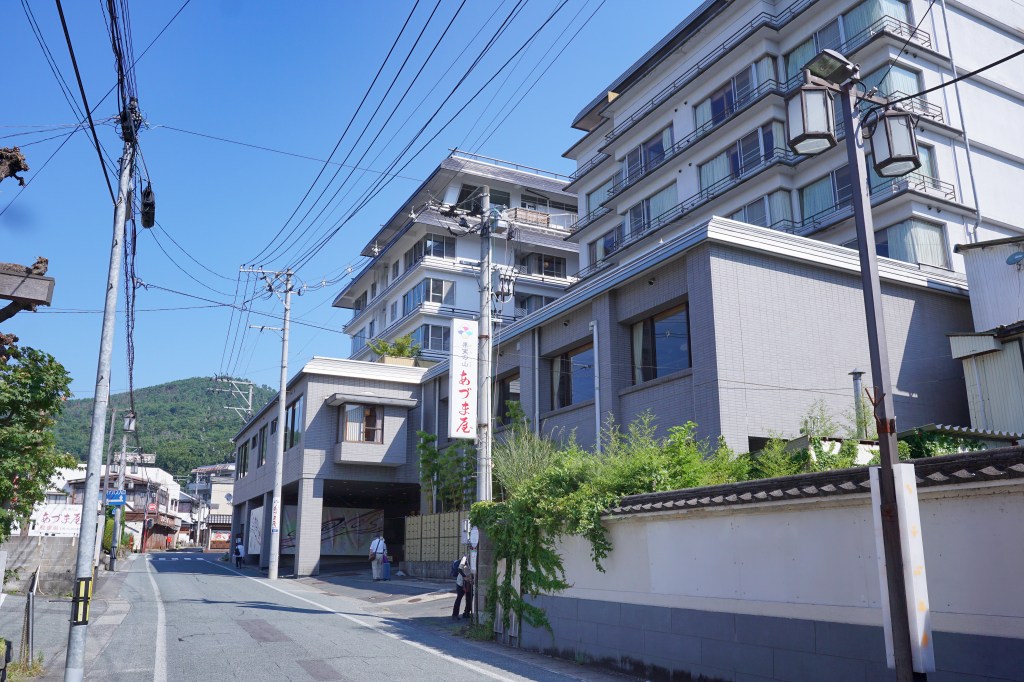
- The town has a wide range of inns, from large hot spring hotels in the Shin-yu and Yu-machi districts to small family-run lodges, and the Hayama district has inns with the best views of Zao. Staying in the centre puts the castle, the public baths and the restaurants within walking distance.
- The large hotels have their own baths and often offer day-use bathing, but the small public baths are the more interesting soak. A stay that uses both the inn’s bath and the Shimodaiyu is the full experience of the town.
- Yamagata city, 15 minutes by Shinkansen, has the widest choice of hotels and the best connections, and Zao Onsen is about 40 minutes by car for the mountain and the snow monsters. Kaminoyama is the quieter and cheaper base between them.
Best time to visit
- Spring is cherry season, and the castle hill and the town’s parks are the local spots. The foot bath at the castle is at its best in April, and the Shinkansen makes a day trip from Tokyo possible.
- Summer is green and warm, with the Zao range as the escape from the heat and the town’s walks and vineyards at their most active. The baths are pleasant in the evening, and the town is quiet on weekdays.
- Autumn is the best season for food and wine, with the grape harvest, the new rice and the colour on the Zao slopes. The town is at its most comfortable in October, and the wine events and the harvest are the reason to plan around it.
- Winter is cold and snowy, with the hot spring at its best and the town under a layer of snow. The castle and the museums keep shorter hours around the New Year, and the Hayama baths are the warmest corner of the day.
Practical tips
- Check the castle’s Thursday closure. The museum closes every Thursday, or the preceding weekday if Thursday is a holiday, and the Saito Mokichi museum closes on Wednesdays. Planning the two museums on the same day can leave you outside one of them.
- Bring small change for the public baths. The Shimodaiyu is 150 yen plus 100 yen for hair washing, and the entry is paid at the bath rather than at a ticket machine in some cases. A towel is not always included.
- Use the foot bath if you are short of time. The castle foot bath is free and gives the view and the hot spring experience without a full bath, and it fits a day trip between trains.
- Walk from the station rather than taking a taxi. The castle is 12 minutes on foot and the town-centre baths are 10 to 15, and the streets in between are the old post town. The walk is the introduction to the place.
- Book the inn for dinner. The town’s restaurants are small and close early, and the best meals are the kaiseki or the set dinners at the inns. If you want to eat out, do it at lunch.
- Take the wine cave seriously. The station’s Yamagata Wine Cave is the easiest place to taste the prefecture’s wines, and the staff can point you to the local producers. Buying a bottle there is better than carrying one from Tokyo.
- Combine the town with Zao rather than Yamagata city. Kaminoyama is the natural overnight stop before or after the Zao ropeway and the crater, and the drive over the mountain is part of the trip.
Suggested day-trip outline
- Arrive at Kaminoyama-Onsen station and walk into the town, stopping at the tourist information office and the wine cave. Follow the old Ushu highway streets to the castle, and take the foot bath before or after the museum.
- Climb the castle for the view and the local history, then walk down through the samurai district to the Miwa house and the temples. Have lunch near the castle or the station.
- In the afternoon, visit the Saito Mokichi Memorial Museum, then soak at the Shimodaiyu public bath before checking in. If you are staying in Hayama, go up to the inn for the view and the evening bath.
- Stay the night and eat at the inn, with a bottle of Kaminoyama wine. The next morning, take an early bath, walk the town before the day visitors arrive, and take the train to Yamagata or on to Zao.
- With a car, add a winery visit and the Hayama public bath, and drive up to the Zao echo line in green season or to the snow monsters in winter. The town is small enough that a second day is a slow day rather than a full one.
Before you go
Timetables, fares, admission fees, and seasonal access rules can change. Check the official tourism and transport sites linked below for the latest information before you travel.
Explore More of Japan
Published guides that pair with this one:
- Zao Onsen Guide: Snow Monsters, Skiing, and the Ropeway
- Yamadera Travel Guide: The Mountain Temple above Yamagata
- Ginzan Onsen Travel Guide: Historic Hot-Spring Town in Yamagata
- Nyuto Onsen Travel Guide: Mountain Baths near Lake Tazawa
- Lake Tazawa Guide: Akita’s Deep Blue Lake
- Lake Towada Travel Guide: Oirase Stream, Autumn Colour and the Calm Side of Aomori
- Dewa Sanzan Travel Guide: Haguro, Gassan, and Yudono
- Hachimantai Travel Guide: Iwate’s Volcanic Highlands
- Oga Peninsula and the Namahage Travel Guide: Highlights, Access, and Planning
Browse every Tohoku guide on this site for the rest of the region.
Sources
- kaminoyama-castle.info (checked 2026-11-04)
- mokichi.or.jp — Access (checked 2026-11-04)
- city.kaminoyama.yamagata.jp (checked 2026-11-04)
- kaminoyama-citypromotion.com (checked 2026-11-04)


Leave a Reply