A practical English guide to Horyu-ji in Ikaruga: the pagoda and main hall, the temple museums, the surrounding sites and access from Nara and Osaka.
Operational details such as opening hours, admission fees, and train times can change. Prefer official pages and reconfirm before you travel (sources checked on 05 November 2026).
Why visit
- Horyu-ji holds the oldest surviving wooden buildings in the world. The five-storey pagoda and the main hall in the western precinct were built in the seventh century, around the time of Prince Shotoku, and they have stood through fire, war, typhoon and fourteen hundred years of Japanese history. Nothing else in the country gives you that span of time in a single courtyard.
- The temple was founded in 607 by Shotoku, the prince who did more than anyone to establish Buddhism in Japan, and it was rebuilt and expanded after a fire in the eighth century. The pagoda and the kondo are the survivors, and they are not reconstructions: the timber, the bracket systems and the proportions are original. In 1993 the temple became one of Japan’s first World Heritage sites, together with Himeji castle and the forests of Yakushima.
- The art inside is the second reason to come. The kondo holds a bronze triad and a famous wooden sculpture of the Buddha and two attendants, and the temple’s treasure hall has one of the great collections of early Buddhist art in Japan. Much of the wall painting in the kondo was destroyed by fire in 1949, and the loss shaped Japanese attitudes to cultural property, but what remains in the museum is extraordinary.
- The eastern precinct is quieter and, for many visitors, more atmospheric: the Yumedono, the Hall of Dreams, stands in its own enclosure behind a wall, and the small temples around it, Chu-mon and the old monks’ quarters, sit among trees. Ikaruga is a rural town with rice fields, and the walk between the two precincts is part of the visit. This is one of the few major sites in the Kansai region where you can still feel the countryside around the temple.
Top places and highlights
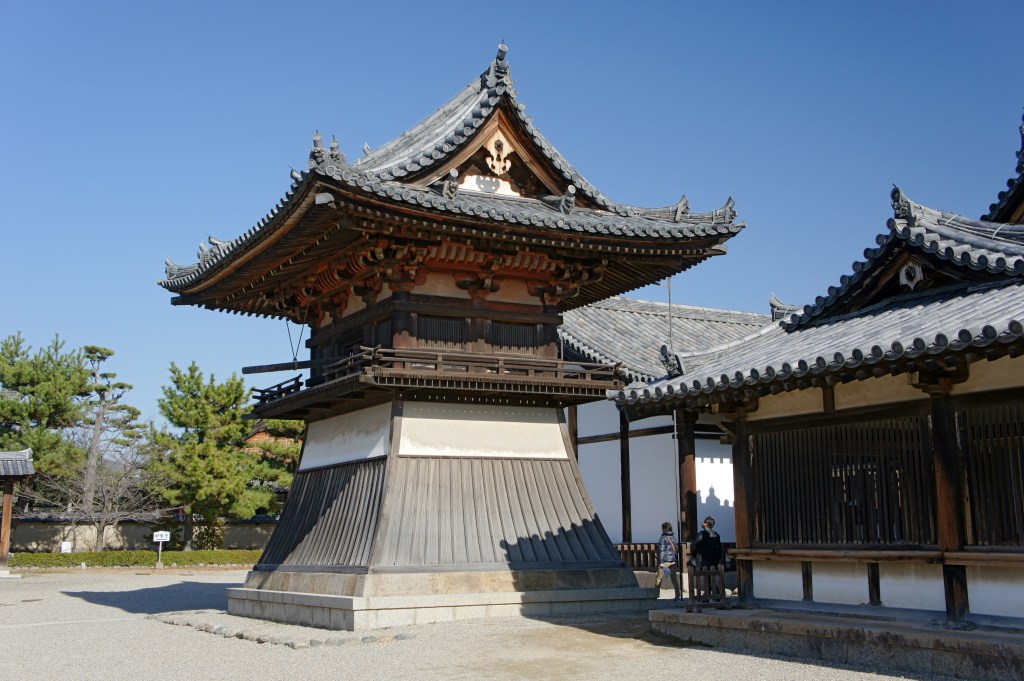
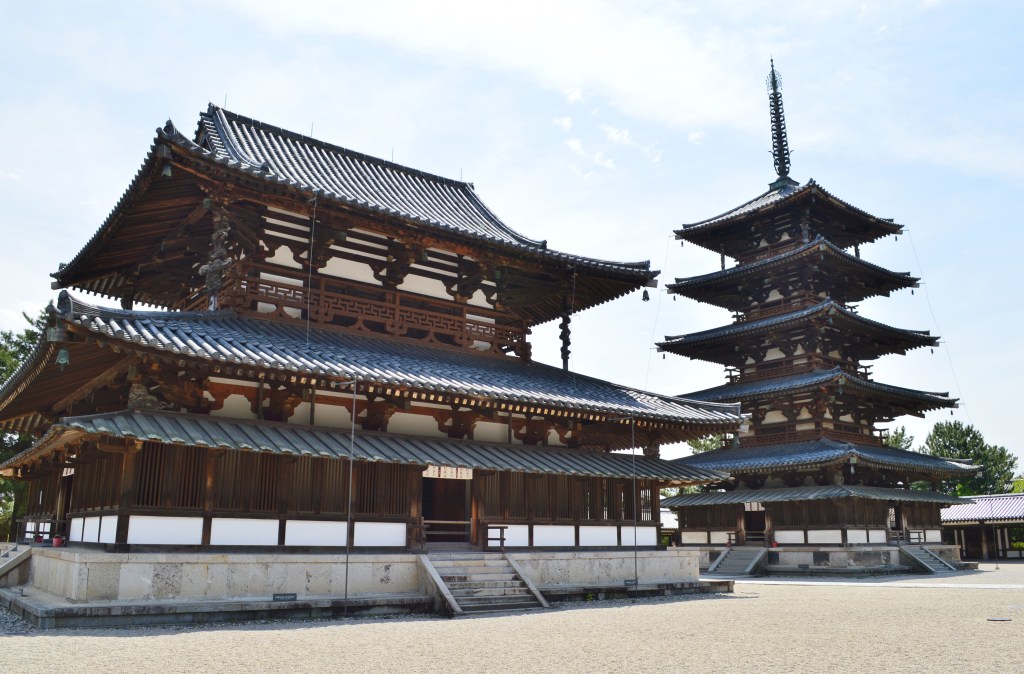
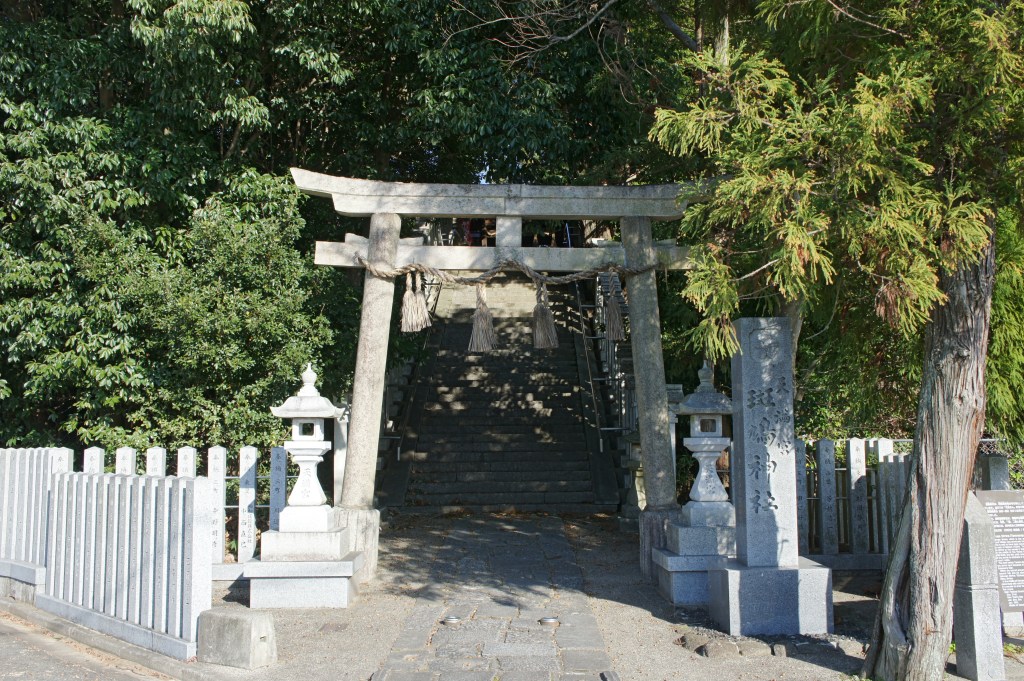
The five-storey pagoda
The pagoda is the oldest of its kind in Japan and the image of Horyu-ji: five roofs stacked above a stone base, each storey smaller than the one below, with a bronze spire and a set of clay figures in the eaves. The proportions are heavier and more grounded than the later pagodas of Kyoto and Nara, and the timber is dark with age. You cannot climb it, and there is no need to: walk around the base slowly and look up at the way each roof overlaps the next. The pagoda and the kondo stand side by side rather than in a line, which is one of the oldest arrangements in Japanese temple design.
The main hall and its sculpture
The kondo is the other seventh-century building, with a steep roof and a porch, and inside it holds a bronze triad of Shaka, Yakushi and Amida on a great platform, surrounded by smaller figures and a canopy. The famous wooden Shaka triad, attributed to the sculptor Kuratsukuri no Tori, is dark and severe, and the faces are the earliest great portrait sculpture in Japanese art. The hall is dim, the statues are behind railings, and the effect is closer to an archaeological interior than to a working temple. Take your time at the railing and let your eyes adjust.
The treasure hall
The Daihozoin, the temple’s museum, holds the objects that tell the temple’s history: bronze and wooden Buddhas, ritual implements, sutra boxes, textiles and the famous Tamamushi shrine, a miniature lacquered pavilion decorated with beetle wings. The collection is old and deep, and the labels are limited in English, but the objects speak for themselves. Allow an hour, and do not skip the upper floor, which holds some of the finest early sculpture in the country. The museum is closed on some days and charges a separate admission.
The eastern precinct and the Yumedono
The To-in, the eastern precinct, is a ten to fifteen minute walk from the main complex, across the fields and along a quiet road, and it is the part most visitors miss. The Yumedono, the Hall of Dreams, is an octagonal hall built around a secret image of Kannon, and it stands inside a walled enclosure with its own gate. The atmosphere here is different: fewer people, more trees, and the sound of the countryside. The hall is open on fixed days, and even when it is closed, the walk and the exterior are worth it.
Chugu-ji and the Miroku
A short walk from the Yumedono, Chugu-ji is a small nunnery temple with one of the most celebrated statues in Japan: a seated Miroku Bosatsu, the Buddha of the future, carved in wood and finished with lacquer and gold, with a face and posture of unusual stillness. It is a single room, a single image, and a guard who keeps the crowd moving, and it is worth the detour. The temple is small and easy to miss, and the combination with the eastern precinct makes a natural loop back towards the station.
The gate and the cloister
The approach runs through the Nandaimon, the great south gate, and then through the middle gate into a rectangular courtyard enclosed by a covered cloister. The cloister is original in parts and rebuilt in others, but the effect is intact: a wooden corridor around a gravel court, with the pagoda and the kondo inside. Walk the full circuit of the cloister rather than cutting across, and look at the pillars, the roof structure and the small details of the joinery. It is also the best place to sit when it rains, since the corridor is covered.
The surrounding temples of Ikaruga
Horyu-ji is the centre of a cluster of old temples, and if you have a car or a bicycle you can make a day of it: Horin-ji, with its three-storey pagoda, and Hoki-ji, on a hill with a view over the plain, are both within a few kilometres. The roads between them run through rice fields and small villages, and the area is flat and easy to cycle. Most visitors only see the main temple, and the satellite sites are quiet even in the busiest seasons.
Food and drink
- Ikaruga is a small town and the food options are limited: a few soba and udon shops near the station, a couple of cafes, and convenience stores. Plan lunch around the visit rather than expecting a restaurant strip.
- The soba shops near Horyu-ji station serve the local buckwheat, cold with a dipping sauce or hot in broth, and they are used by local people rather than tour groups. They close early.
- Nara, twenty minutes away by train, has far more choice: kakinoha sushi, pressed mackerel sushi wrapped in persimmon leaf, and the noodle and rice dishes around Nara park.
- For a picnic, buy rice balls and drinks at the station before you go, and eat in the temple grounds or along the road to the eastern precinct. There are benches and open ground, and bins are scarce, so carry your rubbish out.
- Nara is also the place for the local sake and the sweets, and the shopping arcades near Kintetsu Nara station are the best place to stock up for the train.
Getting there and around
- Horyu-ji is on the JR Yamato line, one stop from Oji and about twelve minutes from Nara, with the station a twenty-minute walk or a short bus ride from the temple. The walk is flat and signposted through the town.
- From Osaka, take the JR Yamatoji line to Oji and change to the Yamato line, or use the Kintetsu line to Nara and continue by bus. The whole trip is about an hour from central Osaka.
- From Kyoto, the Kintetsu line to Nara and the JR Yamato line is the fastest route, at around an hour and a half with the changes. A car is faster on the expressway but the parking fills on holidays.
- Buses run from Horyu-ji station to the temple gate, and taxis are available at the station. The walk between the western and eastern precincts is about fifteen minutes on a quiet road.
- If you are cycling, the roads around Ikaruga are flat and quiet, and a rented bicycle from Nara makes a pleasant half-day loop through the temple cluster.
Where to stay
- Most visitors stay in Nara, which has the widest range of hotels, ryokan and guesthouses and is twenty minutes away by train. It also puts Nara park and the other temples within walking distance.
- Osaka is a practical base for a longer trip, with the temple an hour away and far more choice for food and nightlife. The trade-off is the commute.
- Ikaruga itself has very little accommodation, mostly small guesthouses and a few business hotels near the station. It suits travellers who want the temple at opening time without the crowds.
- A ryokan in the Nara countryside, with a garden and a kaiseki dinner, is the most memorable option if you have a car and want a quiet night after the temples.
Best time to visit
- Spring, from late March to April, is the best time: the temple grounds are green, the cherry trees are out in Nara, and the weather is mild. It is also the busiest season, so arrive at opening time.
- Summer is hot and humid, with the temple grounds baking in the sun. The cloister and the halls provide shade, and the early morning is the only comfortable time to walk between the precincts.
- Autumn, from late October to November, brings colour to the trees around the eastern precinct and clear, dry weather. It is the best season for photography and the second busiest for visitors.
- Winter is cold and quiet, with occasional snow on the roofs and very few visitors. The halls are unheated, and the low light through the doors is beautiful, but dress warmly.
- The rainy season runs from early June to mid-July. The cloister keeps you dry, the moss and the timber look their best in the rain, and the crowds are thin.
Practical tips
- Arrive at opening time. The temple is a major site and the tour buses arrive mid-morning, and the first hour in the courtyard is much quieter.
- Do the western precinct first, then walk to the eastern precinct and Chugu-ji. The light and the crowds both improve as you go.
- Check the museum and the Yumedono opening days before you travel, since they do not open every day and the separate admissions add up.
- Wear shoes you can slip off, and carry socks. The halls are entered barefoot or in socks, and the wooden floors are cold.
- Photography is allowed in the grounds but not inside the halls in most cases. Look for the signs and follow them, and never use a flash near the sculpture.
- Combine the temple with Nara rather than doing it as a rushed stop. The train connection is easy and Nara has enough for a full day.
Suggested day-trip outline
- Morning: train from Nara or Osaka, walk from Horyu-ji station to the temple, and start with the pagoda and the kondo before the crowds.
- Late morning: the cloister circuit and the treasure hall, then a short break in the grounds.
- Lunch: soba near the station, or a picnic bought at the station before the visit.
- Afternoon: walk to the eastern precinct for the Yumedono and Chugu-ji, then continue to Horin-ji or Hoki-ji if you have a bicycle or a car.
- Late afternoon: train back to Nara for the park and the temples there, or on to Osaka for dinner.
- Rainy day: the cloister, the halls and the museum, with the eastern precinct shortened and a longer lunch.
Before you go
Timetables, fares, admission fees, and seasonal access rules can change. Check the official tourism and transport sites linked below for the latest information before you travel.
Explore More of Japan
Published guides that pair with this one:
- Fushimi Inari Travel Guide: The Torii Path, the Hike and the Best Hours
- Kinkaku-ji Travel Guide: The Golden Pavilion, the Pond and the Best Time to Visit
- Enryaku-ji Travel Guide: The Tendai Monastery on Mount Hiei
- Nara Park and Naramachi Travel Guide: Temples, Deer, and Old Town Streets
- Kiyomizu-dera Travel Guide: The Wooden Stage, the Waterfall and the 6 a.m. Start
- Uji Travel Guide: Matcha, Byodo-in Temple, and a Day Trip from Kyoto
Browse every Kansai guide on this site for the rest of the region.
Sources
- horyuji.or.jp (checked 2026-11-05)


Leave a Reply