A practical English guide to Mitokusan Sanbutsu-ji and the Nageiredo hall, the climb rules and gear, Misasa Onsen, and access from Kurayoshi.
Operational details such as opening hours, admission fees, and train times can change. Prefer official pages and reconfirm before you travel (sources checked on 05 November 2026).
Why visit
- Mitokusan Sanbutsu-ji is a mountain temple in Tottori Prefecture whose most important building, the Nageiredo, stands in a recess high on a vertical cliff. It is a national treasure, it is not reachable by road, and it is not visible from below except as a speck from the viewing point across the valley. To stand near it you climb, and the climb is part of the visit rather than an obstacle to it.
- The temple was founded in 706 by En no Gyoja, the legendary founder of Japanese mountain asceticism, and the name Nageiredo means the hall that was thrown in: legend says the building was flung whole from the valley floor into the cliff recess by supernatural power. Nothing about the structure’s construction has been conclusively dated, and it is the only building of its kind in Japan, which is why it holds the highest cultural designation the country has.
- The approach follows the pilgrim’s route up the mountain, past smaller halls, over tree roots and up a chain-assisted rock face, with handrails of root and stone rather than modern hardware. It takes about an hour up and less down, it is genuinely exposed in places, and the temple checks your shoes and clothing before letting you start. That screening is not bureaucratic fussiness: people have fallen here, and the rules exist because of it.
- Below the mountain, Misasa Onsen is one of the world’s strongest radon hot spring resorts, a small river-side town of ryokan, public baths and drinking fountains that has been a healing retreat for centuries. Combining the climb with a night in Misasa is the obvious way to do this: the buses run from Kurayoshi, the town is ten minutes by car from the trailhead, and the contrast between a hard hour on the mountain and an evening in a hot spring is the whole point of the trip.
Top places and highlights
The Nageiredo hall
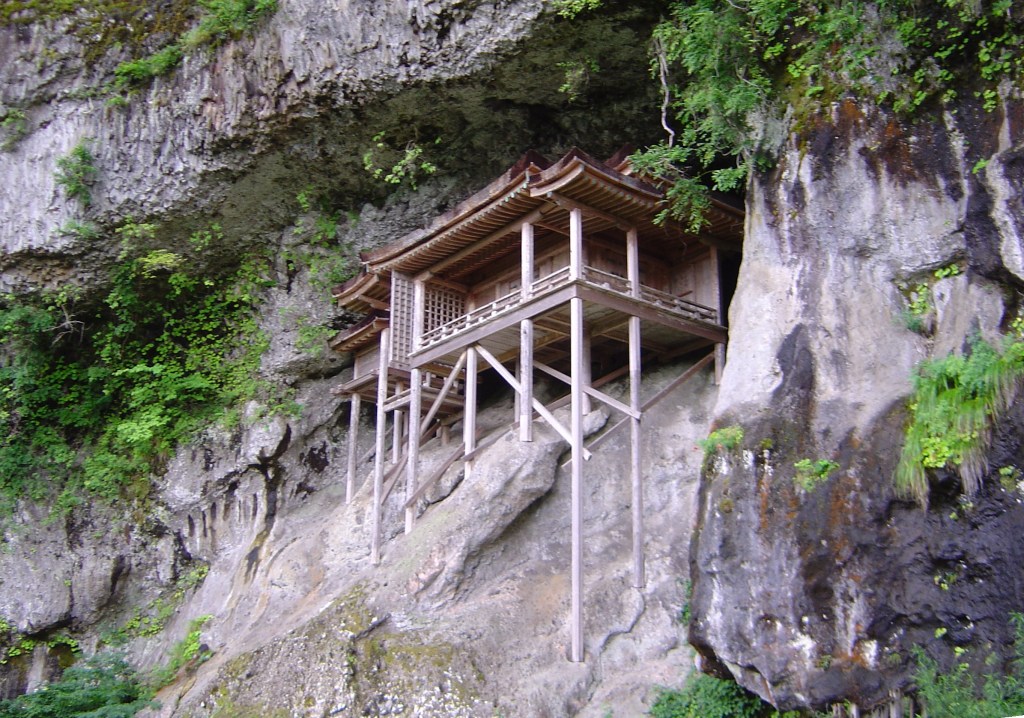
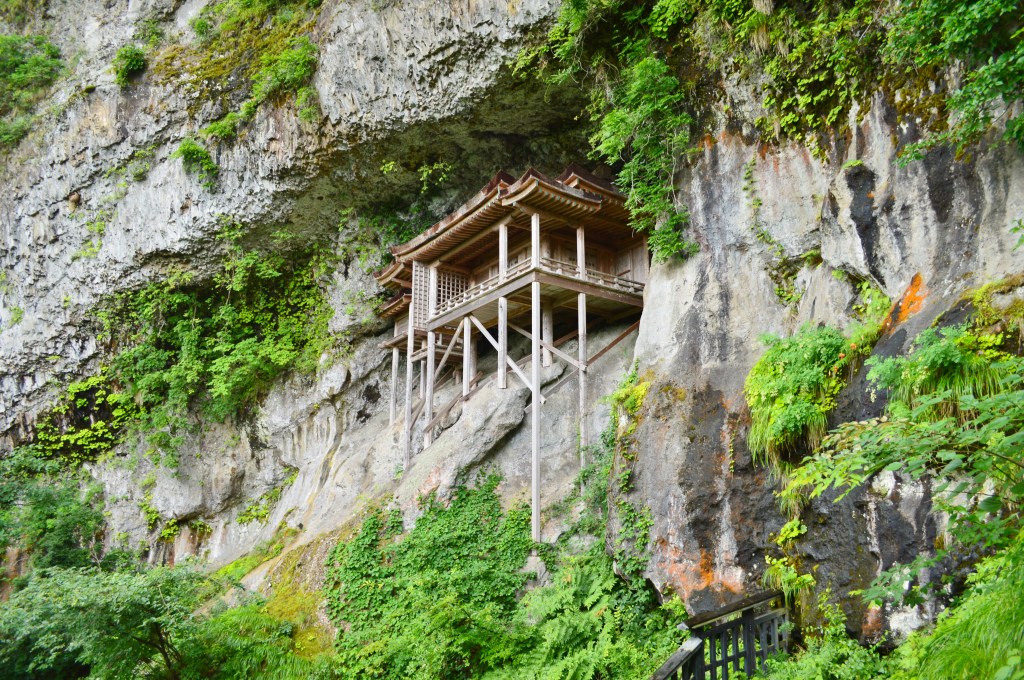
The Nageiredo sits in a shallow cave in a cliff face, its wooden veranda projecting over the drop, supported by posts that appear to rest on almost nothing. It is a national treasure and the reason people climb. The structure is small, dark and difficult to see clearly when you are close, standing as it does in shadow under the overhang with a fence keeping visitors back a few metres away, so the impression is less of architectural detail than of position: a building placed where no building should be. Photography is allowed from the viewing area, but tripods and monopods are not, and the space in front of it is narrow. Most people spend ten to fifteen minutes there before starting down. The story that En no Gyoja threw the hall into the cliff is a legend rather than history, and the temple presents it as such; the actual construction date and method remain unresolved.
The climb up the pilgrim route
The route starts behind the main hall, where you pay the climbing fee and have your footwear checked, and then crosses a bridge into the mountain proper. It is not a hiking trail in the modern sense: it is a course of roots, rock, narrow ledges and short sections with chains fixed to the stone, and the temple describes it as a place of ascetic practice rather than a walk. You are lent a ragesa sash to wear, and the route passes several small halls, including Monjudo with its view back down the valley and Jizodo, before the final stretch. Allow about an hour up for a reasonably fit adult and forty minutes down, more if the surface is wet. The temple allows entry between 8:00 and 15:00 and requires everyone off the mountain by 16:30, and it closes the route entirely in rain, snow or whenever it judges conditions unsafe, which in a normal year means roughly December to March.
The rules and the shoe check
Sanbutsu-ji runs the climb as a religious practice with a safety regime attached, and it turns people away. You must come in a group of at least two, and no solo climbers are admitted at all. Clothing must leave both hands free, so skirts, heels, leather shoes, sandals and slippers are refused, and so are trekking poles, ice axes and anything with spikes or metal fittings on the soles, because they tear up the roots and stone. Trainers are often rejected; firm-soled trekking shoes without metal are the safest choice, and if your shoes fail the check you may be allowed to continue in waraji straw sandals, sold at the temple. Children of preschool age cannot climb, and the temple asks that lower primary school children not attempt it. Eating on the mountain, smoking, candles and incense are all prohibited, and drone flight over the precinct is banned.
The main hall and the treasure hall
The climb is not the whole temple. At the foot of the mountain, Sanbutsu-ji’s main hall is open from 8:00 to 17:00, and the entry donation of 400 yen for adults, 200 for schoolchildren, includes the treasure hall as well as the precinct. The main hall enshrines the three Buddhas that give the temple its name, and the treasure hall holds the temple’s older objects and explains the mountain’s history as a centre of practice. Many visitors pay the 400 yen and then decide whether to add the 800-yen climbing fee at the desk behind the hall, which is a sensible order given how often the mountain is closed. For anyone unable or unwilling to climb, this lower precinct plus the distant viewing point is a legitimate half-day visit rather than a consolation prize.
The distant viewing point
Across the valley from the temple, a viewing point on the road gives the only clear view of the Nageiredo in its cliff, and it is where the classic photograph is taken. Telescopes are provided, because without one the hall is a small dark rectangle in a very large rock face. The point is reachable by car and is worth the stop even if you are climbing, since it explains what you are about to walk into and gives a sense of how far above the valley floor the building actually sits. It is also the fallback on days when the mountain is closed: the climb being shut does not mean the view is, and the road access is independent of the temple’s reception hours.
Misasa Onsen
Misasa is a compact hot spring town along the Mitoku River, about ten minutes by car or bus from the temple, and its water is among the most radioactive in the world in the technical sense: it is a radon spring, and the town promotes the mild stimulation of low-dose radiation as a health treatment. You do not need to accept the theory to enjoy the place. The public bathhouse Kabuyu, the origin of the resort, is open from 8:00 to 21:45 with the last entry at 21:15, opening at 10:00 on Mondays, and costs 400 yen for adults and 250 for children over three. Beside it are a free foot bath and a drinking fountain that runs around the clock, and the riverbank has an open-air bath below Misasa Bridge. Several ryokan sell day-use bathing, and the tourist office, Hot Plaza, arranges the details and rents bicycles for 300 yen.
Food and drink
- Misasa’s local specialities are modest and regional: sweets and foods made from the Japanese horse chestnut, a local crop, and dishes using a local soybean. They appear in ryokan meals and in the town’s shops rather than in dedicated restaurants.
- Ryokan in Misasa generally quote rates with dinner and breakfast included, and the dinner is usually the main meal of a stay here: multi-course Japanese cooking built around local vegetables, river fish and Tottori seafood. Staying without meals is possible but limits your evening options.
- Around the temple itself there is very little: a shop at the temple and not much else within walking distance. Eat before the climb or plan to eat after it in Misasa or Kurayoshi rather than expecting lunch at the trailhead.
- Kurayoshi, the transport hub, has the widest choice in the area, including the town’s own noodle and set-meal restaurants. It is a practical stop for lunch on the way in or out if you are using the bus.
- Tottori is known for crab in season, from autumn through winter, and for sandfish and other Japan Sea fish. Expect these on ryokan menus in winter rather than as street food.
- Carry water for the climb. Eating on the mountain is not allowed, so the meal comes either before the ascent or after the descent, and the temple’s lower area has limited places to sit.
Getting there and around
- The rail gateway is JR Kurayoshi Station, served by the limited express Super Hakuto from Osaka in about three hours fifteen minutes, from Kyoto and Kobe on the same line, and from Tokyo or Nagoya via the Shinkansen at Himeji. From Hiroshima the journey is around three and a half to four hours with a change.
- From Kurayoshi Station’s bus terminal, take the Hinomaru bus towards Misasa Onsen: about 20 to 25 minutes to the onsen, and roughly 40 minutes to the Mitokusan stop for the temple. Buses are infrequent, so check the timetable before setting out rather than assuming a turn-up-and-go service.
- By car, the temple is about 50 minutes from the Innosho interchange on the Chugoku Expressway via Route 179, or about 50 minutes from Yubara interchange on the Yonago Expressway via Routes 313 and 482. Parking is at the temple’s lower area.
- Misasa Onsen is about 7 kilometres and ten minutes by car from the temple, which makes a taxi or the bus between them straightforward if you are staying overnight.
- The Yu-Yu 2-Day Pass costs 1,300 yen and covers two days of unlimited travel on the local buses linking Kurayoshi Station, Misasa Onsen, Mitokusan, Hawai Onsen and Togo Onsen. It is sold at Hot Plaza in Misasa, the tourist office in Kurayoshi Station and the Kurayoshi white-walled storehouses information desk, and it pays for itself on a return trip to the temple.
- From Tokyo by air, fly to Tottori Airport and take the limousine bus to Kurayoshi Station, about 45 minutes, then the local bus; the whole journey is around two and a half hours from Haneda. From Yonago Airport it is about 1 hour 40 minutes by car.
- Allow for the fact that the last climb starts at 15:00 and everyone must be down by 16:30. A late-morning arrival is the safe plan; arriving in the afternoon risks being turned away, and in winter the mountain may be closed entirely.
Where to stay
- Misasa Onsen is the natural base: a compact spread of ryokan along the river, most with their own baths and dinner included, ranging from large traditional inns to small family-run places. Staying here puts the temple ten minutes away and the public baths on your doorstep.
- Ryokan in Misasa often offer slightly cheaper plans aimed at longer ‘modern toji’ stays of two or three nights, with lighter meals and access to the baths for treatment rather than luxury. These suit travellers who want the hot spring as the point of the trip.
- Kurayoshi has business hotels near the station, which is the practical choice for an early bus or a late arrival, but it has none of the atmosphere of the onsen and no reason to stay beyond convenience.
- Tottori city and Yonago are both within reach by train and offer more hotels, but neither is close enough to make a morning climb convenient. Misasa is the only base that makes the mountain and the baths feel like one trip.
Best time to visit
- Late spring and autumn are the best conditions for the climb: dry rock, comfortable temperatures and clear views from the upper halls. Autumn colour on the mountain is the most photogenic time, though the surface can be slick after rain.
- Summer is hot and humid, and the climb is exposed in places; start as early as the 8:00 opening allows and carry more water than you think you need. The mountain is open, but the rocks hold the heat.
- Winter closes the climb. Snow usually shuts the route from around December to March, and the temple states plainly that entry is prohibited when it judges conditions unsafe. The lower precinct and the distant viewing point remain the visit in that season.
- Rain closes the mountain at any time of year, and the temple posts the day’s status on its website. A wet forecast is a reason to reorder the trip rather than to hope for the best, since the decision is made at the desk and not by you.
- Misasa’s hot springs are a year-round draw, and the town is at its most pleasant in spring and autumn, when walking between the baths and along the river is comfortable.
Practical tips
- Check the temple’s website on the morning of your visit for the day’s opening status. The mountain closes for rain and snow, and the site is updated with current conditions and warnings.
- You cannot climb alone. Two people minimum, no exceptions, so a solo traveller needs to join someone or accept the lower precinct and the viewing point.
- Wear firm-soled shoes without metal fittings, and keep both hands free: a backpack rather than a shoulder bag, no skirt, no heels, no poles. If your shoes are judged unsuitable you may be offered waraji for a fee, but that is a fallback rather than a plan.
- Start early. Reception is 8:00 to 15:00 with a 16:30 descent deadline, and an afternoon arrival in a slow season can mean being refused before you begin.
- Bring cash for the fees: 400 yen entry plus 800 yen for the climb for an adult, paid at two different desks, plus waraji or a drink if you need them. The temple is not a card-payment kind of place.
- Do not treat it as a hike with a photo stop. It is a practising temple: keep noise down, do not eat on the mountain, do not leave offerings, and follow the route rather than exploring off it.
- Combine it with Misasa rather than doing it as a day trip from Osaka or Kyoto. The bus connections and the 15:00 deadline make a long day trip tight, and the hot spring is the reward for the climb.
- The distant viewing point is worth ten minutes before or after the climb, and it is the substitute visit if the mountain is closed. Telescopes are provided because the hall is genuinely small at that distance.
Suggested day-trip outline
- Day 1, morning: travel to Kurayoshi, take the bus towards Misasa and continue to the Mitokusan stop, arriving before the 15:00 climbing deadline with margin.
- Day 1, midday: pay the 400-yen entry, see the main hall and treasure hall, then decide on the climb at the desk behind the hall; allow about two hours for the round trip including time at the Nageiredo.
- Day 1, late afternoon: stop at the distant viewing point on the way down, then continue to Misasa Onsen and check in.
- Day 1, evening: bathe at the ryokan and, if you have energy, walk to Kabuyu and the riverbank baths; dinner is usually at the inn.
- Day 2, morning: a slow breakfast, a last soak, then the bus back to Kurayoshi, with the option of stopping at the white-walled storehouses in the town before the train.
Before you go
Timetables, fares, admission fees, and seasonal access rules can change. Check the official tourism and transport sites linked below for the latest information before you travel.
Explore More of Japan
Published guides that pair with this one:
- Kurayoshi Travel Guide: Tottori’s White-Walled Storehouse Town
- Tottori Sand Dunes Travel Guide: Coastal Walks in Western Honshu
- Tsuwano Travel Guide: The Little Kyoto of San’in
- Mount Daisen Guide: Tottori’s Sacred Mountain
- Sakaiminato Guide: Tottori’s Yokai Port Town
- Uradome Coast Guide: Tottori’s Rocky Ria Shoreline
- Bizen Imbe Travel Guide: Japan\u2019s Pottery Town of Kilns and Bizen Ware
- Hamada Travel Guide: Shimane’s Sea of Japan Coast
Browse every Chugoku guide on this site for the rest of the region.
Sources
- mitokusan.jp (checked 2026-11-05)
- misasaonsen.jp — About the museum (checked 2026-11-05)
- misasaonsen.jp (checked 2026-11-05)
- misasaonsen.jp — Access (checked 2026-11-05)
- town.misasa.tottori.jp (checked 2026-11-05)


Leave a Reply