Plan a visit to Kotohiki Park in Kanonji, Kagawa, with the Zenigata sand coin, the hilltop view over the Seto Inland Sea and access notes.
Operational details such as opening hours, admission fees, and train times can change. Prefer official pages and reconfirm before you travel (sources checked on 03 November 2026).
Why visit
- Kotohiki Park holds one of the oddest monuments in Japan: a giant coin drawn in the sand of a beach, 122 metres east to west and 90 metres north to south, with a circumference of 345 metres. It is a copy of a Kan’ei Tsūhō, an Edo-period copper coin, and it is not a modern artwork: the story is that it was made overnight in the Kan’ei era to welcome the lord of Sanuki as he toured his domain, though the city itself records several versions of when and for whom it was made. Either way it has been there for centuries, and it is best seen from the hill above, where the ellipse drawn on the sand reads as a perfect circle.
- The illustration is the point. The coin is elliptical on the ground, deliberately, because it is designed to be viewed from the top of Kotohiki-yama at 60 metres, and from anywhere else it looks like a distorted shape on a beach. That piece of perspective design, made centuries ago in sand and maintained by hand ever since, is the reason the site is worth the detour rather than a curiosity.
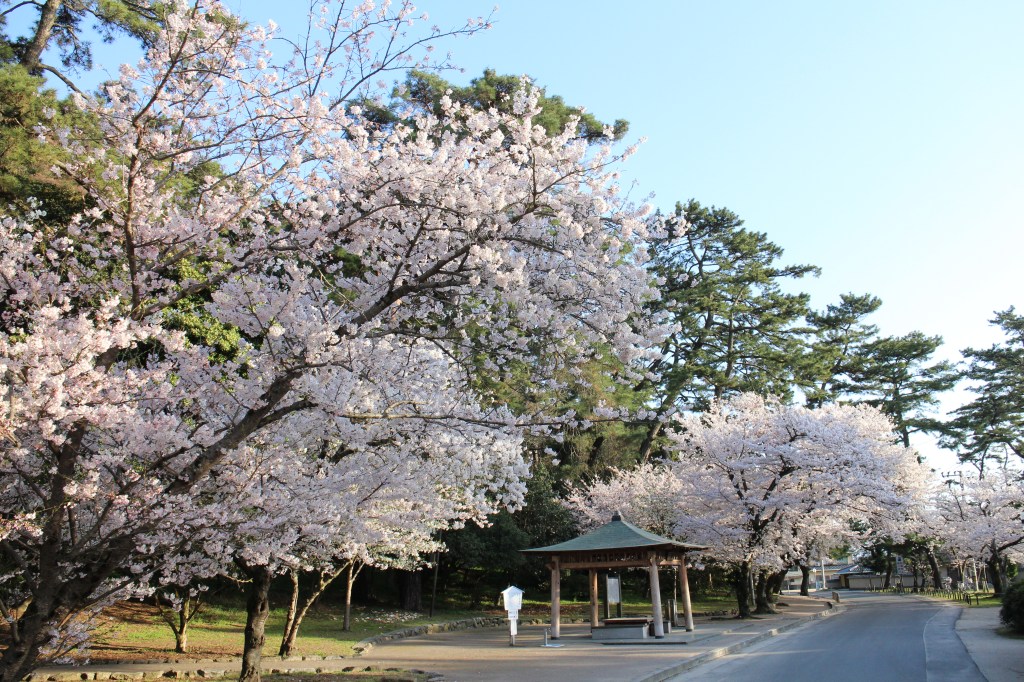
- The park around it is a proper Meiji-era landscape. It opened as a prefectural park in 1897, was designated a Place of Scenic Beauty in 1936 and incorporated into the Seto Inland Sea National Park in 1956, and it covers about 48 hectares of white sand and pine. The garden along the Saita river was designed by Ozawa Keijiro, known as the father of the Japanese garden, and the pond and the cherry trees around it are listed among Japan’s hundred best cherry sites.
- The view from the hill is the second reason. Ariake beach runs two kilometres along the Seto Inland Sea as a strip of white sand and black pine, and from the lookout you see the coin in the foreground and the whole bay behind it, with the islands beyond. The sunset over the bay is listed among Japan’s hundred best, and the park is one of the few places where a famous landscape is also a famous viewpoint.
- The religious layer is easy to miss and worth knowing. Kotohiki Hachimangu stands on the hill, and the Shikoku pilgrimage’s temples 68 and 69, Kannonji Shineiji and Kannonji, are inside the park, so pilgrims pass through on foot. The Suikinkutsu near the rest house is a small buried jar that plays a note when water drips into it, and it is the kind of detail that makes the park more than a viewpoint.
- The practical case is unusually easy. Entry is free, the car parks are free, the coin can be seen at any hour of the day or night, and it is lit from sunset until 22:00. It is five minutes by taxi from Kannonji Station on the Yosan Line, 12 minutes from the Onohara interchange, and it combines with the Kannonji temple and the udon shops of western Kagawa. It is a 90-minute stop that can become a half day.
Top places and highlights
The Zenigata sand coin
The Kan’ei Tsūhō is drawn in the sand of Ariake beach, 122 metres by 90 with a circumference of 345, and it is maintained by hand. It is said that anyone who sees it will live in good health and never want for money, and the association adds that a visitor who bought a lottery ticket after seeing it won big, which is why it is now known as a spot for financial luck. It is free, visible at any hour, and the sand is closed to walking.
The lookout on Kotohiki-yama
The hilltop lookout at about 60 metres is the designed viewpoint, and from it the ellipse on the beach becomes a circle. It can be reached by car on the park’s drive, though the tunnel limits vehicles to 3 metres high and 2.1 metres wide, or on foot in about 15 minutes from the park paths or the stone steps of Kotohiki Hachimangu. The view takes in the coin, the two-kilometre beach and the islands of the Seto Inland Sea.
The night lighting
The coin is lit every evening from sunset until 22:00, normally in green but occasionally in gold or blue for limited periods. The city has warned that the lighting at the lookout has been out of service and may take some days to restore, so anyone going at night should watch their footing. The illuminated coin from above is a different sight from the daytime one, and the beach is empty.
The sand raking
Twice a year, in spring and autumn, several hundred local people rake the coin back into shape, and that event is the only time visitors are allowed inside the shape, which is more than two metres deep in places. The dates are announced by the city, and it is the one way to see the scale of the thing from ground level. Outside those days the sand is off limits, and the rule is enforced.
Ariake beach
The beach runs two kilometres along the Seto Inland Sea, shallow and white, with black pines behind it and a rare set of coastal plants flowering from spring to autumn. It is a swimming beach in summer, with a campsite nearby, and it is the foreground of every photograph taken from the hill. Walking it at low tide gives the coin a completely different context from the lookout.
Kotohiki Hachimangu and the pilgrimage temples
The shrine stands on the hill above the beach, and the Shikoku pilgrimage’s temples 68 and 69 sit inside the park, so the site is a working place of worship as well as a viewpoint. The stone steps up through the shrine are one of the routes to the lookout, and they are steeper and quieter than the park path. The Suikinkutsu near the rest house is a buried jar whose dripping water sounds like a koto, which is the origin of the park’s name.
The Ozawa garden and the cherries
The Japanese garden along the Saita river was designed by Ozawa Keijiro, and although the Kotoji pond has been repaired it keeps its original form. The cherries planted around it are listed among Japan’s hundred best cherry sites, and the azaleas and camellias follow. Spring is the season the park is at its most crowded and the garden at its best.
Food and drink
- Kannonji is in western Kagawa, which means udon, and the shops around the station and along the Route 11 are among the best value in the prefecture. The local style is self-service, with the noodles boiled to order and a simple broth, and a bowl costs less than a coffee in Tokyo.
- The city’s other speciality is the sweet called Kannonji manju and the local sake, and the shops near the station sell both. The fishing port of Kanonji lands small fish and octopus, and the restaurants near the coast serve them simply.
- The park itself has a rest house and a few places to eat, and they are convenient rather than notable. The advice is to eat udon in the town before or after rather than at the park, since the town’s version is the reason people come to this part of Kagawa.
- The Seto Inland Sea gives the region its fish, and the islands offshore produce lemons and olives. The salt and the soy sauce of the area are the take-home items, and the local udon and the dried fish are the practical gifts.
Getting there and around
- By train, take the JR Yosan Line to Kannonji Station, then a taxi for about five minutes or two kilometres to the park. The station is on the limited express route from Okayama and Takamatsu, and the park is close enough that the taxi is cheap.
- By the local ride-sharing bus, take the Gogo Takamuro line from Kannonji Station and tell the driver Kotohiki Koen, since the service has no fixed stops and picks up and drops off anywhere on the route, except on Route 11 where only designated places are allowed. It runs four times a day, which makes it a plan rather than a convenience.
- By car, the park is 12 minutes from the Onohara interchange on the Takamatsu Expressway, about six kilometres, or 15 minutes from the Sanuki Toyonaka interchange, about eight kilometres. The Kannonji smart interchange is also about 12 minutes away.
- There are free car parks at the hilltop, in front of the Yokujitsukan rest house and on the east side of the Ariake ground, and large buses must use the Ariake ground car park. On holidays the hilltop car park fills, and the city recommends parking lower down and walking up in 15 to 20 minutes.
- The park is free, open at all hours and has no ticket office. The coin is visible day and night, the lookout is lit until 22:00, and the shrine and the temples keep their own hours.
Where to stay
- Kannonji is a small city with business hotels near the station, and it is a practical stop between Takamatsu and Matsuyama rather than a destination in itself. The park is five minutes away by taxi.
- Takamatsu, about an hour by train, is the larger base with more hotels and the Ritsurin garden, and Kannonji becomes a half-day trip on the way west.
- The Seto Inland Sea islands and the Shimanami Kaido are within reach, and staying on one of the islands gives a different view of the same water. The area around the park also has a campsite for the summer.
Best time to visit
- Spring is the park’s peak, with the cherries around the Ozawa garden and the azaleas after them, and the coin bright against the new green of the pines. The sand raking in spring is announced by the city and is the one chance to walk inside the shape.
- Summer is the swimming season on Ariake beach, with the shallow water warm and the pines giving shade, and the park busy with local families. The heat is strong and the hill is exposed, so the early morning and the evening are the better hours.
- Autumn is the best season for the light, with the sunset over the bay at its most reliable and the beach quiet, and the second sand raking of the year takes place. The air clears and the islands become visible from the lookout.
- Winter is quiet and cold, with the pines dark and the beach empty, and the coin lit green in the early darkness. It is the season to have the lookout to yourself, and the sunset comes conveniently early.
Practical tips
- See the coin from above, not from the beach. It is drawn as an ellipse so that it appears circular from the hilltop, and from ground level it looks like a distorted shape. The 15-minute walk up is the difference between seeing the thing and missing it.
- Park lower and walk up on holidays. The hilltop car park is small and fills at New Year and in Golden Week, and the city itself recommends using the Yokujitsukan car park or the Ariake ground and walking for 15 to 20 minutes. The drive up has a tunnel that excludes large buses.
- Do not walk on the sand coin. It is closed to visitors except during the sand raking, when hundreds of local people repair it, and that is the only time entry is allowed. The shape is more than two metres deep in places and a footprint lasts until the next raking.
- Check the night lighting before relying on it. The city has reported that the lookout lighting was out of order, and the coin itself is lit from sunset to 22:00. A torch is worth carrying if you go up after dark, since the path is unlit in places.
- Eat udon in the town rather than at the park. Kannonji is in Kagawa, and the self-service shops near the station are the reason to stop here rather than pass through. The park’s rest house is fine but it is not the point.
- Use the ride-sharing bus only if the timetable suits you. The Gogo Takamuro line runs four times a day and has no fixed stops, so you tell the driver where you want to get off, but missing it means a taxi or a 30-minute walk. A taxi from the station is five minutes and inexpensive.
- Combine the park with the temple. Kannonji temple, the 69th stop on the Shikoku pilgrimage, is in the town and gives the visit a second focus, and the walk between them is short. The park’s own shrine and the two pilgrimage temples inside it make the site a religious landscape rather than only a viewpoint.
Suggested day-trip outline
- Take the Yosan Line to Kannonji Station and a taxi for five minutes to the park, or drive in from the Onohara interchange in 12 minutes. Start at the beach and walk the two kilometres of Ariake shore to see the coin at ground level and understand its size.
- Walk or drive up to the lookout on Kotohiki-yama, about 15 minutes on foot, and look down at the coin as a circle with the bay and the islands behind it. This is the photograph, and it is worth waiting for the light to soften.
- Visit Kotohiki Hachimangu and the two pilgrimage temples inside the park, and find the Suikinkutsu near the rest house to listen to the water. Walk the Ozawa garden along the river if it is spring and the cherries are out.
- Eat udon in the town, then return to the park for the sunset over the Seto Inland Sea, which is listed among Japan’s hundred best. Stay for the lighting if you are there between sunset and 22:00, and take a torch for the walk down.
- Continue west towards Matsuyama or east to Takamatsu, or take the train back. If you have a second day, the Shimanami Kaido and the islands of the inland sea are a short drive away, and the park is the best introduction to the water they cross.
Before you go
Timetables, fares, admission fees, and seasonal access rules can change. Check the official tourism and transport sites linked below for the latest information before you travel.
Explore More of Japan
Published guides that pair with this one:
- Kotohira Travel Guide: Konpira Shrine Stairs and Shikoku Pilgrim Town
- Takamatsu Travel Guide: Ritsurin Garden, Udon, and Seto Sea Gateways
- Marugame Castle Travel Guide: An Original Keep on a High Stone Wall
- Shimanami Kaido Guide: Cycling Across the Islands
- Shodoshima Travel Guide: Olive Groves, Coast Roads, and a Seto Inland Sea Ferry
- Shikokumura Open-Air Architecture Museum Travel Guide: Highlights, Access, and Planning
- Naoshima Travel Guide: Art Islands, Museums, and the Seto Inland Sea
- Mount Tsurugi Travel Guide: Shikoku’s Highest Peak by Ropeway
- Shikoku Karst Travel Guide: The Highland Road, Stars, and Access
- The Museum of Art, Ehime Travel Guide: Highlights, Access, and Planning
Browse every Shikoku guide on this site for the rest of the region.
Sources
- city.kanonji.kagawa.jp (checked 2026-11-03)
- city.kanonji.kagawa.jp (checked 2026-11-03)
- city.kanonji.kagawa.jp (checked 2026-11-03)
- kanonji-kanko.jp (checked 2026-11-03)
- kanonji-kanko.jp (checked 2026-11-03)


Leave a Reply