A practical English guide to the Niyodo River in Kochi: Niko-buchi, Nakatsu and Yasui gorges, when the blue is strongest, kayaking and bus access from Kochi.
Operational details such as opening hours, admission fees, and train times can change. Prefer official pages and reconfirm before you travel (sources checked on 05 November 2026).
Why visit
- The Niyodo River runs 124 kilometres from Mount Ishizuchi to Tosa Bay, and it has been named the river with the best water quality in Japan more than once, including a first place in the national survey. What people come for is the colour, a translucent blue-green that photographers started calling Niyodo Blue, and which is strongest not in the main river but in the small tributaries in the upper valley.
- The name is a description rather than a place. The blue is at its best in the tributaries around Ino and Niyodogawa town: the Edagawa river, the Uwagawa, the Doi, the Yasui and the Nakatsu. Each has a different character. Niko-buchi is a small, deep pool under a waterfall, sacred and quiet. Yasui gorge has waterfalls, huge boulders and a swimming hole. Nakatsu gorge has a maintained walking path along the water, with a series of falls and a rock chamber at the top.
- The landscape is steep and forested, the roads are narrow, and the buses are few, which keeps the crowds down except in the autumn colour season. This is a place where the reward for the effort of getting there is that you are standing in a river valley that looks the way the whole country used to.
- It is also somewhere you can be active rather than just look: kayaking, canoeing, stand-up paddleboarding and canyoning are all run commercially on the upper river, in water clear enough that a transparent kayak looks like it is floating in air. That combination of scenery and activity, plus the onsen at Nakatsu, makes it worth a full day and better a night.
Top places and highlights
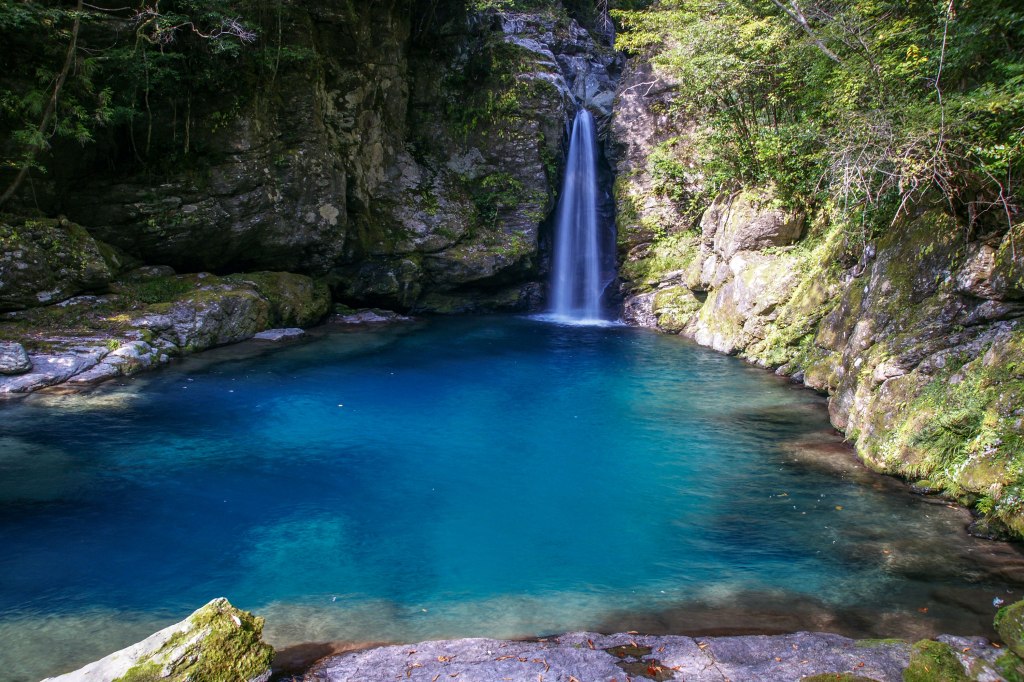
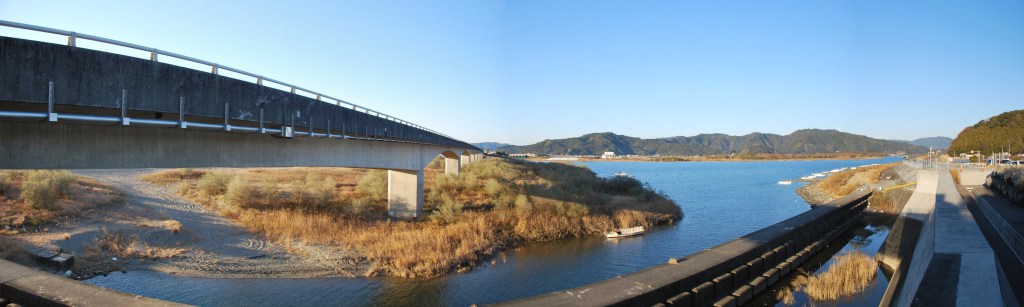
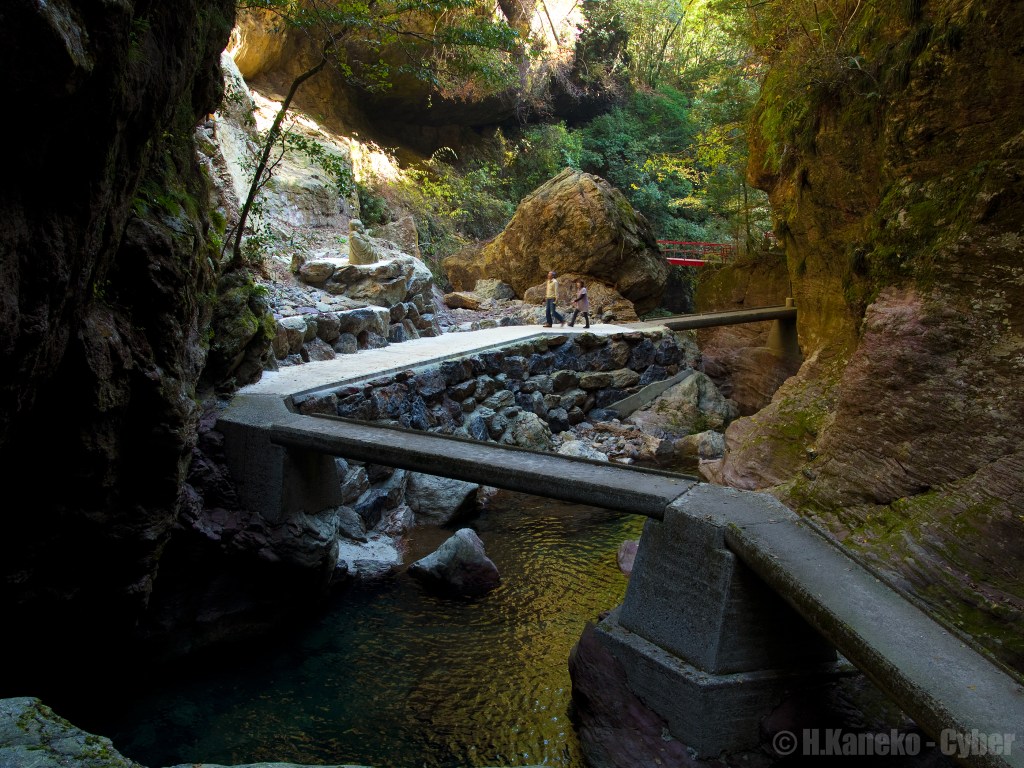
Niko-buchi
Niko-buchi is a deep pool on the Edagawa river, a tributary of the Niyodo, reached by a short walk from a road in the hills above Ino, and it is the most photographed spot on the whole river. The water is an intense blue that shifts with the angle of the sun and the season, held in a bowl of rock below a small waterfall, and the local belief is that a water deity lives in it. That belief is taken seriously: entering the water, eating, drinking and smoking are all prohibited, and visitors are asked to keep quiet and treat it as a shrine. There is no facility beyond a small parking area, and the walk in is steep. Come early in the morning for the clearest light and the fewest people, and go with the expectation of looking rather than swimming.
Nakatsu gorge
Nakatsu is the most accessible of the gorges and the best for walking, because a path runs along the water from the entrance, crossing and recrossing the stream past huge boulders and a series of named falls. The walk to the Ryujin falls, the signature waterfall with wine-red rock and a distinctive split in the flow, takes about twenty minutes, and most visitors turn back there. The path continues to Ryugubuchi, a still pool above the falls, and then to a set of rock columns, about an hour and a half for the round trip from the entrance. The surface is wet and slippery, and there have been falls by people concentrating on photographs, so watch your footing. There is an onsen at the entrance, Yunomori, with an outdoor bath, open to day visitors for 850 yen, with a small seasonal surcharge.
Yasui gorge
Yasui is the gorge for people who want to get into the water. It has the Suisho-buchi pool, a weir, and the Hiryu falls, and the river bed forms natural pools deep enough to swim in, with fish visible through the water. In summer it is a swimming and snorkelling spot, and the commercial kayak and canyoning operators use the upper river here. Access is by a narrow road, unsuitable for anyone nervous about single-track driving, and the last stretch is the reason most people take a taxi from the bus stop rather than driving themselves. There is one inn in the gorge, Horaiso, and a car park in front of it. Insect repellent is not optional in summer; the horseflies are serious.
Kayaking and canyoning
The upper Niyodo is run commercially for kayaking, Canadian canoeing, stand-up paddleboarding and canyoning, mostly from spring to autumn, with operators based around Ino. The transparent kayaks are the gimmick that works: the water is clear enough that the boat appears to float above the fish. Guided tours run about two hours, cost roughly 6,000 to 12,000 yen depending on the craft and the operator, and include instruction, so no experience is needed. Canyoning, which involves jumping into pools and descending rock faces on ropes, runs from March to November at Nakatsu. Book ahead, check what is included, and accept that the river level and the weather can cancel a trip at short notice. Children are usually accepted on the canoe and paddleboard tours from a certain age, but not on canyoning.
The drive on Route 33 and Route 439
The roads are part of the experience. Route 33 from Kochi towards Matsuyama runs along the Niyodo for stretches, and Route 439 climbs into the gorge country, narrow and winding with blind curves and few places to pass. This is not a road for a large vehicle or a nervous driver, and the mountain sections are frequently subject to one-way restrictions and closures after heavy rain, so check the signs before committing. The compensation is that the drive passes through terraced fields, small villages, shrines and viewpoints that no train reaches. Fill the tank before leaving the plain; petrol stations in the valley are scarce and close early.
Ochi and Yokogurayama
At the northern edge of the river country, Ochi is a small town with a museum devoted to Tomitaro Makino, the botanist who founded Japanese plant taxonomy and who did important work on Mount Yokogurayama above the town. The museum holds his drawings and fossils found on the mountain, costs 500 yen, and closes on Tuesdays and Wednesdays, which is more interesting than it sounds if you are travelling with anyone curious about plants. The town also has a riverside park with a Snow Peak outdoor shop and a bike rental point, a retro shopping street and one of the submerged bridges that the region is known for. It is a good half-day combined with Nakatsu, which is twenty minutes further by bus.
Food and drink
- River fish is the local speciality: ayu sweetfish and amago trout grilled with salt at the drive-ins along the valley, and the smell of the grill is a reliable signal that you have found the right place.
- Konnyaku at the Hikijibashi drive-in is a local institution, served on a stick with a sweet miso glaze, and it is the standard stop for anyone driving Route 33.
- Buntan, the large citrus that grows in Kochi, appears in ice cream and juice, and the local shops sell it as a cooling treat in summer.
- The restaurants are few and clustered around Nakatsu and Ochi. Yunomori at the Nakatsu entrance serves meals and has the onsen, and there are a couple of tea houses near the gorge path.
- Kochi’s signature dishes, katsuo no tataki and the Sunday market street food, are in the city rather than the valley, so plan a meal in Kochi before or after the river.
- Carry water and snacks. Between Ochi and the gorges there is very little, and a wrong turn on the mountain roads can add an hour.
Getting there and around
- The rail gateway is JR Sakawa station on the Dosan line, about 30 minutes from Kochi by limited express. From Sakawa, the Kuroiwa Kanko bus runs towards Kawado and Kariyaguchi, and the route divides at Osaki: one branch serves Nakatsu, the other Yasui.
- For Nakatsu, take the bus to the Nano-kawa stop and walk about 700 metres uphill to the gorge entrance. The bus is infrequent and does not run every day of the week, so check the timetable for the day you plan to travel.
- For Yasui, take the bus to the Kariyaguchi stop and then a taxi for the last 8.2 kilometres, which should be reserved in advance. There is no practical bus service into the gorge itself.
- From Kochi station or Ino station, Tosa Den Traffic’s northern service also runs to Kariyaguchi, which avoids the change at Sakawa for anyone coming from the city.
- Niko-buchi has no convenient public transport. The nearest bus stop leaves a walk of 30 to 40 minutes, and the realistic options are a car or a taxi, about 70 minutes from Kochi.
- By car, take the Kochi west bypass and Route 33 towards Matsuyama, then the local roads into the valleys. Nakatsu is about 80 minutes from central Kochi, Yasui about 70, and Niko-buchi about 70.
- The roads into the gorges are narrow, with passing places and blind curves, and some sections are subject to weekly restrictions. Check before driving in, especially in autumn.
Where to stay
- Nakatsu has Yunomori at the gorge entrance, with an onsen and meals, which is the most convenient base for walking the gorge path early in the morning.
- Yasui has Horaiso, the only inn inside the gorge, simple and quiet, and the obvious choice for anyone wanting to swim at dawn.
- Ochi has a handful of guesthouses and the riverside park, and is convenient for the museum and the bus route.
- Kochi city has the full range of hotels and is 80 minutes away by car, which makes the river a long day trip rather than a relaxed one.
- There is very little accommodation overall, and it books out in the autumn colour season and around the summer holidays, so reserve rather than turning up.
Best time to visit
- The blue is visible all year, but the contrast is strongest in summer, when the green of the trees sets off the water, and in winter, when the water is at its clearest and the light is low and flat.
- Summer is the season for swimming, kayaking, paddleboarding and canyoning, and the gorge car parks fill early. The water is cold even in August, which is part of the appeal.
- Autumn is the colour season, with maples along the gorge walls from late October into November, and it is by far the busiest time at Nakatsu and Yasui.
- Spring is quiet and green, with new leaves and high water from the snowmelt, and some activities only start in March or April.
- Heavy rain closes the mountain roads and makes the river dangerous, and typhoon season can disrupt travel for days. Check the weather and the road conditions rather than assuming.
Practical tips
- Rent a car or book a taxi. The buses exist but are so infrequent that a public transport day gives you about two hours at the gorge and a lot of waiting.
- If you do use the bus, check which days it runs. Some services on the Kawado line do not operate every day of the week, and the last bus back leaves in the late afternoon.
- Go early. The blue is strongest in the morning light, the car parks at Nakatsu and Yasui fill by mid-morning in autumn, and the valley is in shadow by late afternoon.
- Treat Niko-buchi as a shrine. No swimming, no food, no smoking, no drones, and keep your voice down. It is a place of worship before it is a photo spot.
- Wear shoes with grip on the Nakatsu path. It is wet, uneven and often muddy, and people have fallen while framing a photograph.
- Bring insect repellent in summer. The horseflies in Yasui are aggressive and the bites are memorable.
- Take cash. The drive-ins, the onsen and the small shops do not all take cards, and there may be no ATM between Ochi and the gorges.
- Combine Nakatsu with Ochi rather than trying to see all three gorges in one day. The distances on the map are short but the roads are slow.
Suggested day-trip outline
- Morning: limited express from Kochi to Sakawa, bus to Nano-kawa, and the walk up to Nakatsu gorge for the path to Ryujin falls and Ryugubuchi.
- Midday: lunch at Yunomori and a bath in the outdoor onsen, with the sound of the river below.
- Afternoon: bus back to Ochi for the Makino museum and the riverside park, or a taxi to Yasui for the swimming hole if the weather is warm.
- Late afternoon: Niko-buchi on the way back towards Ino, in the low light, for the colour and the quiet.
- Evening: return to Kochi for katsuo no tataki, or stay at Yunomori and walk the gorge again at dawn.
Before you go
Timetables, fares, admission fees, and seasonal access rules can change. Check the official tourism and transport sites linked below for the latest information before you travel.
Explore More of Japan
Published guides that pair with this one:
- Shimanto River Travel Guide: Japan’s Last Clear Stream and the Boats That Drift It
- Kochi Castle Travel Guide: The Keep and Palace That Both Survive
- Iya Valley Travel Guide: Vine Bridges and Mountain Villages
- Oboke Gorge Travel Guide: The Yoshino River between the Cliffs
- Kochi Sunday Market Travel Guide: 300 Years of Street Food and Produce
- Ainan Travel Guide: Kochi’s Deep South Coast
- Shikoku Karst Travel Guide: The Highland Road, Stars, and Access
- Cape Ashizuri Guide: Kochi’s Southern Tip
- Kochi and Katsurahama Guide: The Pacific Coast and Ryoma
Browse every Shikoku guide on this site for the rest of the region.
Sources
- niyodoblue.jp (checked 2026-11-05)
- niyodogawa.tv (checked 2026-11-05)
- niyodoblue.jp (checked 2026-11-05)


Leave a Reply