Plan a trip to Nemuro and Cape Nosappu in eastern Hokkaido, Japan’s easternmost point, with access, seasons and what to see.
Operational details such as opening hours, admission fees, and train times can change. Prefer official pages and reconfirm before you travel (sources checked on 03 November 2026).
Why visit
- Cape Nosappu is the easternmost point of mainland Japan, at 43 degrees 23 minutes north and 145 degrees 49 minutes east, and it is the place where the country meets the sunrise first. That fact alone draws people, but what makes it worth the long journey is the view: the Habomai islands and Kunashiri are close enough to see clearly, with the lighthouse on Kaigara island in front of you and the mountains of Kunashiri behind it, and the water between is a strait rather than an ocean.
- The islands are not a distant prospect. On a clear day the lighthouse on Kaigara-jima is a few kilometres away, Suisho-jima is behind it, and Kunashiri fills the horizon with Rausu-dake and Chacha-dake. This closeness is the point of the place, and it is also the source of its weight: these are the Northern Territories, and the cape is the origin point of the movement for their return.
- The museums at the cape explain that history without charge. The Bokyo no Ie was founded as a place for the former islanders who were expelled after the Second World War to gather, and it holds photographs, household items and maps with the old street names and house numbers of the islands. The Hoppo-kan next door covers the outbreak and the diplomatic history of the territorial dispute, and the Nemuro City Northern Territories Museum focuses on daily life before the war. All three are free.
- The monuments are the other layer. The Shima no Kakehashi, the bridge of four islands, is an arch of four blocks representing the four islands, and the flame at its base was lit from a natural source on Hateruma island in Okinawa and carried here by a youth group. That detail, that the fire came from the other end of Japan, is the most moving thing at the cape and the one most visitors do not know.
- The landscape around the cape is worth the drive. The Nemuro Peninsula is grassland and moor, with the Notsuke and Furen lakes and the Kushiro Shitsugen marshes on the way, and the birdlife is exceptional: Steller’s sea eagles in winter, swans on the lakes, and the largest breeding colony of rhinoceros auklets in Japan on the cliffs nearby. The cape is the end of the road, but the road there is part of the trip.
- The practical truth is that Nemuro is far. It is two hours by train from Kushiro, or a bus from Nakashibetsu airport, and the cape is another 30 minutes by car or 45 by bus from the station. That distance is the filter, and it means the people who come have decided to come. The reward is a place that feels like the edge of the country, because it is.
Top places and highlights
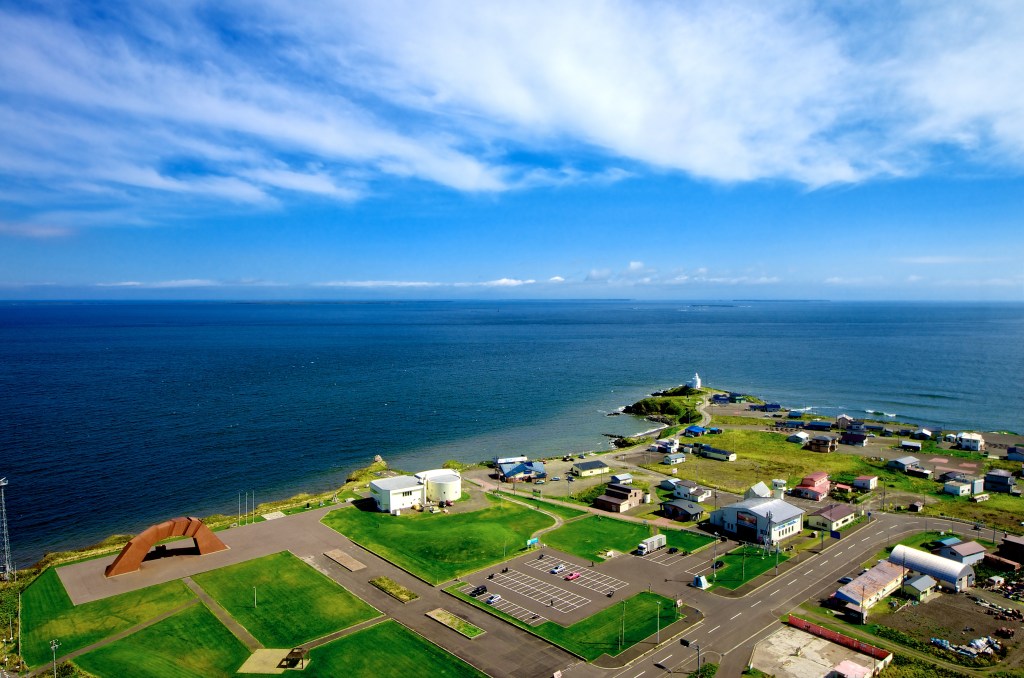
The easternmost point and its lighthouse
The cape’s lighthouse was first lit in 1872, making it the oldest in Hokkaido, and it stands at the tip of the point as the symbol of the place. The geographic marker is a short walk from the car park, and the sea beyond it is the Pacific meeting the Sea of Okhotsk. Sunrise here is the earliest in the country, and people come in winter specifically for it, though the only accommodation at the cape is a seasonal riders’ house.
Kaigara-jima and the view of Kunashiri
The lighthouse on Kaigara island is the nearest of the Habomai group, and Suisho island and the mountains of Kunashiri, Rausu-dake and Chacha-dake, stand behind it. The distance is small enough that the islands read as land rather than as a horizon, which is what gives the view its force. Summer fog often closes it entirely, so the clearest months are the cold ones.
Bokyo no Ie
The House of Longing for Home was set up as a gathering place for the former islanders, and it holds household goods, photographs and maps that show the streets and house numbers of the islands before the war. It has telescopes and a three-dimensional panorama of the territories, and it is free. It is open 9:00 to 17:00 from March to October and to 16:30 from November to February, closed on Mondays in the colder months and over New Year.
The Hoppo-kan
The Hoppo-kan is the exhibition hall next to Bokyo no Ie, covering how the territorial problem arose and its historical background, and it issues the signature campaign forms and the certificate of inspection of the Northern Territories. It is free, it is open the same hours as Bokyo no Ie, and it is where the political history is set out rather than the personal one. The two buildings together are the reason to give the cape more than twenty minutes.
The Nemuro City Northern Territories Museum
This museum focuses on daily life on the islands before the war, with clothing, food and housing, a diorama, film material and records of the undersea telegraph cable between Nemuro and Kunashiri. It is a short walk from the other two and it is also free, with different closing days: Wednesdays from November to April rather than Mondays. It is the one that makes the islands feel inhabited rather than disputed.
The Shima no Kakehashi and its flame
The monument is an arch of four blocks, one for each island, forming a gate in prayer for their return, and the flame in the lantern below it was taken from Hateruma island in Okinawa and carried to Nemuro by a youth caravan. It stands in the Bokyo no Misaki park at the cape, it is free and always accessible, and the flame is kept burning. It is the single most eloquent object at the site.
Furen Lake and Notsuke
The road to the cape passes Furen Lake and the Notsuke peninsula, both of which are Ramsar sites and among the best birdwatching areas in Japan, with swans, geese and sea eagles depending on the season. The Kushiro marsh is on the way from the west. Anyone driving to Nosappu should treat these as part of the trip rather than as scenery on the way.
Food and drink
- Nemuro is a fishing town and the food is the reason many Japanese visitors come: Hanasaki crab in season, scallops, salmon and, above all, saury, which the town is famous for in autumn. The port and the station area have the restaurants, and the sushi and seafood bowls are the dishes to order.
- Escalope is the town’s own dish, a pork cutlet covered in a demi-glace sauce over rice, and it is served in the older restaurants in the centre. It is a local invention rather than a national dish, and it is the cheap, filling meal that people who grew up here order.
- The cape itself has a small restaurant and souvenir shops near the car park, and they serve simple seafood and the local dairy products. They are convenient rather than memorable, and the better eating is back in Nemuro town.
- Nemuro’s dairy is as important as its fish, and the milk, butter and ice cream of the region are the other thing to try. The combination of the coldest sea and the grass of the peninsula is what makes the dairy distinctive.
Getting there and around
- By train, take the JR Hanasaki Line from Kushiro to Nemuro, which takes about two hours and twenty minutes along the coast, and then the Nemuro Kotsu bus on the Nosappu line from the station to the terminus at Nosappu Misaki, about 40 to 45 minutes. The cape is about 22 kilometres from the station.
- By air, the nearest airport is Nakashibetsu, with a connecting bus to Nemuro Station, and Kushiro Airport is the other option with a bus to Kushiro Station and the train onward. Both routes take the better part of a day from Tokyo.
- By car, the cape is about 30 minutes from Nemuro Station on Route 35, and the drive from Kushiro is about two hours. The road is straight and open across the peninsula, with the lakes and the moor on either side, and it is one of the easier drives in eastern Hokkaido.
- Parking at the cape is free, with space for about 80 cars at the museums, and there is no charge at the point itself. In winter the roads are icy and the wind is severe, and the cape can be closed by snow, so the drive should be planned with the weather rather than against it.
- There is no accommodation at the cape apart from a seasonal riders’ house, and no restaurant outside the shops, so the practical base is Nemuro town. The exception is New Year’s Day, when a special bus runs for the first sunrise, which is the only public transport timed for dawn.
Where to stay
- Nemuro town has business hotels and a few smaller inns around the station, and it is the only practical base for the cape. The town is a working fishing port rather than a resort, and the hotels are functional.
- The riders’ house at the cape is the one option at the point itself, seasonal and basic, and it is for people who want the sunrise without a 30-minute drive in the dark. It needs to be booked and confirmed directly.
- Kushiro, two hours west, is the larger base with more hotels, the marsh, and the airport, and it turns Nemuro into a long day or an overnight. Nakashibetsu is the other option for an early flight, with hotels and the airport bus.
Best time to visit
- Winter is the season for the clearest views and the strongest wind, with the air cold enough that Kunashiri appears sharp and close, and drift ice sometimes visible offshore in the coldest weeks. The cape is at its most dramatic and its most uncomfortable, and the museums are the shelter.
- Spring brings the swans and the geese through Furen Lake and Notsuke, and the snow melts late on the peninsula. It is the best season for birdwatching and a quiet one for the cape itself.
- Summer is the season of fog, which is a genuine problem rather than a minor inconvenience: the cape’s own museum explains that summer fog frequently hides the islands entirely, and the whole point of the view can be lost. It is the busiest season for tourists and the least reliable for seeing anything.
- Autumn is the best all-round season, with clear air returning, the saury season at its peak in the town, and the peninsula turning colour. September and October give the combination of visibility and food that makes the long journey worthwhile.
Practical tips
- Go for the clearest weather you can get, not for a fixed date. Summer fog hides the islands often enough that the cape’s own museum was built partly because of it, and a visit in July can show nothing but white. Autumn and winter give the best chance of seeing Kunashiri.
- Allow two hours at the cape rather than twenty minutes. The three museums are free and separate, with different closing days, and they are what turn a viewpoint into an understanding of the place. Check the days: Bokyo no Ie and Hoppo-kan close on Mondays from November to April, the territories museum closes on Wednesdays in the same period.
- Do not plan to visit the islands. The Japanese government has asked since 19 September 1989 that people refrain from entering the four Northern Territories, and the tourist association states this plainly. The cape is a place to look at them, and the visa-free exchange programmes are separate and organised, not something to arrange on arrival.
- Take the bus if you are not driving, and check the return times. The Nosappu line runs from Nemuro Station to the cape in 40 to 45 minutes, and the cape has no other public transport. Missing the last bus means a taxi back or a night at the riders’ house.
- Use Nemuro town as the base. There is nowhere to stay at the cape except the seasonal riders’ house, and no restaurant outside the shops. Eating Hanasaki crab, scallops or saury in the town is part of the reason to come this far.
- Drive the peninsula slowly and stop at Furen Lake and Notsuke. They are Ramsar sites with exceptional birdlife, and the drive between Kushiro and Nemuro is one of the great wildlife roads of Japan. Treating it as a transfer rather than as part of the trip wastes the best of the region.
- Expect wind and cold at any time of year. The cape is exposed on three sides and the wind is constant, and even in summer the temperature is lower than inland. A windproof layer is the one piece of equipment that makes the difference between staying an hour and leaving after ten minutes.
Suggested day-trip outline
- Take the Hanasaki Line from Kushiro to Nemuro, about two hours and twenty minutes, and stay overnight in the town. If you are driving, come across the peninsula in the afternoon and stop at Furen Lake and Notsuke on the way, which is the birdwatching part of the trip.
- Start early the next morning and drive Route 35 to the cape, about 30 minutes, or take the Nosappu line bus from the station. Arrive before the museums open so you have the point itself in the quiet, and walk from the car park to the easternmost marker and the lighthouse.
- Spend the late morning in the three museums: Bokyo no Ie for the personal history and the maps of the old streets, the Hoppo-kan for the diplomatic history, and the territories museum for daily life before the war. All three are free, and together they take about an hour and a half.
- Look at the Shima no Kakehashi and the flame from Hateruma, and use the telescopes if the islands are visible. Eat at the shops or drive back to Nemuro for a seafood lunch, and in autumn order the saury.
- Return to Nemuro in the afternoon, or continue along the coast to Rausu and the Shiretoko peninsula if you have another day. The cape is the end of the road in one direction and the beginning of the wildest coast in Japan in the other.
Before you go
Timetables, fares, admission fees, and seasonal access rules can change. Check the official tourism and transport sites linked below for the latest information before you travel.
Explore More of Japan
Published guides that pair with this one:
- Kushiro Marsh Guide: Japan’s Largest Wetland and Its Cranes
- Shiretoko Travel Guide: UNESCO Wilderness at the Edge of Hokkaido
- Abashiri Drift Ice Travel Guide: Winter on the Okhotsk Coast
- Akan-Mashu Travel Guide: Lakes, Marimo, and Ainu Culture in Hokkaido
- Obihiro Guide: Pork Bowls and the Tokachi Plain
- Cape Erimo Travel Guide: Wind, Seals, and the End of the Hidaka Mountains
- Lake Shikotsu Travel Guide: Highlights, Access, and Planning
- Matsumae Castle Travel Guide: Hokkaido’s Southern History Town
- Nikka Whisky Yoichi Distillery Travel Guide: Highlights, Access, and Planning
- Sapporo Beer Museum Travel Guide: Highlights, Access, and Planning
Browse every Hokkaido guide on this site for the rest of the region.
Sources
- nemuro-kankou.com (checked 2026-11-03)
- nemuro-kankou.com (checked 2026-11-03)
- nemuro-kankou.com — FAQ (checked 2026-11-03)
- city.nemuro.hokkaido.jp (checked 2026-11-03)
- cas.go.jp (checked 2026-11-03)


Leave a Reply