A practical English guide to Suwa in Nagano: the four shrines of Suwa Taisha, Lake Suwa, Takashima castle, Kamisuwa onsen and how to do the circuit by bus and train.
Operational details such as opening hours, admission fees, and train times can change. Prefer official pages and reconfirm before you travel (sources checked on 05 November 2026).
Why visit
- Suwa is one of the oldest religious centres in Japan, and the shrine that owns the place is not one building but four, spread around a lake: the upper shrine’s main and front halls on the south shore, the lower shrine’s spring and autumn halls on the north. Together they form Suwa Taisha, the head of every Suwa shrine in the country, and they are set in cedar groves that have the weight of very old ground.
- The shrines are unusual. There is no main hall with a statue; the object of worship is the mountain behind, and the buildings are rebuilt every six years in a cycle called the Onbashira, when huge fir logs are dragged down from the mountain by hand and hauled upright at the corners of the precinct. The last one was in 2022, the next is due in 2028, and the town is already preparing.
- Around the lake there is the onsen, one of the biggest hot spring resorts in the Chuo line, a small castle rebuilt in the 1970s, and a shoreline that is good for walking and cycling. In winter the lake freezes, and in a cold year the ice ridges and cracks in a phenomenon called the omiwatari, which the shrine treats as a sign that the god has crossed the water.
- The mountains above the town, Kirigamine and the Yatsugatake foothills, make this a good base for a night between Tokyo and Matsumoto, and the local sake and soba are excellent. It is a serious place that has been on the pilgrimage route for a thousand years, and it is not crowded.
Top places and highlights
Kamisha Honmiya, the upper main shrine
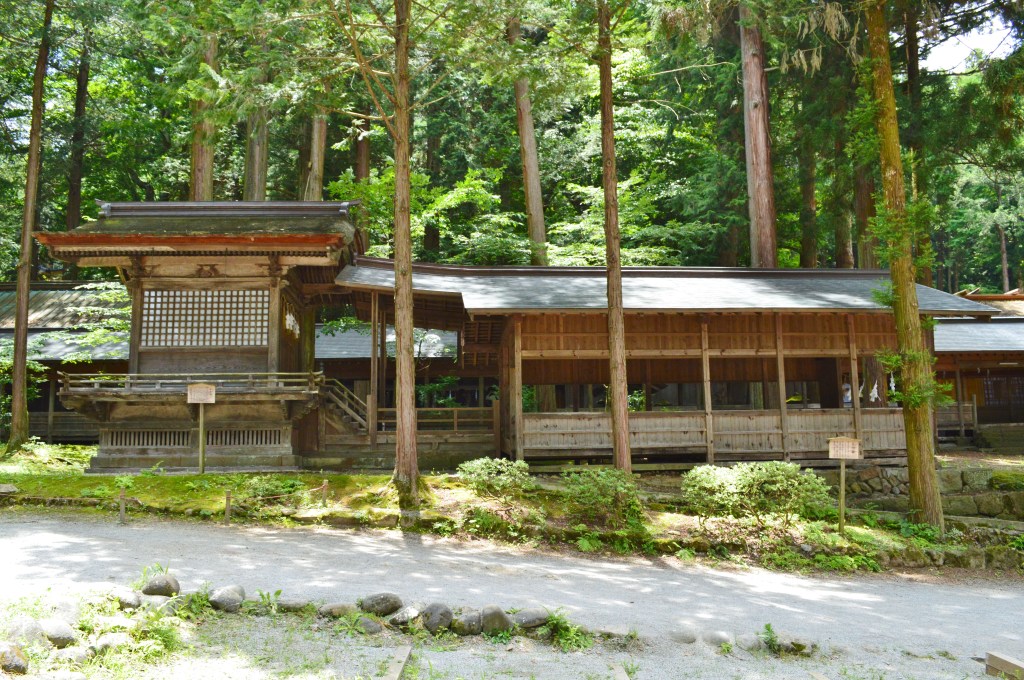
The upper main shrine stands in a grove of cedars at the foot of Mount Moriya, which is itself the object of worship, and the precinct is entered through a torii and a long gravel approach between trees. The buildings are in the old Shinano style, with a raised floor and a steep bark roof, and the one you see is a reconstruction in the six-year cycle rather than an ancient structure, which is the point: the shrine is maintained by rebuilding rather than by repair. Look for the sacred rock and the small subsidiary shrines around the main hall, and the storehouse of drums. It is free, open from early morning, and at its best just after opening, when the gravel is quiet. There is a car park, and the bus from Kamisuwa station stops at the entrance.
Kamisha Maemiya, the front shrine
The front shrine is a twenty-five minute walk or five minute drive from the main shrine, and it is the older of the two in origin, with a small hall in a hollow below a hill and a sense of a place that predates the formal buildings. It is quieter than the main shrine and most visitors skip it, which is a reason to go. The approach passes through a residential district and a small stream, and the precinct is compact, with a large sacred tree and a spring. There is no charge and a small car park. Combining the two upper shrines on foot takes about an hour and a half, and is the nicest walking in the area.
Shimosha Akimiya and Harumiya
The lower shrine has two halls about a kilometre apart in Shimosuwa, the autumn hall and the spring hall, and the autumn hall is the more impressive, with a great cedar in front of it, a large thatched roof and a stone approach lined with lanterns. The spring hall is smaller and quieter, with a stream beside it and a garden. Both are free and always open, and both are a short walk from Shimosuwa station, twelve minutes to the autumn hall and eighteen to the spring. The Meiji-era poet and traveller poems, and the surrounding streets of Shimosuwa have the shape of a post town on the Nakasendo, with old inns and a couple of good soba shops. This is the easiest of the four shrines to visit by train.
Lake Suwa and the omiwatari
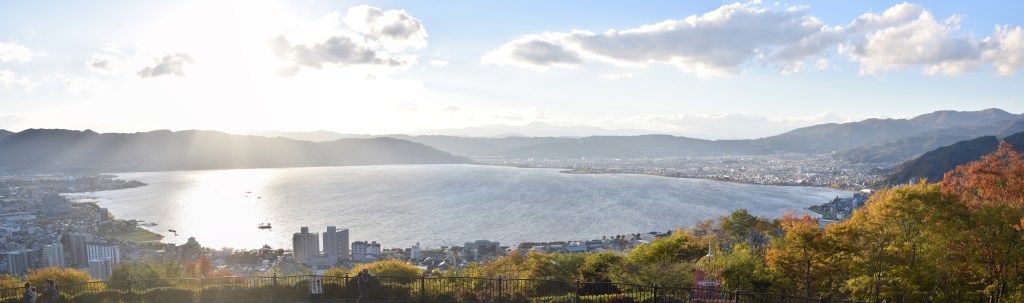
Lake Suwa is the largest lake in Nagano, ringed by mountains, and the shoreline has a path and a road that make a circuit of about sixteen kilometres, good for cycling. In winter, when the lake freezes completely, the ice expands and cracks and ridges of ice are pushed up along the shore, a phenomenon called omiwatari, the god’s crossing, which the shrine has recorded for centuries and which is treated as a sign of the year’s fortunes. It is becoming rarer with warmer winters, so it cannot be promised. In summer the lake hosts one of the biggest fireworks displays in the country, forty thousand shells over the water on 15 August, and the shore is packed. At any time, the view from the Tateishi park on the north shore is the classic one.
Takashima castle and Kamisuwa onsen
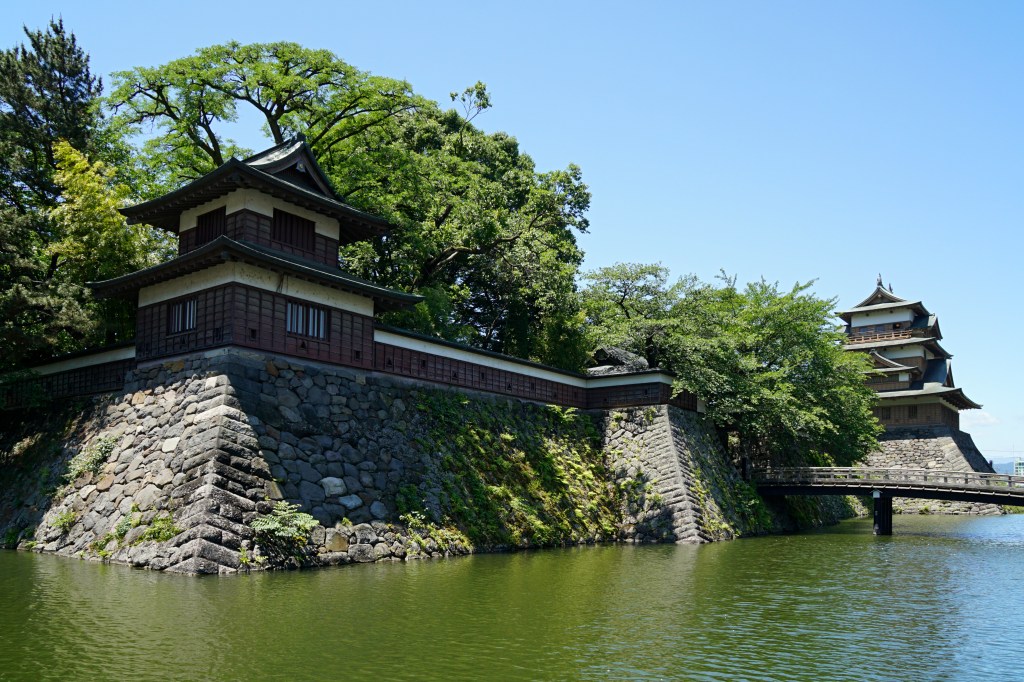
Takashima castle sits on a small island site in the middle of the town, surrounded by a moat, and its keep was rebuilt in 1970 in concrete, so treat it as a viewpoint and a small museum rather than a medieval building. The grounds are a park and a cherry spot, and the castle is a ten-minute walk from Kamisuwa station. Kamisuwa onsen is the resort around the station, with hotels along the lake, a public bath, and footbaths on the street, and the water comes out at a high volume and a comfortable temperature. It is a working onsen town rather than a resort strip, and one night here is enough, with a lake view at breakfast.
Kirigamine and the mountain roads
Above the lake to the east, the Kirigamine plateau is a broad, rolling grassland at about 1,600 metres, with a gondola, a flower season in June and July, and views to the Northern Alps and Fuji on a clear day. The road up from Suwa takes about forty minutes by car and is a good half-day in summer and autumn. In winter it is a ski area and the road may be closed. There is also the Venus line, a scenic road running along the ridges towards Yatsugatake, which is one of the best drives in central Japan and connects Suwa with Matsumoto and the highlands beyond.
Food and drink
- Soba is the staple of the region, and the shops around the shrines and in Shimosuwa serve it cold with a dipping sauce, often with tempura.
- Local sake is excellent, with several breweries in the town using rice from the surrounding valleys and water from the mountains above the lake.
- Wakasagi, the small smelt from the lake, is eaten fried or in a sweet soy glaze, and in winter it is fished through holes in the ice.
- Miso from Suwa is a darker, stronger style than the surrounding regions, and the miso ramen and the miso soup in the local restaurants use it.
- The town is known for its manju and for the sweets sold near the shrines, which are made for pilgrims and are better than the average souvenir.
- The restaurants along the lake shore serve lake fish and set meals, and there are izakaya around Kamisuwa station for the evening.
Getting there and around
- Kamisuwa station is on the JR Chuo line, about two hours and thirty-five minutes from Shinjuku by the Azusa limited express, and about an hour and ten minutes from Matsumoto.
- Shimosuwa is one stop before Kamisuwa and is the station for the lower shrines, twelve minutes on foot to the autumn hall.
- Chino is the station for the upper shrine’s front hall and is a thirty-minute walk or a short taxi ride from it.
- By car, the Suwa interchange on the Chuo expressway is about five minutes from the upper main shrine, and the Okaya interchange is ten to twelve minutes from the lower shrines. All four shrines have free car parks.
- The Kamisuwa community bus, the Karin-chan bus, connects the station with the upper main shrine in about twenty minutes on weekdays and fifty minutes on the weekend loop.
- The four shrines can be done in a day by car in about half a day, and by train and bus in a full day, with a taxi for the front shrine, which has no convenient bus.
- A shared taxi or a guided shrine tour from a hotel is the simplest option for anyone without a car who wants all four in one day.
Where to stay
- Kamisuwa onsen has hotels and ryokan along the lake, from large modern ones to small family inns, most with a bath and a lake view.
- Shimosuwa has a few inns and guesthouses near the station and the lower shrines, which is convenient for an early start at the autumn hall.
- The hotels around the upper shrine and on the Kirigamine road are quieter and cheaper, but you need a car.
- Book ahead for the fireworks on 15 August and for the Onbashira years, when the whole town fills.
Best time to visit
- Spring is the cherry season around the castle and the lake, usually in mid to late April, later than Tokyo.
- Summer is green and cool on the plateau, with the fireworks on 15 August and the best walking weather.
- Autumn is the best season overall, with clear air, colour on the mountains and the lake at its calmest.
- Winter is cold and clear, with the chance of the omiwatari on the frozen lake and good views of the Alps, but some mountain roads close.
- The Onbashira festival comes every six years, most recently in 2022, and the next is due in 2028.
Practical tips
- Do the four shrines in a sensible order: upper main and front shrine together, then the train one stop to Shimosuwa for the lower pair.
- Bring a car or budget for a taxi for the front shrine, which has no useful bus service and is a thirty-minute walk from the station.
- The shrines are free and open early, and the cedar groves are at their best before the coaches arrive.
- Check the bus timetable at the tourist office at Kamisuwa station rather than relying on the online map.
- If you want the omiwatari, come in a cold February and accept that it may not happen; it depends on the lake freezing completely.
- The lake circuit is sixteen kilometres, which is a good half day by bicycle and too far to walk comfortably.
- Onbashira years bring crowds and road closures, so check the calendar if you are travelling in spring or autumn of that year.
Suggested day-trip outline
- Morning: Kamisuwa station, bus to the upper main shrine, then walk to the front shrine through the back lanes.
- Lunch: soba near the upper shrine or back in Kamisuwa.
- Afternoon: train one stop to Shimosuwa, walk to the autumn hall and then the spring hall, and look at the old post town streets.
- Late afternoon: back to Kamisuwa for the castle and the lake shore, with a footbath on the way.
- Evening: an onsen bath and dinner at the hotel, or an izakaya near the station.
Before you go
Timetables, fares, admission fees, and seasonal access rules can change. Check the official tourism and transport sites linked below for the latest information before you travel.
Explore More of Japan
Published guides that pair with this one:
- Matsumoto Castle Travel Guide: Japan’s Original Black Keep
- Takayama Travel Guide: Hida Old Town and Alps Access
- Kamikochi Travel Guide: Alpine Valley Walks in the Japan Alps
- Karuizawa Guide: Highland Walks, Old Ginza and Shiraito Falls
- Ise Jingu and Ise-Shima Travel Guide: Naiku, Geku and the Coast
- Narai-juku Travel Guide: The Nakasendo Post Town That Time Forgot
- Nozawa Onsen Travel Guide: Hot Springs, Snow, and the Fire Festival
- Hakusan and Shirayama Hime Shrine Guide: Ishikawa’s Sacred Mountain
- Jigokudani Snow Monkey Park Travel Guide
- Hida Furukawa Travel Guide: White Storehouses, Sake and the Furukawa Festival
- West Izu Travel Guide: Dogashima, Tensodo Cave and the Toi Coast
- Noto Peninsula Travel Guide: Wajima, Senmaida and the Okunoto Coast
- 21st Century Museum of Contemporary Art, Kanazawa Travel Guide: Highlights, Access, and Planning
- Fukui Prefectural Dinosaur Museum Travel Guide: Highlights, Access, and Planning
Browse every Chubu guide on this site for the rest of the region.
Sources
- suwataisha.or.jp — Access (checked 2026-11-05)
- city.suwa.lg.jp (checked 2026-11-05)
- omairi-dash.jp (checked 2026-11-05)


Leave a Reply